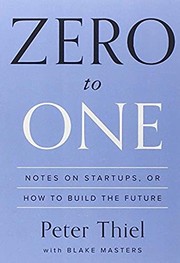

In one sentence
The best startups do not win by entering crowded markets and competing incrementally. They create a distinctive product, establish dominance in a small market, and expand from that strong base. Innovation requires independent judgment, a specific plan for the future, and the ability to capture enough of the value created to sustain further progress.
Overview
Adapted from Peter Thiel’s Stanford startup lectures and published with Blake Masters in 2014, the book is a compact argument about innovation, company-building, and technological progress. Its core contrast is 0→1—creating something new—versus 1→n—copying or scaling what already exists. The later chapters apply this lens to sales, teams, venture capital, energy, and the future.
Core ideas
0→1 is qualitatively different from 1→n
Replication can spread an existing model, but invention changes what is possible. Thiel therefore asks founders to identify opportunities where a company can create a new category or a much better solution, not merely improve a familiar offering.
Monopoly is the strategic objective
In the book’s positive sense, a monopoly is a company with a unique product and no close substitutes. Thiel argues that intense competition tends to compress profits, whereas a durable monopoly gives a firm the resources and time to keep innovating. His recommended sequence is: dominate a small, defensible niche, then expand carefully into adjacent markets.
Start with a secret
A promising startup begins with an important truth that is underappreciated or disputed. The founder’s task is to discover a non-obvious problem or opportunity and turn that insight into a product—not to ask what the market currently rewards.
Technology should produce a large leap
Thiel distinguishes genuine technological progress from globalization or simple scaling. A valuable innovation should be substantially better in some important dimension, rather than just another version of an existing product.
Distribution is part of the product
A technically strong product can still fail without a reliable path to customers. Sales strategy, pricing, marketing, and the founder’s ability to sell are central company-building capabilities, not secondary business functions.
Plan for a definite future
Thiel contrasts definite optimism—a belief that a specific, better future can be deliberately built—with indefinite optimism, which expects improvement without committing to a concrete plan. Startups need conviction about what they will build and why it can work.
Founders and teams are designed systems
The company’s founding team, ownership structure, incentives, culture, and internal narrative shape execution. Thiel treats the startup as a tightly aligned group pursuing a shared mission, rather than as a loose collection of employees.
Venture returns follow a power law
A small number of investments generate most of the returns. This implies that investors and founders should search for exceptional opportunities rather than assume that a diversified portfolio of merely promising companies will produce exceptional results.
Practical takeaways
- Ask: “What important truth do few people agree with me about?” Use the answer to generate hypotheses, not just provocative opinions.
- Define the smallest market in which you can become clearly best; win there before broadening the ambition.
- Describe the product’s 10× advantage in concrete terms and identify why competitors cannot quickly copy it.
- Treat customer acquisition and distribution as design constraints from the beginning.
- Write down the specific future your company is trying to create, the assumptions behind it, and the milestones that would validate them.
- Look for defensibility: proprietary technology, network effects, economies of scale, brand, or a structural advantage in distribution.
- Use contrarian thinking to find opportunities, but test the underlying facts through customer conversations, experiments, and unit economics.
Caveats and counterpoints
- “Monopoly” is rhetorically powerful but can blur the distinction between legitimate differentiation and harmful market power. The book largely emphasizes the founder’s ability to capture value and gives less attention to consumer welfare, labor effects, regulation, or how dominance can become exploitative.
- The argument is optimized for ambitious, venture-scale technology companies. It is less directly applicable to ordinary small businesses, public-interest ventures, capital-intensive industries, and businesses whose success depends on steady execution rather than category creation.
- The book’s examples and investment logic reflect strong survivorship bias: famous winners illustrate the framework more clearly than the many companies that pursued ambitious secrets, narrow niches, or definite plans and still failed.
- Thiel sometimes presents competition as primarily destructive, but competition can also improve quality, reduce prices, reveal demand, and prevent abuse of power. His framework is best used as a challenge to undifferentiated competition, not as a universal rejection of rivals.
- The distinction between technological progress and globalization is useful, but the book’s diagnosis of societal stagnation is broad and selective; it does not fully explain institutional, scientific, environmental, or political barriers to innovation.
Questions worth revisiting
- What is the genuinely new value proposition, rather than the familiar business model with a new interface?
- Which overlooked truth or “secret” gives this opportunity an unfair starting advantage?
- What narrowly defined market can the company dominate first?
- Why will customers choose this product, and how will they reliably discover and buy it?
- What prevents a large incumbent from copying the idea once demand is demonstrated?
- Is the plan definite enough to guide action, while still allowing evidence to change the assumptions?
- Would the proposed monopoly benefit customers through better value, or mainly benefit owners through restricted choice?
- Which claims depend on exceptional founder ability, timing, or access to capital rather than a generally transferable method?
Return to this when…
Return to this book when evaluating a startup idea that sounds like a crowded-market improvement, when deciding whether a niche is strategically attractive, or when a technically promising project lacks a clear distribution plan. Revisit the caveats when the advice is being used to justify market dominance, extreme founder certainty, or venture-scale growth as ends in themselves.
Highlights
Monopolists can afford to think about things other than making money; non-monopolists can’t.
We preach competition, internalize its necessity, and enact its commandments; and as a result, we trap ourselves within it—even though the more we compete, the less we gain. This is a simple truth, but
The perfect target market for a startup is a small group of particular people concentrated together and served by few or no competitors.
Always err on the side of starting too small. The reason is simple: it’s easier to dominate a small market than a large one.
No technology company can be built on branding alone.
to succeed, “you must study the endgame before everything else.”
Instead of pursuing many-sided mediocrity and calling it “well-roundedness,” a definite person determines the one best thing to do and then does it.
Jobs saw that you can change the world through careful planning, not by listening to focus group feedback or copying others’ successes.
A business with a good definite plan will always be underrated in a world where people see the future as random.
If there are many secrets left in the world, there are probably many world-changing companies yet to be started.
If everything worth doing has already been done, you may as well feign an allergy to achievement and become a barista.
People are scared of secrets because they are scared of being wrong.
We can be glad that there are fewer crazy cults now, yet that gain has come at great cost: we have given up our sense of wonder at secrets left to be discovered.
The actual truth is that there are many more secrets left to find, but they will yield only to relentless searchers.
Consider the monopoly secret again: competition and capitalism are opposites.
So who do you tell? Whoever you need to, and no more. In practice, there’s always a golden mean between telling nobody and telling everybody—and that’s a company.
a startup messed up at its foundation cannot be fixed.
As a founder, your first job is to get the first things right, because you cannot build a great company on a flawed foundation.
Choosing a co-founder is like getting married, and founder conflict is just as ugly as divorce.
It’s very hard to go from 0 to 1 without a team.
Actually, a huge board will exercise no effective oversight at all; it merely provides cover for whatever microdictator actually runs the organization.
If you want an effective board, keep it small.
However, anyone who doesn’t own stock options or draw a regular salary from your company is fundamentally misaligned. At the margin, they’ll be biased to claim value in the near term, not help you create more in the future. That’s why hiring consultants doesn’t work. Part-time employees don’t work. Even working remotely should be avoided, because misalignment can creep in whenever colleagues aren’t together full-time, in the same place, every day.
For people to be fully committed, they should be properly compensated.
A company does better the less it pays the CEO—that’s one of the single clearest patterns I’ve noticed from investing in hundreds of startups.
Aaron Levie, the CEO of Box, was always careful to pay himself less than everyone else in the company—four years after he started Box, he was still living two blocks away from HQ in a one-bedroom apartment with no furniture except a mattress. Every employee noticed his obvious commitment to the company’s mission and emulated it.
The graffiti artist who painted Facebook’s office walls in 2005 got stock that turned out to be worth $200 million, while a talented engineer who joined in 2010 might have made only $2 million.
“Company culture” doesn’t exist apart from the company itself: no company has a culture; every company is a culture. A startup is a team of people on a mission, and a good culture is just what that looks like on the inside.
We sold PayPal to eBay for $1.5 billion in 2002. Since then, Elon Musk has founded SpaceX and co-founded Tesla Motors; Reid Hoffman co-founded LinkedIn; Steve Chen, Chad Hurley, and Jawed Karim together founded YouTube; Jeremy Stoppelman and Russel Simmons founded Yelp; David Sacks co-founded Yammer; and I co-founded Palantir. Today all seven of those companies are worth more than $1 billion each.
Since time is your most valuable asset, it’s odd to spend it working with people who don’t envision any long-term future together.
At PayPal, if you were excited by the idea of creating a new digital currency to replace the U.S. dollar, we wanted to talk to you; if not, you weren’t the right fit.
For the company to work, it didn’t matter what people looked like or which country they came from, but we needed every new hire to be equally obsessed.
employees. The best thing I did as a manager at PayPal was to make every person in the company responsible for doing just one thing.
The best startups might be considered slightly less extreme kinds of cults. The biggest difference is that cults tend to be fanatically wrong about something important. People at a successful startup are fanatically right about something those outside it have missed.
This explains why almost everyone whose job involves distribution—whether they’re in sales, marketing, or advertising—has a job title that has nothing to do with those things. People who sell advertising are called “account executives.” People who sell customers work in “business development.” People who sell companies are “investment bankers.” And people who sell themselves are called “politicians.” There’s a reason for these redescriptions: none of us wants to be reminded when we’re being sold.
In general, the higher the price of your product, the more you have to spend to make a sale—and the more it makes sense to spend it.
In 2009, Blake sold a small Box account to the Stanford Sleep Clinic, where researchers needed an easy, secure way to store experimental data logs. Today the university offers a Stanford-branded Box account to every one of its students and faculty members, and Stanford Hospital runs on Box.
But the kitchen sink approach—employ a few salespeople, place some magazine ads, and try to add some kind of viral functionality to the product as an afterthought—doesn’t work.
But the most valuable companies in the future won’t ask what problems can be solved with computers alone. Instead, they’ll ask: how can computers help humans solve hard problems?
- The Engineering Question Can you create breakthrough technology instead of incremental improvements? 2. The Timing Question Is now the right time to start your particular business? 3. The Monopoly Question Are you starting with a big share of a small market? 4. The People Question Do you have the right team?
- The Distribution Question Do you have a way to not just create but deliver your product? 6. The Durability Question Will your market position be defensible 10 and 20 years into the future? 7. The Secret Question Have you identified a unique opportunity that others don’t see?
If you don’t have good answers to these questions, you’ll run into lots of “bad luck” and your business will fail. If you nail all seven, you’ll master fortune and succeed. Even getting five or six correct might work.
Companies must strive for 10x better because merely incremental improvements often end up meaning no improvement at all for the end user.
Only when your product is 10x better can you offer the customer transparent superiority.
Customers won’t care about any particular technology unless it solves a particular problem in a superior way.
And if you can’t monopolize a unique solution for a small market, you’ll be stuck with vicious competition.
There’s nothing wrong with a CEO who can sell, but if he actually looks like a salesman, he’s probably bad at sales and worse at tech.
Every entrepreneur should plan to be the last mover in her particular market. That starts with asking yourself: what will the world look like 10 and 20 years from now, and how will my business fit in?
but they’re weak players in the wider economy. Social entrepreneurs aim to combine the best of both worlds and “do well by doing good.” Usually they end up doing neither.
Doing something different is what’s truly good for society—and it’s also what allows a business to profit by monopolizing a new market.
at both. Elon describes his staff this way: “If you’re at Tesla, you’re choosing to be at the equivalent of Special Forces.
Cleantech companies faced the same problem: no matter how much the world needs energy, only a firm that offers a superior solution for a specific energy problem can make money.
the most important task in business—the creation of new value—cannot be reduced to a formula and applied by professionals.
The single greatest danger for a founder is to become so certain of his own myth that he loses his mind. But an equally insidious danger for every business is to lose all sense of myth and mistake disenchantment for wisdom.
Our task today is to find singular ways to create the new things that will make the future not just different, but better—to go from 0 to 1.
When we think about the future, we hope for a future of progress. That progress can take one of two forms. Horizontal or extensive progress means copying things that work—going from 1 to n. Horizontal progress is easy to imagine because we already know what it looks like. Vertical or intensive progress means doing new things—going from 0 to 1. Vertical progress is harder to imagine because it requires doing something nobody else has ever done. If you take one typewriter and build 100, you have made horizontal progress. If you have a typewriter and build a word processor, you have made vertical progress.
WHENEVER I INTERVIEW someone for a job, I like to ask this question: “What important truth do very few people agree with you on?” This question sounds easy because it’s straightforward. Actually, it’s very hard to answer. It’s intellectually difficult because the knowledge that everyone is taught in school is by definition agreed upon. And it’s psychologically difficult because anyone trying to answer must say something she knows to be unpopular. Brilliant thinking is rare, but courage is in even shorter supply than genius.
New technology tends to come from new ventures—startups. From the Founding Fathers in politics to the Royal Society in science to Fairchild Semiconductor’s “traitorous eight” in business, small groups of people bound together by a sense of mission have changed the world for the better. The easiest explanation for this is negative: it’s hard to develop new things in big organizations, and it’s even harder to do it by yourself. Bureaucratic hierarchies move slowly, and entrenched interests shy away from risk. In the most dysfunctional organizations, signaling that work is being done becomes a better strategy for career advancement than actually doing work (if this describes your company, you should quit now). At the other extreme, a lone genius might create a classic work of art or literature, but he could never create an entire industry.
Positively defined, a startup is the largest group of people you can convince of a plan to build a different future. A new company’s most important strength is new thinking: even more important than nimbleness, small size affords space to think.
OUR CONTRARIAN QUESTION—What important truth do very few people agree with you on?—is difficult to answer directly. It may be easier to start with a preliminary: what does everybody agree on? “Madness is rare in individuals—but in groups, parties, nations, and ages it is the rule,” Nietzsche wrote (before he went mad). If you can identify a delusional popular belief, you can find what lies hidden behind it: the contrarian truth.
- Stay lean and flexible All companies must be “lean,” which is code for “unplanned.” You should not know what your business will do; planning is arrogant and inflexible. Instead you should try things out, “iterate,” and treat entrepreneurship as agnostic experimentation.
The hazards of imitative competition may partially explain why individuals with an Asperger’s-like social ineptitude seem to be at an advantage in Silicon Valley today. If you’re less sensitive to social cues, you’re less likely to do the same things as everyone else around you. If you’re interested in making things or programming computers, you’ll be less afraid to pursue those activities single-mindedly and thereby become incredibly good at them.