
In one sentence
High-performance brands do not win by doing what competitors do slightly better; they win by finding a distinctive, valuable position— their “zag”—and making every important brand decision reinforce it. Differentiation must be meaningful to customers, strategically focused, and consistently expressed across the whole experience.
Overview
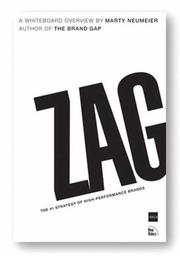
Published by New Riders in 2006, ZAG is a short, highly visual “whiteboard” book organized around three movements: finding, designing, and renewing a brand’s zag. Neumeier begins with marketplace clutter and the limits of conventional differentiation, then develops a 17-checkpoint process covering identity, purpose, vision, category, competitors, distinctiveness, naming, messaging, experience, loyalty, extension, and portfolio protection. The final section addresses how brands maintain momentum without losing focus.
Core ideas
Radical differentiation beats incremental improvement
In a crowded category, being somewhat better, cheaper, or faster may be easy to copy. The strategic question is not simply “How can we improve?” but “Where is there a valuable position others are not occupying?” Neumeier calls this move from ordinary differentiation to radical differentiation the zag.
Look for white space and an unmet need
Finding the zag involves studying the competitive landscape, identifying underserved “need states,” and locating a position where customer value and brand credibility overlap. The opportunity is often created by redefining the category rather than fighting head-on within its existing rules.
A brand is a system, not a logo
The book treats brand strategy as an integrated system: who the organization is, what it does, its vision, category, distinctive promise, name, story, communications, customer interactions, experience, loyalty, extensions, and portfolio architecture. A memorable identity cannot compensate for an incoherent experience.
The “only” statement creates strategic focus
Neumeier’s central positioning exercise is to state what the brand is the only one to do for a particular audience, in a particular category or context. The point is not literal uniqueness in every respect; it is disciplined ownership of a specific, valuable meaning.
Clarity turns difference into marketable meaning
A distinctive position must be easy to recognize, explain, remember, and repeat. Naming, messaging, design, and experience should translate the strategic difference into signals customers can quickly understand and associate with the brand.
Brand growth requires controlled extension
Expansion can strengthen a brand when new products reinforce its core meaning, but extensions can also blur the position. Neumeier highlights portfolio dangers and frames growth as a balance between focus, momentum, and reach.
Renew the zag without abandoning it
Competitive advantage decays: markets change, competitors imitate, and once-distinctive ideas become ordinary. Renewal means adapting the expression or application of the position while preserving the underlying strategic meaning. The book’s closing sections connect this to the competition cycle and organizational change.
Practical takeaways
- Map the category before brainstorming tactics: list the major competitors, their promises, target customers, emotional territory, and obvious points of similarity.
- Define the audience narrowly enough that the brand can be especially relevant to someone; “everyone” usually produces generic positioning.
- Write a provisional “only” statement: the only [category/brand] that [distinctive benefit or approach] for [specific audience] in [specific situation]. Test whether it is valuable, credible, and defensible.
- Separate meaningful difference from novelty. A strange feature, visual style, or slogan is not a zag unless customers care about it and the organization can consistently deliver it.
- Audit every touchpoint—name, product, pricing, service, sales process, design, content, and post-purchase experience—for reinforcement or contradiction of the chosen position.
- Use customer feedback diagnostically: repeated praise may reveal the real point of difference, while requests for familiar features may indicate a need to protect focus rather than add everything requested.
- Before launching an extension, ask whether it increases the clarity and strength of the parent brand or merely exploits its name.
- Schedule periodic renewal reviews: what has become common, what customer need is emerging, and which part of the brand’s meaning must evolve?
Caveats and counterpoints
- The framework is intentionally compressed and prescriptive. It is useful as a workshop checklist, but it does not replace market research, financial modeling, product validation, or operational analysis.
- “Radical differentiation” is not automatically superior. A highly distinctive position can fail if the market is too small, customers do not value the difference, the brand lacks credibility, or the economics cannot support delivery.
- The book’s language of owning a category or being the “only” is strategically clarifying but can overstate how controllable brand perception is; competitors, cultural changes, distribution, and customer memory complicate positioning.
- Some advice fits challenger brands more naturally than regulated, infrastructure-heavy, or procurement-driven organizations, where buying decisions may depend more on reliability, compliance, switching costs, and institutional trust.
- The book’s examples and competitive assumptions come from the mid-2000s. Its principles can still be applied, but digital platforms, creator brands, algorithmic discovery, and rapidly shifting communities require updating the execution details.
Questions worth revisiting
- What customer need is poorly served by the current category—not merely what feature is missing?
- Which part of our proposed difference would customers actually miss if it disappeared?
- Can we state our position in one sentence without using vague claims such as “better,” “innovative,” or “high quality”?
- What evidence shows that the position is credible for us and valuable to the intended audience?
- Which competitors could copy the visible expression quickly, and what deeper capability would make our zag defensible?
- Would our next product, partnership, or campaign sharpen the brand’s meaning or make it harder to explain?
- What has changed enough in the market that our current zag is becoming a zig?
Return to this when…
Return to these notes when defining a new brand or category, revising positioning, naming a product, evaluating a brand extension, aligning marketing with product and service design, or diagnosing why a previously distinctive brand has become interchangeable.