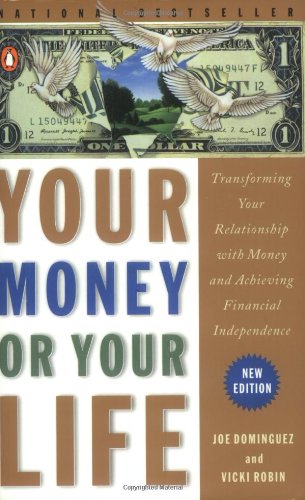

In one sentence
Money is not merely currency: it represents time, attention, health, and energy exchanged for income. Financial independence comes from making that exchange conscious, reducing spending that does not serve one’s values, increasing the gap between income and expenses, and investing the surplus until work becomes optional.
Overview
Originally published in 1992 and later revised, the book presents a nine-step program rather than a conventional budgeting manual. Its central shift is psychological: replace automatic consumption and status-seeking with deliberate choices about what constitutes “enough.” The program moves from reconstructing one’s financial history to tracking current spending, reassessing work, designing a values-based spending plan, reducing debt and expenses, increasing income, building savings, and investing for sustainable independence. The book’s best-known framework is the “crossover point,” when investment income covers monthly expenses.
Core ideas
Money as life energy
The authors ask readers to interpret each dollar as a portion of life exchanged for money. This reframes purchases: the relevant question is not only “Can I afford it?” but “Was this use of my life energy worth it?”
Calculate the real hourly wage
Employment costs more than the advertised commute-adjusted wage. The method adds commuting, clothing, meals, decompression, work-related services, and other job-linked costs, then compares net pay with total work-related time.
Track without shame or blame
The program begins with complete, ongoing records of income and expenses. The purpose is awareness rather than self-punishment: spending patterns become data for deciding what to keep, change, or stop.
Values-based spending
Monthly spending is plotted against personal fulfillment. The goal is not maximal frugality but a closer match between resources and what genuinely improves life, while distinguishing satisfaction from habit, advertising, and social pressure.
Financial independence as optionality
Independence means that income from accumulated capital can cover necessary expenses, making paid employment optional. The book therefore treats savings as the purchase of future time, not simply as a larger balance.
The crossover point
Readers chart monthly expenses alongside investment income. The practical milestone is reached when income from investments meets or exceeds expenses; the chart makes progress visible and links small spending changes to the amount of capital required.
Enoughness and purposeful work
The authors challenge the assumption that higher consumption and career advancement are automatically desirable. Once basic security is established, the question becomes how to use time meaningfully—including paid work, unpaid work, creativity, community, and rest.
Nine-step behavior change
The sequence combines retrospective financial review, present-moment tracking, conscious spending, debt reduction, income improvement, saving, and investing. Its strength is cumulative: each step supplies information or surplus needed for the next.
Practical takeaways
- Reconstruct your lifetime financial history: total earnings, major spending, debt, savings, and assets. Use it as a diagnostic, not a moral verdict.
- Track every expense for at least several months, using categories that reflect your own life rather than a generic budget template.
- Compute your actual hourly wage after taxes, commuting, work clothing, meals, equipment, childcare, and recovery time.
- For each spending category, ask whether it increases fulfillment, supports a value, or merely maintains a habit or obligation.
- Separate essential expenses from optional ones, then look for changes that reduce cost without reducing what matters.
- Treat savings as buying future freedom. Monitor the difference between monthly income and expenses and direct the surplus toward debt repayment or diversified investments.
- Review the spending-and-fulfillment record regularly; the method depends on repeated feedback, not a one-time austerity challenge.
- Define financial independence personally: the target depends on required expenses, dependents, health needs, taxes, inflation, and tolerance for investment risk.
Caveats and counterpoints
- The book’s investment discussions should not be followed mechanically. Some assumptions and examples reflect earlier interest-rate, tax, and market conditions; current portfolio construction, withdrawal, and tax decisions require up-to-date sources and individualized judgment.
- The program is easier to apply when a reader has stable income, control over housing and transport costs, and enough margin to save. For people facing low wages, disability, caregiving, medical costs, or unaffordable housing, expense optimization alone cannot produce independence.
- The “real hourly wage” calculation is illuminating but can overstate the value of leaving employment if it omits benefits, career development, social connection, or the cost of replacing health insurance and retirement benefits.
- Detailed tracking can clarify behavior, but it can also become burdensome or anxiety-producing. The method works best when tracking serves decisions rather than becoming an end in itself.
- The book’s ethical critique of consumerism is a position, not a universal conclusion. Spending on convenience, pleasure, status, or generosity may be worthwhile even when it does not fit a narrow frugality framework.
Questions worth revisiting
- Which purchases reliably improve my life, and which mainly relieve stress, signal status, or follow routine?
- What is my actual hourly wage after all employment-related costs and time?
- How much is “enough” for my household, including uncertainty, health, dependents, and meaningful activities?
- What work would I choose if income were no longer the main constraint?
- Which expense reduction would buy the most freedom with the least loss of fulfillment?
- Am I pursuing financial independence as a route to a richer life—or merely turning accumulation into another form of compulsion?
Return to this when…
Return to the book when your spending feels automatic, when a job dominates your identity, when you need to distinguish frugality from deprivation, or when you want a values-based financial reset. The most useful reread is the sequence on life energy, real hourly wage, spending-and-fulfillment tracking, and the crossover-point chart.