
In one sentence
The series argues that catastrophe does not erase existing politics, prejudices, or personal failures; it exposes and rearranges them. Its central question is less “What would women do without men?” than “What kinds of people and institutions might emerge when familiar structures suddenly collapse?”
Overview
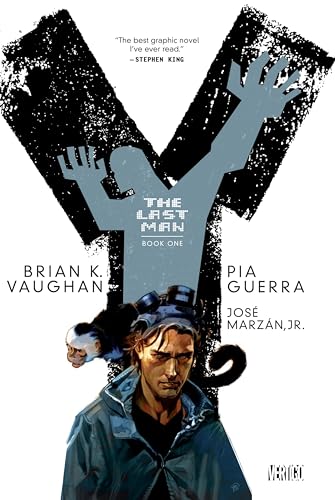
Yorick, an inexperienced escape artist, travels through a destabilized United States with Agent 355, a formidable government operative, and Dr. Allison Mann, a geneticist seeking an explanation for the event. The journey expands into an international conspiracy-and-survival narrative involving governments, religious movements, separatists, scientists, family members, and competing visions of the future. The premise is deliberately provocative, but the series increasingly treats its imagined gender reversal as a vehicle for character conflict rather than a simple thought experiment. It ran for 60 issues from 2002 to 2008 and was collected in multiple editions.
Core ideas
Gender is social power, not a personality template
The story repeatedly resists the idea that women are naturally peaceful or men naturally violent. Characters of different genders occupy many political and moral positions, while institutions reproduce familiar hierarchies even after the biological crisis.
Yorick’s uniqueness is a burden, not uncomplicated privilege
Being apparently indispensable makes Yorick politically valuable and personally constrained. The series uses his status to question whether being symbolically important gives someone meaningful control over their own life.
Survival depends on relationships and institutions
The plot moves beyond immediate survival toward medicine, reproduction, governance, infrastructure, and cultural memory. Individual courage matters, but no lone hero can solve a civilization-scale problem.
The road story is also a coming-of-age story
Yorick begins as immature, self-dramatizing, and romantically preoccupied. Travel forces him to confront responsibility, sacrifice, and the difference between wanting to be special and being accountable to others.
Identity exceeds biology
The premise is built around chromosomes and reproduction, but the emotional and political stakes concern family, nationality, gender roles, sexuality, vocation, and chosen allegiance. Later interpretations often note that the original series’ binary framing reflects the early-2000s context in which it was created.
Hope is practical and contested
The series is interested in rebuilding, but not in restoration as a simple good. Characters disagree over what deserves to be preserved, who gets authority, and whether a future should reproduce the old world or replace it.
Practical takeaways
- When a system changes, ask which supposedly “natural” behaviors are actually habits, incentives, or institutional arrangements.
- Being treated as essential can become another form of captivity; importance does not equal autonomy.
- Large crises reveal character, but they also reveal infrastructure, unequal power, and the consequences of earlier decisions.
- A compelling premise can support several genres at once: thriller, romance, political fiction, comedy, and meditation on mortality.
- Revisit the series with attention to its historical moment: its gender analysis is ambitious, but some of its categories and assumptions can feel dated now.
Caveats and counterpoints
- The series’ gender framework is largely organized around a male/female biological binary. That limitation is central to contemporary criticism and can make parts of the premise feel less expansive than the questions it wants to ask.
- Its long-form structure allows rich character and political development, but also produces detours, tonal shifts, and unevenness; readers differ on whether the later arcs sustain the momentum of the opening concept.
- The title and setup can suggest a straightforward male-fantasy premise, while the actual series is more skeptical and pluralistic. Reading it as a literal forecast of women’s behavior misses much of its institutional and interpersonal focus.
- These notes concern the comic series by Vaughan and Guerra, not the later television adaptation.
Questions worth revisiting
- Which characters treat the catastrophe as a chance to restore the old order, and which treat it as permission to invent a new one?
- Where does the series distinguish biological necessity from cultural assumption?
- Does Yorick become more responsible, or merely more aware of the consequences of his choices?
- Which institutions prove more durable than expected, and which collapse because they depended on unexamined gender arrangements?
- How does the story balance the desire for explanation with the possibility that some losses cannot be made meaningful?
Return to this when…
Return when you want a long-form speculative thriller that combines propulsive travel, political conflict, dark humor, and relationship drama—or when you want to reconsider how early-2000s comics handled gender, biology, and social collapse. The complete run is 60 issues, published from September 2002 through March 2008.