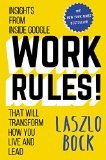

In one sentence
Great workplaces are designed around human motivation, autonomy, learning, and fairness—not merely compensation or managerial authority. Bock’s central prescription is to give employees more freedom while using data, clear standards, and carefully designed processes to guide that freedom.
Overview
Bock draws on his experience leading Google’s People Operations to explain how the company recruited selectively, evaluated managers, used employee surveys and experiments, made information widely available, and treated culture as an operational advantage. The book is both a defense of Google’s approach and a practical menu of ideas for leaders, HR teams, and individuals.
Core ideas
Trust people, then create guardrails
Employees generally do better when treated as responsible adults rather than controlled through layers of rules. Freedom is not the absence of structure: leaders still need clear goals, measurable standards, feedback systems, and intervention when behavior or performance falls short.
Make work meaningful
Motivation improves when people can connect routine tasks to a larger purpose and understand how their contribution matters. Leaders should explain the organization’s mission, show the effects of the work, and let employees shape how goals are achieved.
Hire for capability and learning
Bock favors slow, selective hiring and candidates who are intellectually strong, collaborative, adaptable, and more capable than the hiring manager in relevant areas. A strong recruiting process is treated as a higher-leverage investment than many downstream HR programs.
Use data instead of managerial intuition
People decisions should be treated as testable hypotheses. Surveys, structured interviews, performance data, and controlled experiments can expose bias and reveal which practices actually improve hiring, management, retention, or productivity. Data informs judgment; it does not eliminate judgment.
Managers should enable, not command
The manager’s role is to set direction, coach, remove obstacles, develop people, and build team effectiveness—not to accumulate power. Google’s approach includes evaluating managers through employee feedback and using evidence to identify what effective management looks like.
Learn from both excellence and failure
Top performers can reveal effective practices, while struggling employees can expose flaws in hiring, training, role design, or management. The goal is not simply to rank people, but to turn individual performance into organizational learning.
Separate development from performance judgment
Coaching and career development work better when employees can discuss weaknesses without assuming every conversation immediately affects compensation or promotion. Performance management still requires accountability, but development should be an ongoing learning process.
Pay unevenly when contribution is uneven
Bock argues that equal pay increases can be less fair than differentiated rewards because a small number of people may create disproportionate value. This requires transparent principles, careful review, and safeguards against favoritism or biased evaluation.
Practical takeaways
- Audit one people practice as an experiment: define the problem, choose a measurable outcome, test a small change, and review the evidence.
- Ask employees what information or decision rights they lack, then remove one unnecessary approval or restriction.
- Create structured interviews and written evaluation criteria to reduce inconsistent hiring judgments.
- Give managers a small set of observable responsibilities—clarity, coaching, feedback, development, and team health—and assess them against those responsibilities.
- Use employee surveys as diagnostic tools, not popularity contests; close the loop by explaining what will and will not change.
- Reward useful teaching and knowledge-sharing, not only individual output.
- When someone underperforms, first investigate role clarity, resources, feedback, management, and fit before assuming a character problem.
- Treat Google’s perks as secondary. The transferable principles are autonomy, selection, transparency, measurement, and continuous improvement.
Caveats and counterpoints
- The book is an insider’s account and a persuasive case for Google; it is not an independent audit of Google’s culture or outcomes. Its examples may understate internal conflicts, labor concerns, inequality, or the costs of operating at Google’s scale.
- Practices that work in a highly selective, wealthy technology company may fail in organizations with different labor markets, margins, regulations, missions, or levels of employee autonomy.
- ‘Pay unfairly’ can become an excuse for opaque favoritism unless compensation decisions use consistent criteria, independent review, and meaningful transparency.
- More freedom can increase ambiguity, coordination costs, and stress. Autonomy works best when employees have adequate information, capability, support, and authority.
- Data-driven HR can reproduce historical bias when the underlying data reflects unequal opportunity. Measurement should be paired with qualitative judgment and examination of who benefits or is excluded.
Questions worth revisiting
- Where am I using control because it is genuinely necessary, and where am I using it because trust feels risky?
- What evidence would show that a management or HR practice is working?
- Which employees are best positioned to teach the rest of the organization?
- Does our hiring process identify future capability, or mainly reward familiarity and polished interviewing?
- Are development conversations psychologically separate enough from formal evaluation to be honest?
- If rewards differ substantially, can we explain the principles without revealing confidential individual details?
- Which Google-inspired idea should be adapted rather than copied in our context?
Return to this when…
Return to this book when redesigning hiring, manager evaluation, employee feedback, performance management, or compensation. Its most useful reminder is that culture is not primarily a collection of perks or slogans: it is the repeated result of decisions about authority, information, incentives, selection, and learning.
Highlights
All it takes is a belief that people are fundamentally good—and enough courage to treat your people like owners instead of machines.
“You can’t understand Google… unless you know that both Larry and Sergey were Montessori kids.”22 This teaching environment is tailored to a child’s learning needs and personality, and children are encouraged to question everything, act of their own volition, and create.
“When you’re a grad student,” Larry observed, “you can work on whatever you want. And the projects that were really good got a lot of people really wanting to work on them. We’ve taken that learning to Google, and it’s been really, really helpful. If you’re changing the world, you’re working on important things. You’re excited to get up in the morning. You want to be working on meaningful, impactful projects, and that’s the thing there is really a shortage of in the world. I think at Google we still have that.”
When Google went public on August 19, 2004, Sergey included a letter in our prospectus for investors, describing how the founders felt about their 1,907 employees. The italics are his: Our employees, who have named themselves Googlers, are everything. Google is organized around the ability to attract and leverage the talent of exceptional technologists and business people. We have been lucky to recruit many creative, principled and hard working stars. We hope to recruit many more in the future. We will reward and treat them well. We provide many unusual benefits for our employees, including meals free of charge, doctors and washing machines. We are careful to consider the long-term advantages to the company of these benefits. Expect us to add benefits rather than pare them down over time. We believe it is easy to be penny wise and pound foolish with respect to benefits that can save employees considerable time and improve their health and productivity. The significant employee ownership of Google has made us what we are today. Because of our employee talent, Google is doing exciting work in nearly every area of computer science. We are in a very competitive industry where the quality of our product is paramount. Talented people are attracted to Google because we empower them to change the world; Google has large computational resources and distribution that enables individuals to make a difference. Our main benefit is a workplace with important projects, where employees can contribute and grow. We are focused on providing an environment where talented, hard working people are rewarded for their contributions to Google and for making the world a better place.
In Larry’s words: “I think about how far we’ve come as companies from those days, where workers had to protect themselves from the company. My job as a leader is to make sure everybody in the company has great opportunities, and that they feel they’re having a meaningful impact and are contributing to the good of society. As a world, we’re doing a better job of that. My goal is for Google to lead, not follow.”36 That’s how a founder thinks.
WORK RULES…FOR BECOMING A FOUNDER Choose to think of yourself as a founder. Now act like one.
But two things are immediately obvious from reading these. First, I owe you an apology for making you slog through corporate mission statements, perhaps the worst form of literature known to man. Second, Google’s mission is distinctive both in its simplicity and in what it doesn’t talk about. There’s no mention of profit or market. No mention of customers, shareholders, or users. No mention of why this is our mission or to what end we pursue these goals. Instead, it’s taken to be self-evident that organizing information and making it accessible and useful is a good thing. This kind of mission
The way we solve the “backstabbing” problem, for example, is that if you write a nasty email about someone, you shouldn’t be surprised if they are added to the email thread. I remember the first time I complained about somebody in an email and my manager promptly copied that person, which forced us to quickly resolve the issue. It was a stark lesson in the importance of having a direct conversation with my colleagues!
But rather than announcing top-down corporate initiatives, our CFO, Patrick Pichette, put the power in Googlers’ hands. He launched Bureaucracy Busters, a now-annual program where Googlers identify their biggest frustrations and help fix them. In the first round, Googlers submitted 570 ideas and voted more than 55,000 times. Most of the frustrations came from small, readily addressable issues: The calendar application didn’t allow groups to be added, so large meetings took forever to set up; budget approval thresholds were annoyingly low, requiring managers to review even the smallest transactions; time-saving tools were too hard to find (ironic). We implemented the changes Googlers asked for, they were happier, and it actually became easier to do our work. In contrast, I recall a discussion with an HR leader from one of the ten biggest companies in the country. “Our CEO wants us to be more innovative,” she said. “He asked me to call you because Google is known for having an innovative culture. One of his ideas is to set up a ‘creativity room’ where we have a foosball table, beanbags, lava lamps, and lots of snacks, so people can come up with crazy
In 2009, Googlers told us through our annual survey that it was becoming harder to get things done. They were right. We had doubled in size, growing to 20,222 employees by the end of 2008 from 10,674 at the end of 2006, and growing to $21.8 billion in revenues from $10.6 billion. But rather than announcing top-down corporate initiatives, our CFO, Patrick Pichette, put the power in Googlers’ hands. He launched Bureaucracy Busters, a now-annual program where Googlers identify their biggest frustrations and help fix them. In the first round, Googlers submitted 570 ideas and voted more than 55,000 times. Most of the frustrations came from small, readily addressable issues: The calendar application didn’t allow groups to be added, so large meetings took forever to set up; budget approval thresholds were annoyingly low, requiring managers to review even the smallest transactions; time-saving tools were too hard to find (ironic). We implemented the changes Googlers asked for, they were happier, and it actually became easier to do our work.
In contrast, I recall a discussion with an HR leader from one of the ten biggest companies in the country. “Our CEO wants us to be more innovative,” she said. “He asked me to call you because Google is known for having an innovative culture. One of his ideas is to set up a ‘creativity room’ where we have a foosball table, beanbags, lava lamps, and lots of snacks, so people can come up with crazy ideas. What do you think? How does Google do it?” I told her a bit about how Google’s culture really works, and suggested that perhaps her CEO could try videotaping his staff meetings and sharing the recordings with people so they could see what’s going on in the company and what’s important to their leaders. I was just floating a crazy idea, but I thought it might be a powerful way to share with employees how decisions were made. I didn’t know at the time that Bridgewater was thinking even bigger, taping every meeting. “No,” she countered, “we’d never do that.” How about having junior people attend leadership team meetings as notetakers, and they could then be vectors for that knowledge across the company? (Jonathan Rosenberg, our former SVP of Product, pioneered this for us.) “No, we couldn’t share that information with junior people.” Hmm… okay. How about, when the CEO does employee meetings, seeding the audience with the tough, provocative questions that people are afraid to ask? “Oh no, he would never do that. Think of all the crackpot emails he’d get.” A different angle was to have a suggestion box—which she thought might work—and then each quarter let a self-nominated group of employees decide what suggestions to implement. And maybe even give them a budget for it? “Oh no, that won’t work. Who knows what they might do?” This otherwise remarkable company was afraid of giving employees even the tiniest opportunity for direct expression and dialogue with their CEO. At which point I wished her luck with the beanbags and lava lamps.
you give people freedom, they will amaze you So, to my astonishment, the phrase “culture eats strategy for breakfast” was pretty spot-on.
WORK RULES…FOR BUILDING A GREAT CULTURE Think of your work as a calling, with a mission that matters. Give people slightly more trust, freedom, and authority than you are comfortable giving them. If you’re not nervous, you haven’t given them enough.
The only evidence you have for someone’s performance is their resume and what they (and sometimes their references) tell you, rather than actual recordings of them working. Any given position in baseball is pretty much the same across teams; there are only so many different ways to play first base. But there are many different ways to perform a marketing job, for example. And offering higher wages just means you get more applicants, not that you get better applicants or can better sift the great from the mediocre. For all these reasons, most organizations pursue the Bad News Bears strategy, though they don’t admit it. What executives will tell you is that they recruit the best people and then groom, train, and coach them into champions. There are three reasons to be skeptical of these claims. First, if they were really doing this, wouldn’t more organizations have champion-level performance? The Yankees are in the World Series 37 percent of the time, and when they play in it, they win 67 percent of the time. There are very few organizations that have that level of performance, and fewer still that have sustained it for a hundred years. Second, if they were really better at recruiting, shouldn’t there be something special about how they recruit? Yet most organizations run recruiting the same way: Post a job, screen resumes, interview some people, pick whom to hire. Nothing more complicated than that. If they are all recruiting the same way, why would any of them get a different outcome than their competitors? And by definition, this means firms are recruiting average talent. Sure they’ll get some superstars and some stinkers, just like every other company. But overall, the quality of their new hires is average.
So we’re left with two paths to assembling phenomenal talent. You can find a way to hire the very best, or you can hire average performers and try to turn them into the best. Put bluntly, which of the following situations would you rather be in? We hire 90th percentile performers, who start doing great work right away. We hire average performers, and through our training programs hope eventually to turn them into 90th percentile performers. Doesn’t seem like a hard choice when it’s put that way, especially once you realize there’s probably enough money in your budget to get these exceptional people—it’s just being spent in the wrong places. Companies continue to invest substantially more in training than in hiring, according to the Corporate Executive Board.74 Per employee Training spend: $606.36 Hiring spend: $456.44 % of total HR expense Training spend: 18.3% Hiring spend: 13.6% % of revenue Training spend: 0.18% Hiring spend: 0.15% Companies spent more on training current employees than on hiring new employees. Data from 2012.
Sifting the exceptional from the rest required radically rethinking hiring, and I’ll detail exactly how we did it in the next two chapters. The good news is that it doesn’t have to cost more money, but you do have to make two big changes to how you think about hiring. The first change is to hire more slowly. Only 10 percent of your applicants (at best!) will be top performers, so you go through far more applicants and interviews. I say at best, because in fact the top performers in most industries aren’t actually looking for work, precisely because they are top performers who are enjoying their success right where they are. So your odds of hiring a great person based on inbound applications are low. But it’s worth the wait because, as Alan Eustace, our SVP of Knowledge, often says, “A top-notch engineer is worth three hundred times or more than an average engineer.… I’d rather lose an entire incoming class of engineering graduates than one exceptional technologist.”75 One such is Jeff Dean, an early Googler and key mind behind the search algorithms that enable the fastest, most accurate search on the planet. Jeff, in collaboration with a handful of others, completely reinvented our approach to search multiple times. For example, in the early days, Jeff, Sanjay Ghemawat, and Ben Smith figured out how to keep our search index in memory, rather than served from discs. That by itself was a threefold improvement in efficiency.
How can you tell if you have found someone exceptional? My simple rule of thumb—and the second big change to make in how you hire—is: “Only hire people who are better than you.” Every person I’ve hired is better than me in some meaningful way. For example, Prasad Setty, VP of People Analytics and Compensation, is more analytically insightful. Karen May, our VP of People Development, is a more thoughtful counselor, in part because her emotional intelligence is much higher than mine. Nancy Lee, who leads diversity and youth education programs for the company, has a fearlessness and clarity of vision that I envy. Sunil Chandra, VP of Staffing and People Services, is more operationally disciplined and insightful, and seems able to make any process faster, cheaper, and better for users. Any of these people could do my job tomorrow.
WORK RULES…FOR HIRING (THE SHORT VERSION) Given limited resources, invest your HR dollars first in recruiting. Hire only the best by taking your time, hiring only people who are better than you in some meaningful way, and not letting managers make hiring decisions for their own teams.
In fact, we’ve grown by about five thousand people almost every year. To get there, we start with the 1,000,000 to 3,000,000 people who apply for jobs each year, which means we hire about 0.25 percent of the people we consider. As a point of comparison, Harvard University in 2012 extended offers to 6.1 percent of its applicants (2,076 admitted out of 34,303 applicants). It’s a very hard place to get into, but almost twenty-five times easier than getting hired by Google.
As Urs explained, “I really had a bad experience where I was working in a small start-up, seven people, and we were acquired by Sun, and the team grew from seven to, like, fifty very quickly, and our productivity was less than before. Because few of the new engineers were of the same quality. And they were costing us more time than they were providing, and we would have been much better off with a team of fifteen if, you know, everyone was really very good. I was sort of afraid of having Google with fifty engineers be less productive than Google with ten engineers.”
A handful of firms have been particularly helpful over the years, but we’ve found that more important than the firm is the quality of the individual search professionals working with us. In other words, there’s more variance in quality within search firms than across search firms, so selecting the individual search consultants you work with is more crucial than selecting the company.
Sometimes, though, we just hear about extraordinary people and do whatever it takes to get them, even if it means hiring entire teams and opening up new offices for them. Before becoming VP of People Operationsxx at the speaker and fitness-band maker Jawbone, Randy Knaflic was a key leader in Google’s staffing organization, running technical recruiting for all of Europe, the Middle East, and Africa. He led the recruiting and hiring of our team in Aarhus, Denmark, which would go on to revolutionize the speed at which Web browsers ran. “We knew of this small team of brilliant engineers working from Aarhus,” Randy told me. “They sold off their previous company and were trying to figure out what to do next. Microsoft got wind of them and was all over them. Microsoft wanted to hire all of them, but they would have to move to Redmond. The engineers said ‘No way.’ So we swooped in, ran some aggressive hiring efforts, and said, ‘Work from Aarhus, start a new office for Google, build great things.’ We hired the entire team and it’s this group that built the JavaScript engine in Chrome.”
WORK RULES…FOR FINDING EXCEPTIONAL CANDIDATES Get the best referrals by being excruciatingly specific in describing what you’re looking for. Make recruiting part of everyone’s job. Don’t be afraid to try crazy things to get the attention of the best people.
There is a better way. Research shows that combinations of assessment techniques are better than any single technique. For example, a test of general cognitive ability (predicts 26 percent of performance), when combined with an assessment of conscientiousness (10 percent), is better able to predict who will be successful in a job (36 percent). My experience is that people who score high on conscientiousness “work to completion”—meaning they don’t stop until a job is done rather than quitting at good enough—and are more likely to feel responsibility for their teams and the environment around them.
The neat trick here is that, while interviewers can certainly make up their own questions if they wish, by making it easier to rely on the prevalidated ones, we’re giving a little nudge toward better, more reliable interviewing. Examples of interview questions include: Tell me about a time your behavior had a positive impact on your team. (Follow-ups: What was your primary goal and why? How did your teammates respond? Moving forward, what’s your plan?) Tell me about a time when you effectively managed your team to achieve a goal. What did your approach look like? (Follow-ups: What were your targets and how did you meet them as an individual and as a team? How did you adapt your leadership approach to different individuals? What was the key takeaway from this specific situation?) Tell me about a time you had difficulty working with someone (can be a coworker, classmate, client). What made this person difficult to work with for you? (Follow-ups: What steps did you take to resolve the problem? What was the outcome? What could you have done differently?)
If you don’t want to build all this yourself, it’s easy enough to find online examples of structured interview questions that you can adapt and use in your environments. For example, the US Department of Veterans Affairs has a site with almost a hundred sample questions at www.va.gov/pbi/questions.asp. Use them. You’ll do better at hiring immediately.
In addition to testing technical hires on their engineering ability, we realized that there were four distinct attributes that predicted whether someone would be successful at Google: General Cognitive Ability. Not surprisingly, we want smart people who can learn and adapt to new situations. Remember that this is about understanding how candidates have solved hard problems in real life and how they learn, not checking GPAs and SATs. Leadership. Also not surprising, right? Every company wants leaders. But Google looks for a particular type of leadership, called “emergent leadership.” This is a form of leadership that ignores formal designations—at Google there is rarely a formal leader of any effort. I recall being asked what it meant that I was the “executive sponsor” for a project that culminated in 10 percent salary increases for everyone in the company. I explained that not only did I not know, but that within Google it was a meaningless designation. In all likelihood, a relatively new hire had put those words next to my name because my title was Senior Vice President, but my role on the project was the same as anyone else’s: Provide an opinion, do some analysis, and help get the right outcome. At Google we expect that over a team’s life, different skills will be needed at different times, so various people will need to step into leadership roles, contribute, and—just as important—recede back into the team once the need for their specific skills has passed. We have a strong bias against leaders who champion themselves: people who use “I” far more than “we” and focus exclusively on what they accomplished, rather than how. “Googleyness.” We want people who will thrive at Google. This isn’t a neatly defined box, but includes attributes like enjoying fun (who doesn’t?), a certain dose of intellectual humility (it’s hard to learn if you can’t admit that you might be wrong), a strong measure of conscientiousness (we want owners, not employees), comfort with ambiguity (we don’t know how our business will evolve, and navigating Google internally requires dealing with a lot of ambiguity), and evidence that you’ve taken some courageous or interesting paths in your life. Role-Related Knowledge. By far the least important attribute we screen for is whether someone actually knows anything about the job they are taking on. Our reasoning and experience is that someone who has done the same task—successfully—for many years is likely to see a situation at Google and replicate the same solution that has worked for them. As the psychologist Abraham Maslow wrote: “I suppose it is tempting, if the only tool you have is a hammer, to treat everything as if it were a nail.”92 The problem with this approach is that you lose the opportunity to create something new. In contrast, our experience is that curious people who are open to learning will figure out the right answers in almost all cases, and have a much greater chance of creating a truly novel solution.xxix For technical roles, such as those in engineering or product management, we assess expertise in computer science quite extensively, but even there our bias is to hire people with a general (though expert-level) understanding of computer science rather than specialized knowledge of just one field. And to be fair, we have moved from a philosophy of hiring exclusively generalists to a more refined approach, where we look across our portfolio of talent and ensure we have the right balance of generalists and experts. One of the luxuries of scale is that you can build areas of deep specialization, but even in those pockets we monitor to make sure there is always an influx of fresh, nonexpert thinking.
their new teams. We find that the best candidates leave subordinates
So how do you create your own self-replicating staffing machine? Set a high bar for quality. Before you start recruiting, decide what attributes you want and define as a group what great looks like. A good rule of thumb is to hire only people who are better than you. Do not compromise. Ever. Find your own candidates. LinkedIn, Google+, alumni databases, and professional associations make it easy. Assess candidates objectively. Include subordinates and peers in the interviews, make sure interviewers write good notes, and have an unbiased group of people make the actual hiring decision. Periodically return to those notes and compare them to how the new employee is doing, to refine your assessment capability. Give candidates a reason to join. Make clear why the work you are doing matters, and let the candidate experience the astounding people they will get to work with.
If you’re committed to transforming your team or your organization, hiring better is the single best way to do it. It takes will and patience, but it works. Be willing to concentrate your people investment on hiring. And never settle. There’s one other beneficial effect of hiring this way: In most organizations, you join and then have to prove yourself. At Google, there’s such faith in the quality of the hiring process that people join and on their first day are trusted and full members of their teams.
WORK RULES…FOR SELECTING NEW EMPLOYEES Set a high bar for quality. Find your own candidates. Assess candidates objectively. Give candidates a reason to join.
Does your manager trust you? I’m sure she doesn’t hide her jewelry when you enter the room, but if you thought you were ready for a promotion, could you promote yourself? If you wanted to spend one day a week working on a side project or organizing lectures for other employees, and you figured out a way to still get your job done, could you? Is there a limit to how many sick days you can take? Just as important, do you trust your manager? Does she sponsor and fight for you and help you get work done? If you’re thinking about taking another job, can you talk to her about it? This is the kind of manager we’d all love to have, but few of us have actually enjoyed. At Google, we have always had a deep skepticism about management. This is just how many engineers think: Managers are a Dilbertian layer that at best protects the people doing the actual work from the even more poorly informed people higher up the org chart. But our Project Oxygen research, which we’ll cover in depth in chapter 8, showed that managers in fact do many good things. It turns out that we are not skeptical about managers per se. Rather, we are profoundly suspicious of power, and the way managers historically have abused it.
In 2010 alone, we conducted 8,157 A/B tests and more than 2,800 one-percent tests. Put another way, every single day in 2010 we ran more than thirty experiments to uncover what would best serve our users. And this was just for our search product.
“A core belief of 3M is that creativity needs freedom. That’s why, since about 1948, we’ve encouraged our employees to spend 15% of their working time on their own projects. To take our resources, to build up a unique team, and to follow their own insights in pursuit of problem-solving.”103 Post-it Notes famously came out of this program, as did a clever abrasive material, Trizact, which somehow sharpens itself as it’s used.
Critically, Googlegeist focuses on outcome measures that matter. Most employee surveys focus on engagement,106 which as Prasad Setty explains, “is a nebulous concept that HR people like but doesn’t really tell you much. If your employees are 80 percent engaged, what does that even mean?”xl The Corporate Executive Board found that “The meaning of employee engagement is ambiguous among both academic researchers and among practitioners.… [The] term is used at different times to refer to psychological states, traits, and behaviors as well as their antecedents and outcomes.”107 Engagement doesn’t tell you precisely where to invest your finite people dollars and time. Do you increase it by focusing on health programs? On manager quality? On job content? There’s no way to know. Googlegeist instead focuses on the most important outcome variables we have: innovation (maintaining an environment that values and encourages both relentlessly improving existing products and taking enormous, visionary bets), execution (launching high-quality products quickly), and retention (keeping the people we want to keep). For example, we have five questions that predict whether employees are likely to quit. If a team’s responses to those five questions fall below 70 percent favorable, we know more people will leave during the following year unless we intervene. If scores fall below 70 percent for just one question, the issue is identified and Googlers and leaders partner with their People Operations colleagues to improve that team’s experience (though note that results are never tied back to any individual Googler). We measure many other outcomes, such as our pace of execution and our culture, but above all we want to continue launching cool new stuff, and we want to ensure that the people we’ve worked so hard to hire remain at Google for a long time. The effect has been profound.
The truth is that people usually live up to your expectations, whether those expectations are high or low. Edwin Locke and Gary Latham, in their 1990 book A Theory of Goal Setting & Task Performance, showed that difficult, specific goals (“Try to get more than 90 percent correct”) were not only more motivating than vague exhortations or low expectations (“Try your best”), but that they actually resulted in superior performance. It therefore makes sense to expect a lot of people.
In 1999 we were serving a financial services company and doing one of the first e-commerce projects our firm had ever done. (Remember “e-commerce”?) I brought a draft report to him and instead of editing it, he asked, “Do I need to review this?” I knew deep down that while my report was good, he would surely find some room for improvement. Realizing this, I told him it wasn’t ready and went back to refine it further. I came back to him a second time, and a second time he asked, “Do I need to review this?” I went away again. On my fourth try, he asked the same question and I told him, “No. You don’t need to review it. It’s ready for the client.” He answered, “Terrific. Nice work.” And sent it to the client without even glancing at it. If you expect little, that’s what you’ll get.
The major problem with performance management systems today is that they have become substitutes for the vital act of actually managing people. Elaine Pulakos, a PhD psychologist from Michigan State University and now president of PDRI, a top consulting firm in this area, observed that “[a] significant part of the problem is that performance management has been reduced to prescribed, often discrete steps within formal administrative systems.… Although formal performance management systems are intended to drive… the day-to-day activities of communicating ongoing expectations, setting short-term objectives, and giving continual guidance… these behaviors seem to have become largely disconnected from the formal systems.”110 In other words: Performance management as practiced by most organizations has become a rule-based, bureaucratic process, existing as an end in itself rather than actually shaping performance. Employees hate it. Managers hate it. Even HR departments hate it.
We deliberately set ambitious goals that we know we won’t be able to achieve in all cases. If you’re achieving all your goals, you’re not setting them aggressively enough. Astro Teller,xlii who oversees Google[x], our team that developed Glass (an eyeglass-mounted computer with a viewscreen the size of your fingernail) and our self-driving cars, describes it this way: “If you want your car to get fifty miles per gallon, fine. You can retool your car a little bit. But if I tell you it has to run on a gallon of gas for five hundred miles, you have to start over.” We don’t set all our goals quite that aggressively, but there’s wisdom in his approach. As Larry often points out, “If you set a crazy, ambitious goal and miss it, you’ll still achieve something remarkable.”
tradition to try something new. Based on our experiments, in early 2013 we stopped
Based on our experiments, in early 2013 we stopped doing quarterly ratings, in favor of every six months. There was some kvetching but no harm done. An instant time savings of 50 percent.
Intrinsic motivation is the key to growth, but conventional performance management systems destroy that motivation. Almost everyone wants to improve. Traditional apprenticeship models are based on this notion. An inexperienced worker wants to learn, and will learn best when paired with a more expert partner who teaches them. Remember the first time you rode a bike, or learned to swim, or drove a car? The thrill of mastery, of accomplishment, is a powerful motivator. But introduce extrinsic motivations, such as the promise of promotion or a raise, and the willingness and ability of the apprentice to learn starts to shut down.
We have an embarrassingly simple solution. Never have the conversations at the same time. Annual reviews happen in November, and pay discussions happen a month later.
To make sure employees’ conversations with their managers were more useful, we developed a one-page handout for them to use during their performance conversation. Again, the goal was to make the conversation more specific and tangible. We distributed these handouts to employees just to be on the safe side; we hoped the managers would cover the right topics, but it didn’t hurt to have the employees ready to guide the discussion too.
In 2013, we also experimented with making our peer feedback templates more specific. Prior to that, we’d had the same format for many years: List three to five things the person does well; list three to five things they can do better. Now we asked for one single thing the person should do more of, and one thing they could do differently to have more impact. We reasoned that if people had just one thing to focus on, they’d be more likely to achieve genuine change than if they divided their efforts. We used to ask individuals to list any and all accomplishments from the past year in a single, blank field. Now we asked them to list specific projects, their roles, and what they accomplished. We limited Googlers to 512 characters to describe what they did on each project,123 figuring that if peer reviewers needed to read more explanation than that, they probably didn’t know what the project was. And if they didn’t already know the project, then peers were merely assessing the person’s summary, not their actual work. Peer reviewers were then asked to rate (using a slider on the screen) how well they knew that particular project and how large the individual’s impact was, and to add any comments.
Making the templates more specific reduced the time spent writing reviews by 27 percent, and for the first time, 75 percent of peers felt that writing the reviews was helpful, up 26 points (on a scale of 100) from the prior year. Those using the discussion guide with their managers rated their performance conversations 14 points more favorably than those who didn’t. As one effusive Googler wrote, “OMG this version is so much easier and takes SO much less time. Thank you for giving me my September back!!!” The experiments gave us the confidence, and credibility with Googlers, to roll out these changes to the entire company in 2014. And Googlers have been happier. Eighty percent of all Googlers now agreed that providing feedback this way was time well spent, up from 50 percent two years earlier. Still not perfect, but massive improvements.
And it wouldn’t be Google if we didn’t also rely on the wisdom of crowds. Peer feedback is an essential part of the technical promotion packet that committees review. There’s just one other twist. Googlers working in engineering or product management can nominate themselves for promotion.xlv Interestingly enough, we found that women are less likely to nominate themselves for promotion, but that when they do, they are promoted at slightly higher rates than men. This seems to be related to the dynamic that is seen in classrooms: In general, boys raise their hands and try to answer any question. Girls tend to wait to be certain, even though they are right as often as boys, if not more often.
In fact, human performance in organizations follows a power law distribution for most jobs. Herman Aguinis and Ernest O’Boyle of Indiana University and the University of Iowa explain that “instead of a massive group of average performers dominating… through sheer numbers, a small group of elite performers [dominate] through massive performance.”130 Most organizations undervalue and underreward their best people, without even knowing they are doing it. In chapter 10 I’ll explain why and suggest a better way to manage and pay people.
So we actually ended up trying to prove the opposite case—that managers don’t matter. Luckily, we failed.”137 Engineers at Google deeply believed that managers don’t matter. On the face of it, that may sound preposterous. But you have to understand how much engineers hate management. They don’t like managers and they certainly don’t want to become managers. Engineers generally think managers are at best a necessary evil, but mainly they get in the way, create bureaucracy, and screw things up. It was such a deeply held belief that in 2002 Larry and Sergey eliminated all manager roles in the company. We had over three hundred engineers at the time, and anyone who was a manager was relieved of management responsibilities. Instead, every engineer in the company reported to Wayne Rosing. It was a short-lived experiment. Wayne was besieged with requests for expense report approvals and for help in resolving interpersonal conflicts, and within six weeks the managers were reinstated.
Our hiring credo was that an engineering manager had to be at least as technically capable as her team.xlviii When that wasn’t the case, the manager wasn’t respected and was known as a NOOP, a term borrowed from computer science that means “no operation performed.” While in the United States there was some history of companies having parallel tracks for technical individual contributors and for managers (IBM, for example, pioneered an individual-contributor promotion track where you could receive the same rewards and titles as a manager purely on the basis of your technical achievements), in Asia and Western Europe it was far more common for engineers to be promoted to management roles and then remove themselves from day-to-day engineering. As a result, we often rejected senior candidates who might have been good managers but were too distant from technical issues.
The 8 Project Oxygen Attributes Be a good coach. Empower the team and do not micromanage. Express interest/concern for team members’ success and personal well-being. Be very productive/results-oriented. Be a good communicator—listen and share information. Help the team with career development. Have a clear vision/strategy for the team. Have important technical skills that help advise the team.
We now had a prescription for building great managers, but it was a list of, quite frankly, pretty dull, noncontroversial statements. To make it meaningful and, more important, something that would improve the performance of the company, we had to be more specific. For example, of course the best managers are good coaches! Superficially this seems obvious, but most managers, if they have regular one-on-one meetings at all, just show up and ask “What’s going on with you this week?” Most don’t hold regular 1:1 meetings where they partner with the employee to diagnose problems and together come up with ideas tailored to the employee’s strengths. Most don’t combine praise and areas to work on. The specific prescription for managers is to prepare for meetings by thinking hard about employees’ individual strengths and the unique circumstances they face, and then use the meeting to ask questions rather than dictate answers.
My manager gives me actionable feedback that helps me improve my performance. My manager does not “micromanage” (i.e., get involved in details that should be handled at other levels). My manager shows consideration for me as a person. My manager keeps the team focused on our priority results/deliverables. My manager regularly shares relevant information from his/her manager and senior leadership. My manager has had a meaningful discussion with me about my career development in the past six months. My manager communicates clear goals for our team. My manager has the technical expertise (e.g., coding in Tech, accounting in Finance) required to effectively manage me. I would recommend my manager to other Googlers.
Care about upgrading your organization. Everyone says they do, but few really take action. As a team leader, a manager, or an executive, you have to be willing to act personally on the results you see, changing your own behavior if needed, and to be consistent over time in staying focused on these issues. Gather the data. Group your managers by performance and employee survey results, and see if there are differences. Then interview them and their teams to find out why. If you’re a small team or organization, simply ask people what they value in great managers. Or failing all that, start with our Oxygen checklist. Survey teams twice a year and see how managers are doing. A variety of companies provide survey applications. We rely of course on Google products, specifically Google Sheets, which can send out surveys called Forms and has the advantage of being easy to use, easy to export, and low cost. Have the people who are best at each attribute train everyone else. We ask our Great Manager Award recipients to train others as a condition of winning the award.
American companies spent $156,200,000,000 on learning programs in 2011,141 a staggering sum. A hundred and thirty-five countries have GDPs below that amount. Roughly half the money went to programs put on by the companies themselves, and the other half was paid to outside vendors. The average employee received thirty-one hours of training over the year, which works out to more than thirty minutes each week. Most of that money and time is wasted. Not because the training is necessarily bad, but because there’s no measure of what is actually learned and what behaviors change as a result. Think about it this way. If you spent thirty minutes a week studying karate, you wouldn’t be a black belt after a year, but you’d certainly know some basic blocks and strikes. If you spent thirty minutes a week experimenting with pancake recipes, you wouldn’t be a Cordon Bleu chef, but you’d be able to make mouthwatering pancakes and be a hero to your friends and family on weekend mornings.
Why then is so much invested in corporate learning, with so little return? Because most corporate learning is insufficiently targeted, delivered by the wrong people, and measured incorrectly.
It turns out that’s the best way to learn. K. Anders Ericsson, a professor of psychology at Florida State University, has studied the acquisition of expert-level skill for decades. The conventional wisdom is that it takes ten thousand hours of effort to become an expert. Ericsson instead found that it’s not about how much time you spend learning, but rather how you spend that time. He finds evidence that people who attain mastery of a field, whether they are violinists, surgeons, athletes,144 or even spelling bee champions,145 approach learning in a different way from the rest of us. They shard their activities into tiny actions, like hitting the same golf shot in the rain for hours, and repeat them relentlessly. Each time, they observe what happens, make minor—almost imperceptible—adjustments, and improve. Ericsson refers to this as deliberate practice: intentional repetitions of similar, small tasks with immediate feedback, correction, and experimentation. Simple practice, without feedback and experimentation, is insufficient.
I can, however, tell you exactly where to find the best teachers. They are sitting right next to you. I promise you that in your organization there are people who are expert on every facet of what you do, or at least expert enough that they can teach others. We’re all familiar with the concepts of maximum and minimum. In theory, you want the best person, the one with the maximum expertise, to be delivering training. But in mathematics there’s a more refined concept: the local maximum. The local maximum is the highest value within a more constrained range of values. The largest number is infinity, but the largest number between one and ten is ten. Yo-Yo Ma is considered the best cellist in the world by many. In South Korea, the very gifted Sung-Won Yang is the most prominent cellist. Yang is the local maximum.
But perhaps you don’t want to have your best salesperson teaching. After all, shouldn’t she be focused solely on selling? I’d argue that’s a shortsighted move, because individual performance scales linearly, while teaching scales geometrically. I’ll explain what I mean. Let’s imagine your best salesperson brings in $1 million in sales each year, and that you have ten other salespeople each selling $500,000 per year. Let’s further imagine you pull your best salesperson out of the field for 10 percent of her time—five weeks a year—to train the others. She spends those five weeks teaching, following the others around, and generally giving them focused advice as they work to improve small, discrete sales tasks. Before any training happens, you have revenues of $6 million ($1M + 10 x $500k). In the first year where your best person is training, she brings in only $900,000 because she’s teaching instead of selling 10 percent of the time. But if she can improve the other people by just 10 percent, they’ll each sell $550,000, and your total firm revenues will now be $6.4 million. In year two, if there’s no further training, your top person sells $1 million but the others are 10 percent better and so sell $550,000 each, for a total of $6.5 million. Your top person spent less time selling for one year, and your revenues went up. Forever. But if instead in year two she took another 10 percent of her time to train people, and they go up another 10 percent to $605,000 each, sales will total $6.05 million. Sales are now up 16 percent for the company—and 21 percent for your new salespeople—in two years. At this rate the new salespeople will double their sales volume in just over eight years (110 percent, 121 percent, 133 percent, 146 percent, 161 percent, 177 percent, and 195 percent at the start of year eight). That rate of increase is geometric growth.
Former Intel CEO Andy Grove made the same point over thirty years ago: Training is, quite simply, one of the highest-leverage activities a manager can perform. Consider for a moment the possibility of your putting on a series of four lectures for members of your department. Let’s count on three hours of preparation for each hour of course time—twelve hours of work in total. Say that you have ten students in your class. Next year they will work a total of about twenty thousand hours for your organization. If your training results in a 1 percent improvement in your subordinates’ performance, your company will gain the equivalent of two hundred hours of work as the result of the expenditure of your twelve hours.
Our spare presentation was so unorthodox that one of our earliest challenges was that users would look at the Google Web page and not type anything. We couldn’t figure out why until we went out and did a user study at a nearby college, actually watching students try to use Google. According to Marissa Mayer, at the time a Googler and now CEO of Yahoo, they were so accustomed to cluttered websites that “flashed, revolved, and asked you to punch the monkey” that they thought there had to be more coming.165 They weren’t searching because they were waiting for the page to finish loading. Engineering vice president Jen Fitzpatrick added: “We wound up sticking a copyright tag at the bottom of the page, not so much because we needed a copyright on the page, but because it was a way to say ‘This is the end.’ ” The copyright notice fixed the problem.
Pay unfairly: Your best people are better than you think, and worth more than you pay them In a misguided attempt to be “fair,” most companies design compensation systems that encourage the best performers and those with the most potential to quit. The first and most critical principle requires you to turn your back on received practice—and it might feel uncomfortable at first.
Why would a company design a system that makes the best and highest-potential people quit? Because they have a misconception of what is fair and lack the courage to be honest with their people. Fairness in pay does not mean everyone at the same job level is paid the same or within 20 percent of one another. Fairness is when pay is commensurate with contribution.liv As a result, there ought to be tremendous variance in pay for individuals.
Bill Gates took a more aggressive view, purportedly saying, “A great lathe operator commands several times the wage of an average lathe operator, but a great writer of software code is worth 10,000 times the price of an average software writer.” The range of values for software engineers may be broader than for other jobs, but while a great accountant might not be worth a hundred average accountants, he’s surely worth more than three or four of them!
Individual performance also follows a power law distribution. In many fields it’s easy to point to people whose performance surpasses their peers’ by an inhuman amount. Jack Welch as CEO of GE or Steve Jobs as CEO of Apple and Pixar. Walt Disney and his twenty-six Academy Awards, the most ever for an individual.173 The Belgian novelist Georges Simenon wrote 570 books and stories (many featuring his detective Jules Maigret), selling between 500 and 700 million copies, and Dame Barbara Cartland of the United Kingdom published more than 700 romance stories, selling between 500 million and one billion copies.174 (I am clearly writing the wrong kind of book.) As of early 2014, Bruce Springsteen had been nominated for a Grammy forty-nine times, Beyoncé forty-six times, and U2 and Dolly Parton forty-five times each, but are eclipsed by conductor Georg Solti (seventy-four) and Quincy Jones (seventy-nine).175 Bill Russell of the Boston Celtics won eleven NBA championships in thirteen seasons,176 Jack Nicklaus had eighteen major championships,177 and Billie Jean King won thirty-nine Grand Slam titles.
How many people would you trade for your very best performer? If the number is more than five, you’re probably underpaying your best person. And if it’s more than ten, you’re almost certainly underpaying. At Google, we do have situations where two people doing the same work can have a hundred times difference in their impact, and in their rewards.
As Napoleon is purported to have written, though in a more sinister vein: “I have made the most wonderful discovery. I have discovered men will risk their lives, even die, for ribbons!” Simple, public recognition is one of the most effective and most underutilized management tools.
At the same time, when you do reward people, make sure to sprinkle in experiences, not just cash. Few people look back on their lives as a series of paychecks. They remember the conversations, lunches, and events with colleagues and friends. Celebrate success with actions, not dollars. Trust your people enough to let them recognize each other, as well. It may be kudos and nice words, or it may be small awards. A gift card for a local coffee shop or a bottle of wine sent to an understanding spouse as a thank-you for the employee working late. Give employees the freedom to care for each other. And if people shoot for the stars and only hit the moon, don’t treat them too harshly. Ease the pain of failure to leave room for learning. As Larry often says: If your goals are ambitious and crazy enough, even failure will be a pretty good achievement.
In contrast, our founders’ letter from our 2004 IPO filing read: We provide many unusual benefits for our employees, including meals free of charge, doctors and washing machines. We are careful to consider the long-term advantages to the company of these benefits. Expect us to add benefits rather than pare them down over time. We believe it is easy to be penny wise and pound foolish with respect to benefits that can save employees considerable time and improve their health and productivity. [italics mine]
As we’ve added programs, I’ve been pleased to find that the ones that matter the most to Googlers don’t come with enormous price tags. In part this is because the times when a person could most use his employer’s help come infrequently, as I’ll explain shortly. And in part it’s because adding new programs is largely about saying yes to employee ideas. Most people assume Google spends a fortune on doing special things for our employees. Aside from our cafés and shuttles, we don’t.lvi Most of the programs we use to delight and care for Googlers are free, or very close to it. And most would be easy for almost anyone to duplicate. The astonishing thing is that more companies don’t come up with ones of their own. All it takes is imagination and the will to do it.
We use our people programs to achieve three goals: efficiency, community, and innovation. Every one of our programs exists to further at least one of these goals, and often more than one.
These cost Google nothing, because we don’t pay for them. Entrepreneurs want to provide these services and require only our permission to come on our site. Googlers pay for the services (though in some cases we are able to negotiate volume discounts on their behalf). And in some cases, such as grocery delivery, Googlers themselves organize the services. And they are easy to establish. In our Chicago office, a Googler asked a local nail salon owner if she would set up shop in a conference room each week so Googlers could get their mani-pedis at the office. Now it’s a Googler-maintained perk that costs Google nothing more than the coffee the manicurist drinks. All we needed to provide was the culture, where Googlers knew they could suggest new programs and shape their own workplaces.
David Radcliffe, our VP of Real Estate and Workplace Services, lays out our cafés and manages the lengths of lines so that there are “casual collisions” between people who might have interesting conversations. We dot our floors with microkitchens, pockets where you can grab a coffee, a piece of organic fruit, or a snack, and take a few minutes to relax. Often you’ll see Googlers chatting and comparing notes over a cookie and a chessboard or around a pool table. Sergey once said, “No one should be more than two hundred feet away from food,” but the real purpose of these microkitchens is to do the same thing Howard Schultz tried to create with Starbucks. Schultz saw the need for a “third place” beyond the home and office, where people could relax, refresh, and connect with one another. We try to do the same thing, by giving Googlers a place to meet up that looks and feels different from their desk. And we use the placement of these microkitchens to draw people from different groups together. Often they’ll sit at the border between two different teams, with the goal of having those people bump into one another. At minimum, they might have a great conversation. And maybe they’ll hit on an idea for our users that hasn’t been thought of yet.
Ronald Burt, a sociologist at the University of Chicago, has shown that innovation tends to occur in the structural holes between social groups. These could be the gaps between business functional units, teams that tend not to interact, or even the quiet person at the end of the conference table who never says anything. Burt has a delicious way of putting it: “People who stand near the holes in a social structure are at higher risk of having good ideas.”
Burt explains: “The usual image of creativity is that it’s some sort of genetic gift, some heroic act.… But creativity is an import-export game. It’s not a creation game.… Tracing the origin of an idea is an interesting academic exercise, but it’s largely irrelevant.… The trick is, can you get an idea which is mundane and well known in one place to another place where people would get value out of it.”
People waited as long as twelve hours to see the exhibit in both cities, yet London visitors spent an average of seven minutes inside while in New York—where the museum asked that people limit their visit to ten minutes and even gave a “courtesy tap” on the shoulder to those overstaying—many stayed forty-five minutes or longer. Both cities are similarly cosmopolitan; it doesn’t seem that those in London would be any less interested in art or the rain; and the wait times weren’t different. So what was? The exhibit was free in London, but it cost $25 in New York.206 Complementary to what we saw in chapter 7—where professors Deci and Ryan saw intrinsic motivation and productivity drop once they started paying people to perform tasks—once you charge for something, people think about it differently. They want to “get their money’s worth.” Without meaning to, and despite requesting that people limit the length of their visits, the Museum of Modern Art instituted an incentive system that caused exactly the behavior they hoped to avoid.
In their book Nudge, Richard Thaler and Cass Sunstein, professors at the University of Chicago and Harvard Law School, document at length how an awareness of the flaws in our brains can be used to improve our lives. They define a nudge as “any aspect of the choice architecture that alters people’s behavior in a predictable way without forbidding any options or significantly changing their economic incentives.… To count as a mere nudge, the intervention must be easy and cheap to avoid. Nudges are not mandates. Putting the fruit at eye level counts as a nudge. Banning junk food does not.”
Some argue that nudges are unethical, forcing people into choices they would not otherwise make or want. But opponents of nudging ignore the reality that someone first made a choice not to put the fruit at eye level. Scottish philosopher David Hume described this problem, referred to as the “is-ought” fallacy or as Hume’s Guillotine (because it severs the connection between “is” and “ought”). Just because something is done a certain way today, doesn’t mean it ought to be done that way. In fact, many nudges are changes to poorly chosen current conditions that result in less health, wealth, or happiness.
In the pilot, managers received just-in-time emails the Sunday before a new hire started. Like the Project Oxygen checklist, which showcased the eight behaviors of successful managers, the five actions were almost embarrassing in their simplicity: Have a role-and-responsibilities discussion. Match your Noogler with a peer buddy. Help your Noogler build a social network. Set up onboarding check-ins once a month for your Noogler’s first six months. Encourage open dialogue. And as with Project Oxygen, we saw a substantial improvement. Nooglers whose managers took action on this email became fully effective 25 percent faster than their peers, saving a full month of learning time. I was shocked at how profound the result was. How was it possible that a single email could have such a big effect? It turns out checklists really do work, even when the list is almost patronizingly simple.
Even the president of the United States limits the volume of things he needs to think about, so that he can focus on important issues, as he explained to Michael Lewis in Vanity Fair: “ ‘You’ll see I wear only gray or blue suits,’ [President Obama] said. ‘I’m trying to pare down decisions. I don’t want to make decisions about what I’m eating or wearing. Because I have too many other decisions to make.’
As an experiment, we added a fifteen-minute segment to Noogler orientation for some people that explained the benefits of being proactive, provided five specific actions Nooglers could take to find the things they needed, and reiterated how this behavior fits with Google’s entrepreneurial mindset: Ask questions, lots of questions! Schedule regular 1:1s with your manager. Get to know your team. Actively solicit feedback—don’t wait for it! Accept the challenge (i.e., take risks and don’t be afraid to fail… other Googlers will support you).
Two weeks later, they received a follow-up email reminding them of the five actions. Again, this doesn’t look like rocket science, does it? That’s because when you design for your users, you focus on what is the minimal, most elegant product required to achieve the desired outcome. If you want people to change behavior, you don’t give them a fifty-page academic paper or ahem a four-hundred-page book.
We also tried color-coding food in our cafés, with red labels for unhealthy food and green labels for healthy food, which Googlers told us they appreciated but didn’t lead to a measurable change in consumption. This is consistent with the findings of Julie Downs, an associate research professor at Carnegie Mellon, and Jessica Wisdom, a PhD member of our People Analytics team, who looked at whether publishing calorie information in two McDonald’s locations in Manhattan and Brooklyn made any difference in consumption: It didn’t.239 Simply providing information wasn’t enough to change behavior. Customers’ buying habits didn’t change at all, even once they could see that a ten-piece order of Mighty Wings had 960 calories, almost as much as two orders of large fries.
Reducing options didn’t work so well. Our “Meatless Monday” pilot stopped serving land-based meat in two cafés on Mondays for one month. Attendance at one of the cafés dropped off, and the primary reason people gave for avoiding it was that they didn’t like having choices made for them. As we’ll discuss in the next chapter, there were much, much stronger reactions as well. Googlers also told us they valued options. Fifty-eight percent of the comments across six microkitchen-based studies were supportive of more healthy food only if it was in addition to existing offerings. Googlers were willing to eat healthier, but not at the expense of choice. Thus far we’d
If information by itself was insufficient, what if we reduced the range of options to include only healthy choices? I suspect it’s this kind of approach that is feared by those who oppose nudging. Reducing choice also ran counter to our democratic impulses, but we wanted to be responsive to Googlers who were enthusiastic about getting people healthier, now. Reducing options didn’t work so well. Our “Meatless Monday” pilot stopped serving land-based meat in two cafés on Mondays for one month. Attendance at one of the cafés dropped off, and the primary reason people gave for avoiding it was that they didn’t like having choices made for them. As we’ll discuss in the next chapter, there were much, much stronger reactions as well. Googlers also told us they valued options. Fifty-eight percent of the comments across six microkitchen-based studies were supportive of more healthy food only if it was in addition to existing offerings. Googlers were willing to eat healthier, but not at the expense of choice.
The professors presented six studies, one of which considered breakfast at a health and fitness camp. The subjects were overweight teenagers, who had been taught about portion control and how to monitor consumption. Experts, right? Not even close. Campers who were given smaller cereal bowls not only consumed 16 percent less than campers who received larger bowls, they thought they consumed 8 percent more than the large-bowl campers. They ate less but were more satisfied, despite having been trained in how to measure and pace their consumption.
Each time we make changes to Google’s performance management system, two truths become self-evident: No one likes the system. No one likes the proposed change to the current system.
One of these questioners was a slight, brown-haired man. He had a gentle mien and always seemed to ask his questions in the form of a narrative. “Larry,” he’d start, “I heard an interesting story recently that [five-minute digression]… and so I was just wondering if Google would [five-minute question]…?” The questions were sometimes wacky, sometimes prophetic. He asked about two-factor authenticationlxviii years before it was offered. Then one day, after a decade, he retired. The next week someone else was sitting in his front-row seat at TGIF. It turns out he’d been one of our very early Googlers. I mentioned his departure to Eric Schmidt, who wondered if we weren’t a bit poorer for having lost some of the quirky folks who’d been with us from the beginning. We are.
It is those moments of crisis that determine the future. Some organizations will declare defeat, pointing to the smallest backsliding as evidence that people can’t be trusted, that employees need rules and oversight to force them to serve the company. “We tried it this way,” they’ll declare, “and look where it got us. Employees got mad, or wasted money, or wasted my time.” Other leaders will prove to be made of sterner stuff. Those of you who, in the face of fear and failure, persevere and hold true to your principles, who interpose yourselves between the forces and faces buffeting the organization, will mold the soul of the institution with your words and deeds. And these will be the organizations that people will want to be a part of.
You either believe people are fundamentally good or you don’t. If you do believe they’re good, then as an entrepreneur, team member, team leader, manager, or CEO, you should act in a way that’s consistent with your beliefs. If people are good, they should be free.
Organizations build immense bureaucracies to control their people. These control structures are an admission that people can’t be trusted. Or at best, they suggest that one’s baser nature can be controlled and channeled by some enlightened figure with the wisdom to know what is best. That the nature of man is bad, and must be forged through rules, rewards, and punishments.
Too many organizations and managers operate as if, absent some enlightened diktat, people are too benighted to make sound decisions and innovate. The question is not what management system is required to change the nature of man, but rather what is required to change the nature of work. In the introduction, I posited that there are two extreme models of how organizations should be run. The heart of this book is my belief that you can choose what type of organization you want to create, and I’ve shown you some of the tools to do so. The “low-freedom” extreme is the command-and-control organization, where employees are managed tightly, worked intensely, and discarded. The “high-freedom” extreme is based on liberty, where employees are treated with dignity and given a voice in how the company evolves.
The proof that you are hiring well is that nine out of ten new hires are better than you are. If they’re not, stop hiring until you find better people. You’ll move more slowly in the short term, but you’ll have a much stronger team in the end.
Remember that performance follows a power law distribution in most jobs, no matter what your HR department tells you. Ninety percent or more of the value on your teams comes from the top 10 percent. As a result, your best people are worth far more than your average people. They might be worth 50 percent more than your average people or fifty times more, but they are absolutely worth more. Make sure they feel it. Even if you don’t have the financial resources to provide huge differences in pay, providing greater differences will mean something.
The french-fry graphic labeled “anticipation” needs a little explaining. I drew the name from an episode of the comedy 30 Rock. Set at NBC’s headquarters in Rockefeller Center, the show followed the cast and crew of a variety show, starring comedian Tracy Jordan (played by the real-life comedian Tracy Morgan). In one episode, Tracy is furious because his staff has brought him a hamburger, but failed to bring the fries he did not ask for: “Where are the french fries I didn’t order?! When will you learn to anticipate me?!” When I first saw the episode, I thought Tracy was a hilarious monster of ego. Then I realized he was right. He wasn’t a psycho. He was an executive! People are happy when you give them what they ask for. People are delighted when you anticipate what they didn’t think to ask for. It’s proof that they’re wholly visible to you as people, not just as workers from whom you’re trying to squeeze productivity. Anticipation is about delivering what people need before they know to ask for it. Thanks to 30 Rock, we call these instances of perfect anticipation “french fry moments.”
References
- Work Rules!: Insights from Inside Google That Will Transform How You Live ... - Laszlo Bock - Google Books
- kirkusreviews.com
- Work Rules! by Laszlo Bock | Hachette Book Group
- Work Rules! Insights from Inside Google That Will Transform How You Live and Lead by Laszlo Bock
- play.google.com
- books.apple.com
- goodreads.com
- goodreads.com
- openlibrary.org
- openlibrary.org
- blinkist.com
- publica.ro