
In one sentence
The authors’ position is that a nonhuman craft crashed near Roswell, New Mexico, in July 1947; military personnel recovered unusual debris and bodies; and the U.S. government suppressed the evidence through secrecy, intimidation, misinformation, and changing public explanations. The argument is presented as an investigative case file rather than as a speculative survey of extraterrestrials generally.
Overview
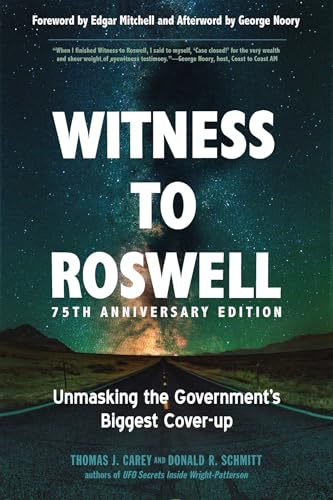
The book reconstructs the Roswell story chronologically: the reported debris field, the Army Air Forces’ initial “flying disc” announcement, the rapid retraction and weather-balloon explanation, alleged debris recovery and transport, and later recollections by military personnel, civilians, relatives, and deathbed witnesses. The revised editions expand the testimony and include a timeline, notes, bibliography, photographs, maps, and additional affidavits. The 2009 revised edition is listed at 318 pages; the 2022 75th-anniversary edition retains the same central case while adding updated framing and material.
Core ideas
Roswell as a cumulative case
The authors do not rely on one decisive artifact. They treat the alleged convergence of many accounts—military witnesses, ranchers, local officials, medical personnel, relatives, and later informants—as stronger than any isolated testimony.
Witness testimony as primary evidence
Carey and Schmitt emphasize what witnesses reportedly remembered or later disclosed, including descriptions of unusual materials, restricted recovery operations, bodies, guarded facilities, and threats against people who talked.
The cover-up explains contradictions
Conflicting official explanations are interpreted not as evidence of confusion or ordinary bureaucratic error, but as successive concealment stories designed to hide the recovery of an extraterrestrial vehicle.
The Walter Haut affidavit is pivotal
A major feature of the 2007 book is a posthumously released statement attributed to Walter Haut, the Roswell base public-information officer. The authors treat it as confirmation that Haut saw or knew more than his earlier public accounts indicated. Critics have questioned how the statement was produced and its divergence from prior testimony.
Four explanatory frameworks
The expanded presentation contrasts the extraterrestrial-crash interpretation with explanations involving a conventional weather balloon, Project Mogul surveillance equipment, or later crash-test-dummy memories. The authors reject the non-extraterrestrial accounts as inadequate.
A legal-investigative standard
The book repeatedly frames the issue like a cold case: establish a timeline, compare statements, identify motive and opportunity for concealment, and assess whether the total record reaches a practical standard of proof.
Practical takeaways
- Read the book primarily as an example of advocacy-driven historical investigation, not as a neutral history of Roswell.
- Separate the layers of evidence: contemporaneous documents, firsthand recollections, secondhand reports, retrospective interviews, and posthumous affidavits do not carry equal weight.
- Track when each witness first spoke, what they personally observed, and whether later versions became more elaborate. This is especially important in cases where memories surfaced decades after 1947.
- The book’s strongest methodological lesson is that chronology and source comparison matter; its weakness is that it often treats agreement among later testimonies as validation without adequately testing shared rumor, memory distortion, or investigator influence.
- For balance, compare its account with the U.S. Air Force’s official conclusion that the debris came from Project Mogul, a classified balloon-borne research program.
Caveats and counterpoints
- The central claims remain unverified by publicly available physical evidence: no authenticated extraterrestrial debris, craft, or bodies are presented for independent examination. A contemporary account also notes that the alleged material has never been recovered.
- The book is committed to the extraterrestrial interpretation and does not give sustained, even-handed treatment to skeptical objections. This was specifically criticized in reviews for relying heavily on anecdote and failing to seriously engage the Project Mogul explanation.
- Much of the case depends on recollections recorded decades after the event, including secondhand and deathbed testimony. Such evidence can preserve important memories but is vulnerable to contamination, embellishment, selective reporting, and changing cultural expectations.
- The official explanation is not automatically conclusive either: the Air Force’s reports were produced decades after the event and address a historical record already shaped by public controversy. The useful conclusion is not that one side has absolute proof, but that the evidentiary standards and source assumptions differ sharply.
- The supplied catalogue description appears to describe a different kind of New Age/extraterrestrial compendium. The Carey–Schmitt book is specifically about the Roswell incident, its witnesses, alleged recoveries, and the cover-up claim.
Questions worth revisiting
- Which witnesses had direct access to the debris or recovery operation, and which were repeating what someone else told them?
- How does each major witness’s earliest account compare with later versions?
- What independent evidence corroborates the alleged bodies and unusual materials?
- Does the Project Mogul hypothesis explain the reported debris, or only some descriptions of it?
- How much of the alleged cover-up is supported by contemporaneous documents rather than later testimony?
- What would count as disconfirming evidence for the authors’ interpretation?
Return to this when…
Return to these notes when evaluating extraordinary historical claims built from witness testimony, retrospective affidavits, alleged government secrecy, and the accumulation of circumstantial evidence. Also revisit them before reading the authors’ later book, Roswell: The Ultimate Cold Case, which presents their final and more emphatic version of the case.
References
- Witness to Roswell: Unmasking the 60-year Cover-up - Thomas J. Carey, Donald R. Schmitt - Google Books
- Witness to Roswell - Thomas J. Carey, Donald R. Schmitt - Google Books
- goodreads.com
- boulder.marmot.org
- Roswell: the Ultimate Cold Case: Eyewitness Testimony and Evidence of ... - Thomas J. Carey, Donald R. Schmitt - Google Books
- books.google.com
- books.google.com
- books.google.com
- books.google.com
- books.google.com
- allbookstores.com
- countycat.mcfls.org
- skepticalinquirer.org
- af.mil
- inquirer.com
- app.thestorygraph.com