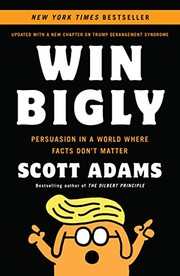

In one sentence
The book’s central claim is that persuasion succeeds less by presenting the strongest facts than by shaping the audience’s emotional experience and mental picture of reality. Adams presents Trump as a “master persuader” whose campaign repeatedly used simple language, vivid imagery, conflict, branding, and relentless attention capture. The advice is useful as a descriptive toolkit, but Adams often treats controversial psychological claims and his interpretation of the 2016 election as more con إن
Overview
The 2017 edition is organized around persuasion vocabulary, cognitive dissonance, mass delusions, hypnosis, the “persuasion stack,” campaign messaging, slogans and logos, reputation management, tribal identity, and the 2016 election. Trump is the main case study; Steve Jobs and Adams’s own experiences appear as supporting examples. The book is primarily an interpretive guide to influence, not a balanced account of campaign strategy or political science.
Core ideas
People respond to stories and feelings before analysis
Adams argues that people commonly form an intuitive or emotional judgment first and generate reasons afterward. In marketing and sales, therefore, factual superiority may matter less than whether the offer creates a compelling feeling, image, or identity.
The Persuasion Stack
Persuasion becomes especially powerful when several elements reinforce one another: a simple message, emotional resonance, visual imagery, credibility, repetition, a recognizable brand, and an audience already primed to care. A single clever argument is weaker than a coherent stack.
Visual language beats abstraction
Concrete images are easier to remember and discuss than policy abstractions. Adams uses Trump’s “wall” as an example of converting a complicated concern about borders into a single physical object and a simple mental picture.
Attention is a strategic resource
A persuader who controls the topic, pace, and emotional temperature of a conversation can gain an advantage before the substantive debate begins. Provocation, novelty, repetition, and conflict can function as attention-generating tools.
Framing changes perceived meaning
The same facts can support different interpretations depending on context, labels, comparisons, and the implied choice. Effective communicators define the problem and the available solutions before asking the audience to evaluate details.
Identity and tribal affiliation amplify messages
Messages become more persuasive when accepting them signals membership in a valued group. Political and commercial brands can therefore sell belonging, status, or resistance—not merely a policy or product.
The High-Ground Maneuver
Instead of defending every disputed detail, a speaker can shift the argument to a broader value—such as safety, patriotism, fairness, or common sense—where opposing the speaker becomes socially or morally costly. This can be rhetorically effective while still avoiding the original question.
Simple language increases reach
Adams emphasizes short, accessible phrasing and repeated slogans. Simplicity is not the same as accuracy, but it lowers processing demands and makes a message easier to remember, repeat, and attach to an emotional narrative.
Practical takeaways
- Before presenting features or evidence, identify the audience’s desired feeling, fear, aspiration, or group identity.
- Turn an abstract benefit into a concrete image, contrast, metaphor, or memorable phrase.
- Build a consistent persuasion stack: clear message, credible messenger, emotional hook, visual shorthand, repetition, and a specific next step.
- Control framing ethically: define the real problem accurately, acknowledge trade-offs, and do not manufacture false binaries.
- Use repetition and consistency, but test whether the audience actually understands and remembers the intended message.
- When evaluating someone else’s pitch, separate attention from evidence, confidence from competence, and emotional agreement from factual support.
- In sales conversations, ask what mental picture the buyer is using; changing that picture may be more effective than adding more data.
- Treat the book as a field guide to influence tactics—not as proof that facts are irrelevant.
Caveats and counterpoints
- Adams’s analysis is heavily centered on Trump and is openly sympathetic to the thesis that Trump’s persuasion explains his success. It should not be mistaken for a comprehensive explanation of the 2016 election; institutions, media coverage, party dynamics, economic conditions, opposition weaknesses, and voter preferences also mattered.
- The title’s “facts don’t matter” framing is provocative but overstated. Facts can constrain decisions, establish credibility, and matter greatly when audiences have time, incentives, and trustworthy methods for checking claims.
- Several psychological ideas are presented in an informal, anecdotal style rather than with systematic evidence. The book’s usefulness is strongest as a vocabulary for noticing rhetoric, not as a validated theory of human behavior.
- Some tactics described—provocation, ambiguity, attacks on opponents, and exploiting identity—may win attention while damaging trust, accuracy, relationships, or institutions.
- The 2017 edition analyzes the 2016 campaign. A substantially expanded second edition was published in 2024, so notes or descriptions referring to January 6 or the 2024 election belong to that later edition, not necessarily to the original book.
Questions worth revisiting
- Which parts of the “persuasion stack” are genuinely necessary, and which merely correlate with a charismatic or famous messenger?
- When does simplifying a message clarify the decision, and when does it conceal important complexity?
- What evidence would distinguish persuasion from preexisting agreement, partisan loyalty, media amplification, or strategic voting?
- Which techniques could be used in a sales setting without misleading customers or exploiting fear and tribal identity?
- What safeguards—fact-checking, cooling-off periods, competing frames, or trusted intermediaries—help people resist emotionally powerful but false claims?
Return to this when…
Return to this book when designing a pitch, slogan, campaign, presentation, or brand narrative—or when a communicator seems unusually effective. Use it alongside a more evidence-based treatment of judgment and persuasion so that rhetorical effectiveness is not confused with truth.
References
- Win Bigly: Persuasion in a World Where Facts Don't Matter - Scott Adams - Google Books
- Win Bigly: Persuasion in a World Where Facts Don't Matter - Scott Adams - Google Books
- Win Bigly: Persuasion in a World Where Facts Don’t Matter by Scott Adams
- en.wikipedia.org
- knowledgeartist.org
- garygiroux.net
- books.max-nova.com
- goodreads.com
- krauserpua.com
- antoinebuteau.com
- shortform.com
- shortform.com