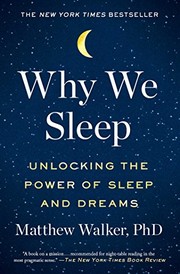

In one sentence
Sleep is a complex, active biological process with multiple benefits for brain and body; modern society routinely treats it as expendable, creating preventable costs in health, learning, safety, and performance.
Overview
Walker organizes the book in four movements: what sleep is and how it changes across life; the benefits and consequences of sleep loss; dreams; and sleep disorders, treatment, and social policy. His central practical message is to protect a regular, sufficient sleep opportunity rather than regard sleep as an obstacle to productivity.
Core ideas
Sleep performs many jobs
The book rejects the idea that sleep has one single purpose. Walker presents it as a collection of processes that support learning, memory, emotional balance, immune function, metabolism, and physical maintenance.
Sleep and wakefulness are governed by different systems
A circadian rhythm helps determine when the body is biologically prepared for sleep, while accumulated sleep pressure increases the longer one stays awake. Light exposure, schedules, caffeine, and irregular routines can disrupt the alignment between these systems.
Sleep strengthens learning and memory
A major mental model is that learning is not finished when studying ends. Sleep helps stabilize recently acquired information and, in Walker’s account, supports the integration of new material with existing knowledge.
Sleep loss impairs judgment before it feels intolerable
People can adapt subjectively to chronic short sleep while objective attention, reaction time, decision-making, and emotional control continue to deteriorate. Feeling accustomed to insufficient sleep is therefore not reliable evidence of functioning normally.
REM and non-REM sleep contribute differently
Walker describes sleep as a repeating architecture rather than a uniform state. Non-REM sleep is emphasized for physical restoration and memory processing; REM sleep is associated with emotional processing, associative thinking, and dreaming. These are broad functional themes, not perfectly isolated roles.
Dreaming may recombine experience
Dreams are presented as a form of internally generated simulation in which memory fragments and emotions can be reorganized. Walker links this process to creativity, but the strongest version of the claim—that dreams reliably produce major creative breakthroughs—should be treated cautiously.
Sleep advice is behavioral and environmental
The practical recommendations include keeping a consistent sleep schedule, maintaining a cool and dark bedroom, reducing evening light, avoiding late caffeine and alcohol, exercising regularly but not immediately before bed, and not forcing wakefulness in bed. For persistent insomnia, the book favors non-drug approaches such as cognitive behavioral therapy for insomnia over routine reliance on sleeping pills.
Sleep is also a systems problem
Walker argues that schools, hospitals, shift-work systems, workplaces, and transportation policies often reward sleep deprivation while externalizing its costs. His proposed remedy is cultural and institutional change, not merely individual discipline.
Practical takeaways
- Treat sleep as a health behavior with a protected place in the schedule, not as leftover time.
- Aim for a stable wake time and regular sleep opportunity; consistency often matters more than trying to recover from chaotic schedules.
- Use morning and daytime light to anchor circadian timing, and reduce bright light late in the evening.
- Be skeptical of caffeine’s apparent harmlessness: it can mask sleepiness without removing the underlying impairment and may remain active for many hours.
- If unable to sleep, avoid turning the bed into a place for frustration; use stimulus-control principles and seek evidence-based insomnia treatment when the problem persists.
- Use the book’s strongest general lesson—sleep supports cognition and health—but do not treat its most alarming disease-risk numbers as precise personal predictions.
Caveats and counterpoints
- The book is persuasive popular science, not a systematic review or clinical guideline. A serious review praised its explanation of circadian rhythm and sleep pressure but noted that not all claims were equally supported.
- Alexey Guzey’s detailed critique alleged errors, misleading statistics, and overstatement of evidence, including claims about cancer risk and recommended sleep duration. These criticisms do not erase the broad case for adequate sleep, but they weaken confidence in some of Walker’s specific numbers and causal formulations.
- The book often moves from associations between short sleep and disease to language that sounds causal. In practice, sleep, illness, stress, work schedules, socioeconomic conditions, and mental health can influence one another.
- The recommended amount of sleep is not identical for every person or every age group. A target such as seven to nine hours for adults is a useful population-level guideline, not a guarantee that every individual needs exactly the same duration.
Questions worth revisiting
- Which claims in the book are supported by randomized experiments, and which come mainly from observational studies?
- When does longer sleep improve health, and when might unusually long sleep be a symptom or marker of underlying illness?
- Which sleep interventions have the strongest evidence for a specific problem: insomnia, circadian delay, shift work, or sleep apnea?
- How can institutions redesign schedules so that adequate sleep is feasible rather than merely recommended?
Return to this when…
Return to the core ideas when planning a schedule, evaluating productivity advice that glorifies sleep deprivation, or deciding whether a sleep problem calls for behavioral treatment or medical assessment. Revisit the caveats before using the book’s disease-risk statistics or dramatic claims as personal health guidance.
References
- Why We Sleep | Book by Matthew Walker | Official Publisher Page | Simon & Schuster
- publishersweekly.com
- Matthew Walker's "Why We Sleep" Is Riddled with Scientific and Factual Errors - Alexey Guzey
- statmodeling.stat.columbia.edu
- Why We Sleep: The New Science of Sleep and Dreams | Occupational Medicine | Oxford Academic
- kqed.org
- pbs.org
- journals.sagepub.com
- articles.mercola.com
- research.ulapland.fi
- physoc.org
- en.wikipedia.org