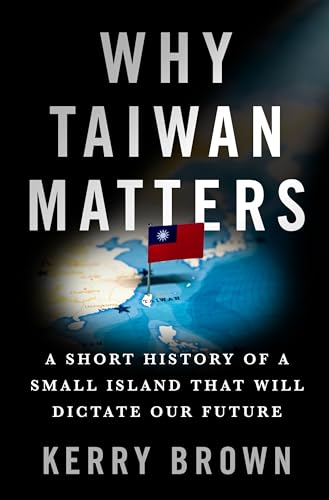

In one sentence
Taiwan matters not simply because China claims it, but because it has developed into a distinct political society whose security now connects democracy, global technology supply chains, and the balance of power in East Asia. Brown’s practical conclusion is cautious: preserving the unstable status quo may be safer than forcing a final settlement.
Overview
The book is a short, accessible history organized around the question of what it means to be Taiwanese and why the answer complicates the China–Taiwan dispute. Brown surveys Japanese rule from 1895 to 1945, the Nationalist retreat after the Chinese Civil War in 1949, Taiwan’s authoritarian period, democratization, economic development, and the intensifying strategic rivalry of the last two decades. The emphasis is less on exhaustive chronology than on explaining how history produced today’s dangerous ambiguity.
Core ideas
Taiwan is neither simply China nor wholly separable from China
Brown treats identity as historically layered rather than legally or culturally obvious. Taiwan’s people, institutions, memories, and political values have diverged from the mainland, while language, migration, culture, and the Republic of China’s historical claims preserve important links. The dispute cannot be reduced to a straightforward property or territorial question.
1949 created a durable political split
The Communist victory on the mainland and the Nationalist government’s retreat to Taiwan produced two rival Chinese political entities. Over subsequent decades, they became increasingly separate societies: Taiwan moved from authoritarian rule toward competitive democracy, while the People’s Republic developed under Communist Party rule.
Taiwan’s democracy changes the stakes
Taiwan is not merely a strategic location or an unresolved remnant of civil war. Its political liberalization created a self-governing society with its own public identity and preferences, including stronger support among many Taiwanese for maintaining distinctiveness or moving toward independence. That makes imposed unification politically and morally different from a negotiated settlement.
Economic importance magnifies geopolitical risk
Taiwan’s semiconductor industry gives the island significance far beyond its size. A blockade or invasion would threaten technology production, trade, and regional stability, while control of Taiwan would alter the strategic balance between China and the United States. Economic interdependence therefore acts both as a deterrent and as a source of vulnerability.
The central policy problem is deterrence without provocation
Brown presents a three-way balancing act: Taiwan wants security and meaningful autonomy; Beijing insists on eventual unification and rejects formal independence; Washington and other Western governments want to deter coercion without triggering war. His reported conclusion is that defending the ambiguous status quo may be the least dangerous available policy, even though it satisfies no side completely.
Practical takeaways
- When evaluating Taiwan-related news, separate three questions: Taiwan’s de facto self-government, the People’s Republic of China’s claim, and the international community’s deliberately ambiguous diplomatic position.
- Treat identity as a political variable, not a fixed historical fact. Changes in how Taiwanese people describe themselves affect the legitimacy and feasibility of different policy options.
- Remember that deterrence has two audiences: it must convince Beijing that aggression will fail or impose unacceptable costs, while convincing Taiwan that it should not take unilateral steps that could trigger escalation.
- Do not analyze a Taiwan crisis only as a military problem. The consequences would also involve semiconductor supply, shipping, financial markets, alliance credibility, and the future political choices of other Asian states.
- Read Brown’s argument as a case for managed ambiguity, not as evidence that the status quo is stable or permanent. Its success depends on restraint by Beijing, Taipei, Washington, and their partners.
Caveats and counterpoints
- This is a concise primer rather than a comprehensive social history of Taiwan; the book’s strategic question receives more attention than the full diversity of Taiwanese regional, ethnic, Indigenous, and partisan experiences.
- The publisher and reviewers characterize Brown’s treatment as balanced and nuanced, but the book is framed around the danger of Chinese coercion and a possible wider war. Readers seeking detailed military analysis, semiconductor-industry research, or competing Taiwanese political perspectives will need supplementary works.
- The status-quo recommendation is contingent. It postpones the sovereignty question rather than resolving it, and it can become harder to sustain as Taiwanese identity, Chinese pressure, and U.S.–China rivalry continue to change.
- The book was published in the United States on January 28, 2025, so its account is a snapshot of a rapidly changing strategic environment rather than a timeless forecast.
Questions worth revisiting
- Is preserving ambiguity genuinely sustainable if Taiwanese identity continues becoming more distinct from Chinese identity?
- How much should Taiwan’s democratic character influence the willingness of the United States and other countries to accept economic and military risks on its behalf?
- Does semiconductor centrality deter attack because the industry is globally valuable, or make Taiwan more tempting to control?
- What forms of deterrence can protect Taiwan without encouraging either Beijing or Taipei to believe that the other side is preparing for permanent separation or forced unification?
- Would a negotiated political settlement be possible under current conditions, or would unequal power make any agreement effectively coercive?
Return to this when…
Return to these notes when a Taiwan Strait crisis, major election, semiconductor disruption, military exercise, or U.S.–China policy change makes the headlines. The key refresher is Brown’s framework: Taiwan’s distinct identity, democratic development, economic centrality, and ambiguous status are inseparable parts of the same geopolitical problem.