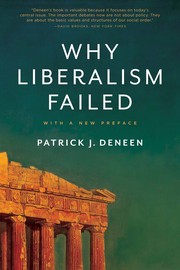

In one sentence
Liberalism has “failed” because it has largely succeeded on its own terms: its pursuit of individual liberation and economic expansion has produced inequality, cultural homogenization, weakened citizenship, pervasive state power, and diminished human freedom. Deneen treats both market-oriented and progressive liberalism as rival expressions of the same project, not genuine alternatives.
Overview
Published by Yale University Press in 2018, the book develops its argument across politics, economics, culture, technology, education, elites, and citizenship. Its conclusion calls for a recovery of liberty through local institutions, practical knowledge, civic participation, and communities that resist total dependence on markets, bureaucracies, and experts. The book is a polemic in political philosophy rather than a neutral history of liberalism.
Core ideas
“Success” can be a form of failure
Deneen’s central reversal is that liberalism’s problems arise from fulfilling its promises, not betraying them. More individual choice, mobility, market exchange, and emancipation can dissolve the social relationships and inherited practices that give those freedoms substance.
Individualism and statism reinforce each other
Liberalism presents the individual and the state as opposites, but Deneen argues that radically autonomous individuals require an increasingly powerful state to regulate social life, manage conflicts, redistribute resources, and secure the conditions of formal choice. This produces a cycle: social fragmentation increases administrative dependence.
Both major liberalisms share a deep structure
Classical liberalism expands freedom through markets and limited government; progressive liberalism expands it through public administration and social transformation. Deneen argues that both privilege abstract individual autonomy over thick communal obligations, even when their preferred policies differ.
Liberalism becomes an “anticulture”
Because liberalism seeks rules that apply universally and treats inherited authorities with suspicion, it tends to weaken particular cultures, religions, families, and local loyalties. It does not merely tolerate diversity; Deneen argues that it actively remakes society around a universal culture of choice.
Technology converts freedom into control
Technological systems promise convenience and expanded agency but can centralize power, make behavior more legible to institutions, and replace practical judgment with technical management. The result is nominal choice alongside less meaningful control over the conditions of life.
Education loses its formative purpose
Deneen contrasts education aimed at cultivating judgment and civic character with education treated primarily as workforce preparation or personal advancement. In his account, the decline of the liberal arts reflects liberalism’s difficulty sustaining a common conception of human excellence.
A new aristocracy emerges
Liberal meritocracy claims to reward talent and effort, yet Deneen argues that it produces a highly educated, mobile elite increasingly insulated from the social costs of liberal economic and cultural change. This elite can defend openness while benefiting from arrangements that restrict opportunity for others.
Citizens become consumers
Citizenship requires shared responsibility, sacrifice, and participation. Liberal society instead encourages people to relate to institutions as customers seeking private benefits, while political authority becomes professionalized and distant. The result is passivity, resentment, and declining civic competence.
Practical takeaways
- When evaluating a policy described as increasing freedom, ask what dependencies, institutions, or social practices it may weaken.
- Distinguish formal choice from substantive freedom: having more options is not necessarily having more power, competence, or belonging.
- Look for the interaction between market individualism and administrative government rather than treating them as simple opposites.
- Treat local associations, families, religious communities, unions, schools, and civic organizations as infrastructure for freedom—not merely private preferences.
- Be skeptical of solutions that rely entirely on either markets or centralized expertise; Deneen’s alternative emphasis is local, participatory, and practical.
- Use the book as a diagnosis of alienation and institutional failure, not as a complete policy program.
Caveats and counterpoints
- Deneen uses “liberalism” very broadly, grouping diverse thinkers, institutions, and historical periods under one system. Critics argue that this can blur important differences between classical liberalism, social democracy, neoliberalism, and contemporary progressivism.
- The book’s historical claims are often schematic. Its account of liberalism’s origins and development is interpretive and polemical rather than a detailed intellectual or socioeconomic history. Critics have specifically objected to omissions, exaggerations, and disputed readings of liberal thinkers.
- Deneen is stronger at identifying losses—community, meaning, civic agency—than at specifying how a post-liberal order would protect dissenters, minorities, mobility, religious freedom, or individual rights.
- His critique can sound nostalgic about pre-liberal communities without fully confronting the coercion, hierarchy, exclusion, and restricted agency that those communities could involve.
- The argument should not be reduced to a critique of left-wing politics: Deneen explicitly treats market-oriented conservatism and progressive liberalism as mutually reinforcing versions of the same underlying order.
Questions worth revisiting
- Which parts of Deneen’s diagnosis apply specifically to liberalism, and which are better explained by capitalism, technology, globalization, or professionalized politics?
- Can local community and inherited tradition be strengthened without giving local majorities excessive power over individual rights?
- What institutions could make citizenship participatory rather than merely electoral or consumer-like?
- Does Deneen offer a workable alternative, or mainly a vocabulary for criticizing liberal modernity?
- Which liberal achievements—constitutional rights, religious liberty, legal equality, democratic accountability—would a post-liberal society retain?
- Is the book’s “both sides” analysis persuasive, or does it understate real conflicts between market libertarianism and egalitarian reform?
Return to this when…
Return to this book when thinking about political alienation, the tension between personal autonomy and social belonging, the relationship between markets and bureaucracy, or contemporary post-liberal and communitarian arguments. Pair it with a detailed history of liberalism and a defense of liberal institutions to test its broad claims rather than accepting its diagnosis wholesale.
Highlights
Not only are all political and economic relationships seen as fungible and subject to constant redefinition, so are all relationships—to place, to neighborhood, to nation, to family, and to religion. Liberalism encourages loose connections.
Liberalism thus culminates in two ontological points: the liberated individual and the controlling state. Hobbes’s Leviathan perfectly portrayed those realities: the state consists solely of autonomous individuals, and these individuals are “contained” by the state. The individual and the state mark two points of ontological priority.
In schools, norms of modesty, comportment, and academic honesty are replaced by widespread lawlessness and cheating (along with increasing surveillance of youth), while in the fraught realm of coming-of-age, courtship norms are replaced by “hookups” and utilitarian sexual encounters.
The norm of stable lifelong marriage is replaced by various arrangements that ensure the autonomy of the individuals, whether married or not. Children are increasingly viewed as a limitation upon individual freedom, which contributes to liberalism’s commitment to abortion on demand, while overall birth rates decline across the developed world.
Taken to its logical conclusion, liberalism’s end game is unsustainable in every respect: it cannot perpetually enforce order upon a collection of autonomous individuals increasingly shorn of constitutive social norms, nor can it provide endless material growth in a world of limits. We can either elect a future of self-limitation born of the practice and experience of self-governance in local communities, or we can back inexorably into a future in which extreme license coexists with extreme oppression.