
In one sentence
Change is unavoidable; suffering grows when we cling to what used to work. A flexible response—anticipating change, accepting loss, exploring alternatives, and acting despite fear—usually creates better options than denial or waiting for certainty.
Overview
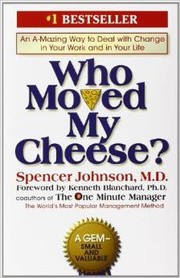
The book is a 96-page business/self-help fable. Two mice, Sniff and Scurry, respond instinctively when their cheese disappears; two Littlepeople, Hem and Haw, react with fear, anger, and attachment. Haw eventually leaves the empty station, learns from movement through the maze, and records lessons on the walls. The story is framed by a conversation among former classmates, followed by discussion of its application to work and life.
Core ideas
Cheese is a desired outcome, not merely food
The metaphor can stand for a job, money, possessions, a relationship, health, status, or inner peace. The maze represents the surrounding system—an organization, family, community, or life situation—in which the search occurs.
Expect change before it arrives
Enjoying a stable situation can obscure warning signs. Regularly checking whether conditions, customers, skills, relationships, or priorities are shifting reduces the shock when the old arrangement ends.
Do not confuse familiarity with permanence
Hem assumes the cheese will return and treats its disappearance as unfair. The book’s point is that past success is evidence of what worked before, not a guarantee that it will continue working.
Fear often exaggerates the cost of movement
Haw initially imagines the maze as dangerous and stays trapped by anxiety. Once he begins moving, action generates information and lowers fear more effectively than prolonged analysis.
Let go of the old cheese quickly
Attachment to a vanished benefit consumes attention that could be used to find alternatives. Adaptation requires acknowledging the loss without making recovery of the old situation the only acceptable outcome.
Exploration creates optionality
The mice move, test routes, and search before they know exactly where the new cheese is. The practical model is small experiments: investigate, learn, revise, and continue rather than waiting for a perfect plan.
Enjoyment is part of adaptation
The book presents change not only as something to endure but as a possible source of discovery. Its emphasis is motivational: a new situation may contain rewards that were invisible while attention remained fixed on the old one.
Practical takeaways
- Identify your current “cheese”: what outcome, role, routine, or assumption are you relying on?
- Schedule periodic reality checks instead of evaluating only after a crisis.
- Watch for early signals that the environment is changing; do not let present comfort silence them.
- When something disappears, separate facts from the story you are telling about fairness, blame, or permanence.
- Create a low-cost next move: a conversation, application, prototype, course, budget, or exploratory visit.
- Use action to gather information, but do not mistake speed for wisdom; adapt while checking evidence.
- Keep multiple sources of meaning and security so that one job, relationship, or identity is not your entire cheese supply.
- In organizations, explain the reasons for change and give people resources—not merely slogans about being flexible.
Caveats and counterpoints
- The fable is intentionally simple and offers attitude-level guidance rather than a tested change-management method. It does not provide much detail about implementation, power, institutional responsibility, or measurable outcomes.
- Its strongest lesson applies to circumstances where movement is feasible. People may face constraints—money, disability, caregiving, immigration status, discrimination, unsafe workplaces, or limited labor markets—that cannot be solved by changing attitude alone.
- The mice’s behavior is presented as efficient, but purely reactive movement can also cause mistakes. Some situations require grieving, collective resistance, negotiation, or careful planning rather than immediate acceptance.
- The book can be used by managers to encourage employees to accept restructuring without addressing whether the change is justified or who bears its costs. A fair reading should distinguish adaptability from obedience. This concern is reflected in critical commentary that views the workplace metaphor as potentially managerial or patronizing.
- Because the central principles are compressed into a very short parable, readers seeking evidence-based psychology, organizational design, or detailed career strategy will need more specialized sources.
Questions worth revisiting
- What is my current cheese, and which parts of it are genuinely under my control?
- What early signals suggest that this situation may not remain stable?
- Am I resisting because the change is harmful, because I fear uncertainty, or because I have not yet explored alternatives?
- What small experiment could produce useful information this week?
- Who benefits from this change, who bears its costs, and what support or negotiation is warranted?
- Where would patience, solidarity, or principled resistance be wiser than simply moving on?
Return to this when…
Return to this book when you are stuck after a job change, loss of routine, organizational upheaval, or personal transition—and need a quick prompt to distinguish grieving the old situation from investigating the next one. Pair it with more substantive guidance when the change involves high stakes, unequal power, or limited realistic options.
Highlights
The mice did not overanalyze things. To the mice, the problem and the answer were both simple. The situation at Cheese Station C had changed. So, Sniff and Scurry decided to change. They both looked out into the Maze. Then Sniff lifted his nose, sniffed, and nodded to Scurry, who took off running through the Maze, while Sniff followed as fast as he could.
What Would You Do If You Weren’t Afraid? He thought about it. He knew sometimes some fear can be good. When you are afraid things are going to get worse if you don’t do something, it can prompt you into action. But it is not good when you are so afraid that it keeps you from doing anything.
Movement In A New Direction Helps You Find New Cheese.
When You Stop Being Afraid, You Feel Good!
Noticing Small Changes Early Helps You Adapt To The Bigger Changes That Are To Come.
Angela countered, “Or, perhaps the ‘Old Cheese’ is just old behavior. What we really need to let go of is the behavior that is the cause of our bad relationships. And then move on to a better way of thinking and acting.” “Ouch!” Cory reacted. “Good point. The New Cheese is a new relationship with the same person.” Richard said, “I’m beginning to think there is more to this than I thought. I like the idea of letting go of old behavior instead of letting go of the relationship. Repeating the same behavior will just get you the same results.
References
- Who Moved My Cheese: How to Deal With Change in Your Work and in Your Life - Spencer Johnson - Google Books
- Who Moved My Cheese?: An A-Mazing Way to Deal with Change in Your Work and ... - Spencer Johnson - Google Books
- openlibrary.org
- getabstract.com
- goodreads.com
- supersummary.com
- evergreen.lib.in.us
- en.wikipedia.org
- dansilvestre.com
- catalog.library.nashville.org
- cheese.com
- publishersweekly.com
- washingtonpost.com