
In one sentence
Ellis argues that contemporary culture—especially its online, celebrity-driven, politically polarized forms—has become hostile to ambiguity, dissent, artistic risk, and individual expression. He presents “offense” and disagreement as necessary conditions of a free culture, while treating progressive moral policing, corporate censorship, and Trump-era outrage as symptoms of a broader loss of tolerance.
Overview
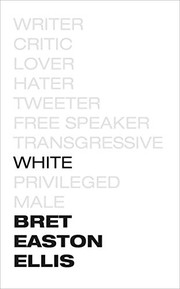
White is Ellis’s first nonfiction book, published in the United States by Knopf on April 16, 2019, at 272 pages. It combines memoir, film and literary commentary, observations about Hollywood and celebrity, and political-cultural polemic. The book repeatedly returns to Ellis’s career, American Psycho, his sexuality and relationships, social media, Donald Trump, and the perceived authoritarianism of contemporary liberal culture.
Core ideas
Freedom of speech as cultural experimentation
Ellis treats free expression not merely as a legal principle but as a precondition for art, criticism, humor, and psychological honesty. He objects to environments in which people avoid saying what they think because of reputational punishment, institutional pressure, or demands for ideological safety.
The cult of likeability
The book’s target is the expectation that public figures must be agreeable, morally legible, and permanently aligned with the audience’s values. Ellis sees social media as rewarding performance, approval-seeking, and group identification rather than difficult or independent thought.
Generational conflict
Ellis contrasts his own Gen-X formation—shaped by provocation, celebrity culture, films, and a less therapeutically managed public sphere—with younger audiences whom he portrays as unusually sensitive to offense and demanding of trigger warnings. This is central to the book, but also one of its most vulnerable generalizations.
Art should not be reduced to representation
Ellis resists judging films, books, and performers primarily by whether they reflect approved identities or political messages. He argues that criticism should be allowed to dislike work by or about marginalized groups without automatically being interpreted as prejudice.
Memoir as evidence—and self-mythology
Personal anecdotes about cinema, fame, sex, drugs, friendships, and American Psycho give the polemic texture and authority. At the same time, the memoiristic material reinforces Ellis’s established persona: detached, glamorous, contrarian, and surrounded by cultural notoriety. The reader should treat the anecdotes as perspective, not neutral social evidence.
The book’s political asymmetry
Although Ellis presents himself as independent of conventional factions, the sustained force of the argument is directed against the contemporary left: political correctness, Trump opposition, identity politics, media norms, and progressive cultural criticism. This makes White less a balanced diagnosis of polarization than a deliberately one-sided counterattack.
Practical takeaways
- Separate a person’s right to say something from the quality or consequences of what they say.
- Be suspicious of criticism that substitutes moral labeling for engagement with the work itself.
- Notice when public discourse rewards conformity, outrage, and personal branding rather than curiosity.
- Preserve room for art that is disturbing, ambiguous, tasteless, or politically unfashionable.
- Test Ellis’s claims against actual evidence: many of his generational and cultural diagnoses are impressions presented with more confidence than demonstration.
- Read the book as a polemic and cultural self-portrait, not as a neutral history of the 2010s.
Caveats and counterpoints
- The catalogue category “History” is misleading. The book is generally classified as nonfiction, literary collections, essays, culture, or social commentary—not conventional history.
- Ellis’s defense of free speech is strongest when applied to artistic risk and dissent, but weaker when he treats criticism of speech as equivalent to censorship. Social disapproval, platform moderation, employment consequences, and state coercion are different mechanisms.
- Reviewers broadly recognized the book’s energy and clarity but also criticized its judgmental tone, repetitive provocations, and tendency to bait opponents rather than seriously engage their strongest arguments.
- Its discussion of millennials, political correctness, and Trump-era culture is historically specific to the late 2010s and should not automatically be generalized to the present.
- The book’s examples are heavily drawn from Ellis’s own celebrity, media, and Hollywood milieu; that narrow social vantage point limits its usefulness as a comprehensive account of American culture.
Questions worth revisiting
- When does protecting artistic freedom require tolerating offense, and when does “provocation” merely protect cruelty or laziness?
- Does Ellis distinguish consistently between censorship, criticism, deplatforming, commercial consequences, and ordinary audience rejection?
- Are his complaints about younger audiences based on representative observation or on highly visible online extremes?
- Does the memoir complicate Ellis’s arguments, or mainly provide a compelling stage for his public persona?
- Can a defense of ambiguity and individual freedom avoid becoming a defense of power, privilege, or indifference to harm?
Return to this when…
Return to White when thinking about the late-2010s culture wars, free speech and artistic freedom, online conformity, celebrity politics, or the relationship between a writer’s public persona and their cultural criticism. Pair it with a more empirically grounded account of social media, polarization, or generational change.
References
- WHITE | Kirkus Reviews
- bookmarks.reviews
- White - Bret Easton Ellis - Google Books
- books.google.com
- In ‘White,’ Bret Easton Ellis baits his critics with morsels specially tooled to elicit outrage - The Washington Post
- White - Bret Easton Ellis - Google Books
- books.google.com
- penguinrandomhouse.com
- everand.com
- books.apple.com
- panmacmillan.com
- White by Bret Easton Ellis