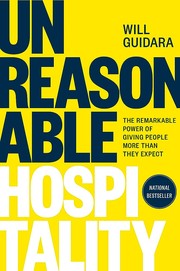

In one sentence
卓越的服务满足期待;真正的 hospitality creates an emotional experience that exceeds them. Guidara’s broader argument is that this is not restaurant-specific: in increasingly similar markets, thoughtful human connection can become a strategic differentiator—but only when supported by culture, judgment, resources, and empowered people.
Overview
The book combines memoir and management advice, tracing Guidara’s career and the transformation of Eleven Madison Park from an underperforming brasserie into a restaurant recognized as the world’s best in 2017. The central lesson is not “spend more on customers,” but notice what matters to particular people and mobilize a team to respond creatively.
Core ideas
Service is not hospitality
Service is functional execution: accuracy, speed, competence, and consistency. Hospitality adds emotional intelligence—understanding how someone wants to feel and shaping the interaction accordingly. A flawless transaction can still feel cold; a small act of attention can make an ordinary transaction memorable.
The experience is the product
Guidara treats the surrounding experience—not merely the core offering—as part of what customers are buying. This shifts managerial attention toward atmosphere, language, transitions, anticipation, and the final details that determine what people remember.
Personalization beats generic extravagance
“Unreasonable” does not necessarily mean expensive. The strongest gestures are specific to the individual: they respond to something noticed, overheard, or learned, and therefore signal genuine attention rather than a standardized perk. The memorable gesture is often modest; its value comes from meaning.
Empower the people closest to the customer
Frontline employees need permission, judgment, and practical support to solve for the guest rather than merely follow procedure. Empowerment is not the absence of standards: leaders establish the principles and boundaries, then trust employees to exercise discretion within them.
Internal hospitality comes first
A customer-facing culture cannot be sustained by asking employees to perform warmth while feeling ignored, disposable, or micromanaged. Leaders must make people feel seen, valued, and part of something larger; the treatment of employees becomes the emotional source of the customer experience.
Culture requires a point of view
A distinctive organization is not built by trying to please everyone or by copying competitors. It needs explicit beliefs about what excellence means, repeated language and rituals that reinforce those beliefs, and leaders willing to make choices consistent with them.
Hospitality is operational, not merely personal
Warmth alone is unreliable. Memorable experiences require systems for gathering information, sharing it across a team, recognizing good judgment, allocating resources, and reviewing failures. Creativity becomes repeatable when the organization designs conditions in which it can occur.
Practical takeaways
- Define the difference between competent service and the feeling you want customers to leave with.
- Map the customer journey and identify one or two emotionally important moments—not just process bottlenecks.
- Create a simple practice for recording preferences, milestones, and clues about what matters to customers.
- Give frontline staff a clear discretionary budget or decision boundary, and review examples rather than requiring advance approval for everything.
- Ask in team meetings: “What would make this person feel especially seen?” Then distinguish genuinely thoughtful ideas from expensive but generic gestures.
- Treat praise as a leadership tool: be specific, timely, and emotionally expressive; deliver criticism calmly and privately.
- Hire and develop for judgment, generosity, and curiosity—not only technical competence.
- Use hospitality internally: improve onboarding, recognition, communication, and the everyday employee experience before promising extraordinary customer treatment.
Caveats and counterpoints
- The model is shaped by luxury fine dining, where margins, staffing, pricing, and customer expectations differ sharply from most businesses. Directly copying Eleven Madison Park’s gestures may be impractical or inequitable.
- The book’s positive, anecdotal style can understate trade-offs: personalized service consumes labor, coordination, and managerial attention, and “going above and beyond” can become unpaid emotional labor or pressure to overwork.
- Exceptional moments cannot compensate indefinitely for a poor core product, unreliable operations, unfair pricing, or unsafe working conditions. Hospitality is an amplifier, not a substitute for competence.
- Personalization can become intrusive or discriminatory if employees infer too much, rely on sensitive information, or give special treatment inconsistently. Set boundaries around privacy, accessibility, and fairness.
- The book emphasizes culture and leadership but, according to Library Journal’s review, gives limited attention to harassment and toxic workplace conditions in the restaurant industry—an important omission when applying its ideas to real organizations.
Questions worth revisiting
- Where does our current experience meet expectations but fail to create belonging or goodwill?
- What information could we notice or remember that would make our service more personal without invading privacy?
- What decisions are unnecessarily centralized, and what principles would let frontline employees make them safely?
- Do employees receive the same care, clarity, and respect that we expect them to show customers?
- Which “wow” gestures are genuinely meaningful, and which are merely costly theater?
- What is our organization’s distinctive point of view about how people should feel after interacting with us?
- How will we measure hospitality without reducing it to a superficial customer-satisfaction score?
Return to this when…
Return to this book when designing a customer experience, revising frontline authority, onboarding or coaching a service team, or trying to turn vague claims about “culture” into observable behaviors. Revisit the caveats when adapting its luxury-restaurant examples to lower-margin, high-volume, or labor-constrained settings.
References
- Unreasonable Hospitality: Books & Materials
- Unreasonable Hospitality Summary of Key Ideas and Review | Will Guidara - Readever
- Unreasonable Hospitality Key Takeaways | SuperSummary
- UNREASONABLE HOSPITALITY | Kirkus Reviews
- mindleap.app
- bookbase.app
- Unreasonable Hospitality: The Remarkable Power of Giving People More Than They Expect | Library Journal
- penguin.co.uk
- unreasonablehospitality.com
- admiredleadership.com
- goodreads.com
- smallbusinessmattersonline.com