
In one sentence
Online media is highly manipulable because its business model rewards attention—especially speed, outrage, novelty, and controversy—more reliably than accuracy. Holiday’s central warning is that media manipulators exploit these incentives to manufacture narratives, while journalists and readers mistake repetition and prominence for verification.
Overview
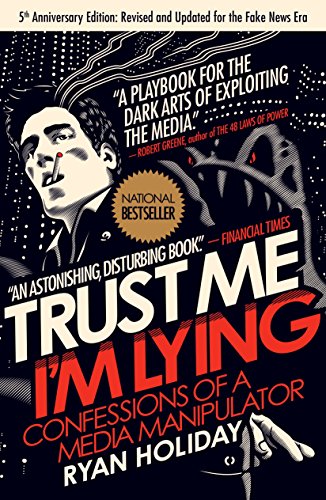
Published in 2012, the book is part confession, part tactical explanation, and part argument for media reform. Holiday describes manipulating coverage for clients and demonstrates the system’s weaknesses through publicity stunts, including posing as a fake expert for reporters. His method is deliberately uncomfortable: the credibility of the exposé is entangled with the manipulator’s own promotional skill.
Core ideas
Incentives shape the news
Holiday focuses less on individual dishonesty than on structural pressures: advertising revenue depends on page views, and page views reward frequent publication, clickable headlines, emotional reactions, and stories that can be produced cheaply. The result is a system where “publish first, verify later” becomes commercially rational.
The media ladder
A manipulator can place a claim in a small or obscure outlet, then anonymously send links to larger sites. Each repetition makes the claim appear more established, allowing a planted item to move upward into increasingly reputable media.
The headline is the payload
Online headlines must compete for attention independently of the article. Questions, insinuation, scandal, conflict, and emotionally loaded framing can generate traffic while preserving deniability or avoiding a plainly falsifiable assertion.
Blogs are part of a wider system
Holiday uses “blogs” broadly: from independent sites and social accounts to major newspaper websites and large group publications. His claim is that different outlets may vary in reputation, but traffic-driven incentives connect them in the same attention market.
Manufactured reality becomes self-reinforcing
Once a claim is repeated across outlets, later journalists may treat its previous appearances as evidence that it matters or is true. The public then encounters an apparently corroborated narrative that originated from a single strategic intervention.
The exposé is also a warning about the exposer
Holiday’s evidence is vivid because he participated in the practices he criticizes. Critics noted the irony: the book’s demonstrations and publicity campaign themselves used manipulation, making the work useful as evidence but less trustworthy as a neutral moral judgment.
Practical takeaways
- Treat repeated coverage as distribution evidence, not independent confirmation; trace a claim back to its earliest identifiable source.
- Ask who benefits from a story, who supplied the information, and what incentive the outlet has to publish it quickly.
- Separate the headline, the article’s evidence, and the claims made by quoted sources; they often differ substantially.
- Be especially skeptical of anonymous tips, outrage-driven stories, “reportedly” claims, and articles built around a provocative question.
- When sharing a story, check whether later outlets merely copied one another instead of conducting independent reporting.
- For organizations, assume that a small inaccurate item can become a major reputational problem if it is easy to amplify.
- Remember that media literacy requires understanding business models and workflows, not merely spotting obviously false statements.
Caveats and counterpoints
- The book’s strongest evidence concerns the early-2010s blog and page-view ecosystem; platforms, recommendation systems, influencer networks, and generative AI have since changed the mechanics, even if attention incentives remain relevant.
- Holiday sometimes generalizes from his own successful stunts and from especially vulnerable outlets. Not every error is deliberate manipulation, and not every traffic-oriented newsroom lacks meaningful editorial standards.
- His account is strategically useful but self-interested: he had reasons to dramatize his effectiveness, and contemporary coverage questioned whether the book’s marketing reproduced the behavior it condemned.
- The book diagnoses weaknesses more effectively than it establishes a complete solution. Its reform impulse is clear, but the practical institutional remedies are less developed than the manipulation playbook.
Questions worth revisiting
- When I encounter a viral claim, can I identify its earliest source rather than its most prominent repetition?
- What financial, political, reputational, or ideological incentive might explain the story’s framing?
- Am I rewarding the attention economy by sharing something mainly because it provokes anger or surprise?
- How should journalists preserve speed while adding verification checkpoints that manipulators cannot easily exploit?
- Where does strategic publicity end and deception begin—and what standards should apply to both media professionals and sources?
Return to this when…
Return to these notes when evaluating viral political claims, reputational controversies, PR campaigns, anonymous-source reporting, or any story that seems to have appeared everywhere at once. The key refresher is: follow the incentives, trace the source chain, and do not confuse amplification with truth.
Highlights
Remember: Every person (with the exception of a few at the top layer) in this ecosystem is under immense pressure to produce content under the tightest of deadlines. Yes, you have something to sell. But more than ever they desperately, desperately need to buy. The flimsiest of excuses is all it takes.
His answer was one word: quickness. “Online journalism is fast-paced,” he explained. “We need people that can get the story out in minutes and can compose the bigger opinion pieces in a couple hours, not a couple of days.” As to any actual experience in journalism, that would be considered only “a definite plus.”1
Online games and apps operate on the same principles and exploit the same impulses: be consuming without frustrating, manipulative without revealing the strings.
social media isn’t a set of tools to allow humans to communicate with humans. It is a set of embedding mechanisms to allow technologies to use humans to communicate with each other, in an orgy of self-organizing…. The Matrix had it wrong. You’re not the battery power in a global, human-enslaving AI, you are slightly more valuable. You are part of the switching circuitry.1 As a user, the fact that blogs are not helpful, deliberately misleading, or unnecessarily incendiary might exhaust and tire you, but Orwell reminded us in 1984: “The weariness of the cell is the vigor of the organism.”
“Talkativeness is afraid of the silence which reveals its emptiness,” Kierkegaard once said.
Now you know why sharing, commenting, clicking, and participating are pushed so strongly by blogs and entertainment sites. They don’t want silence. No wonder blogs auto refresh with new material every thirty seconds. Of course they want to send updates to your mobile phone and include you on e-mail alerts. If the users stops for even a second, they may see what is really going on. And then the business model would fall apart.
One of my favorite books is Kathryn Schulz’s Being Wrong: Adventures in the Margin of Error. Though media mistakes are not the subject of the book, Schulz does do a good job of explaining why the media so regularly gets it wrong.
When intelligent people read, they ask themselves a simple question: What do I plan to do with this information? Most readers have abandoned even pretending to consider this. I imagine it’s because they’re afraid of the answer: There isn’t a thing we can do with it. There is no practical purpose in our lives for most of what blogs produce other than distraction. When readers decide to start demanding quality over quantity, the economics of Internet content will change. Manipulation and marketing will immediately become more difficult.
References
- TRUST ME, I'M LYING | Kirkus Reviews
- Keen On... Ryan Holiday: Confessions Of A Media Manipulator TCTV | TechCrunch
- Our gullible press - Columbia Journalism Review
- Telling the truth about media manipulator Ryan Holiday - Poynter
- laist.com
- socialmediatoday.com
- search.worldcat.org
- ryanholiday.net
- teesche.com
- goodreads.com
- wnycstudios.org
- publishersweekly.com