
In one sentence
Exceptional leadership is fundamentally relational: managers create durable performance by investing in people, building trust, putting the team before individual ego, and combining genuine care with direct, demanding coaching. Campbell’s influence came less from a formal system than from consistently applying these behaviors in high-stakes relationships.
Overview
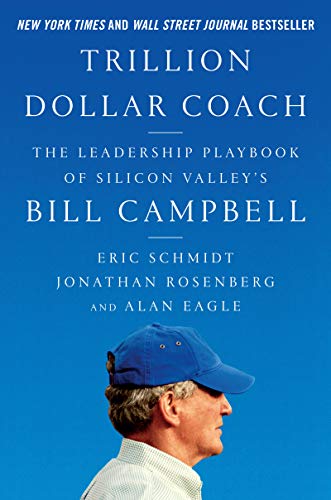
The book is part biography, part case-based leadership manual. Eric Schmidt, Jonathan Rosenberg, and Alan Eagle reconstruct Campbell’s approach through interviews with more than eighty people who knew him, organizing the lessons around trust, team performance, love, coaching, meetings, decision-making, and leadership development. Its examples center heavily on Silicon Valley executives and companies, making it more a tribute and playbook than a research-based management text.
Core ideas
A title gives authority; people determine leadership
Management is not equivalent to leadership. Credibility comes from helping people succeed, making sound judgments, teaching, and earning their willingness to follow—not merely from occupying a senior role. The leader’s primary responsibility is the well-being and success of the people being led.
Build an envelope of trust
Trust makes candor, risk-taking, disagreement, and learning possible. Campbell built it through consistency, confidentiality, close attention, personal knowledge, and a willingness to show up when people needed him. Trust is not softness: it enables harder conversations because people believe the coach is acting for their benefit.
Team first
Strong organizations are built around collective performance rather than the optimization of individual stars. Leaders should create shared context, resolve interpersonal friction, encourage collaboration, and ensure that important issues are discussed in forums where the whole group can understand and commit to the decision. Staff meetings are especially valuable for surfacing disagreement and aligning the team.
Love and high standards are compatible
Campbell treated care as a performance practice, not a sentimental add-on. Knowing people personally, supporting them through difficulty, celebrating their successes, and caring about their lives strengthens the relationships needed for demanding work. The book presents humane leadership and accountability as mutually reinforcing.
Coach the whole person
Effective coaching addresses judgment, confidence, relationships, communication, and personal growth—not only job-specific technique. Campbell listened closely, noticed details and tensions, asked direct questions, and tailored his intervention to the individual. He also emphasized coaching people who were willing to learn and change.
Use candor to resolve tension
Unspoken conflict drains team energy. A leader should identify simmering disagreements, bring the relevant people together, make the issue discussable, and push toward a clear resolution. Candor works best when grounded in trust and oriented toward the team’s shared purpose rather than personal victory.
Meetings are leadership infrastructure
One-to-ones and staff meetings are not administrative chores; they are recurring mechanisms for coaching, coordination, decision-making, and relationship-building. The practical implication is to improve meeting quality deliberately: prepare, listen, debate important issues in the right forum, and leave with shared understanding.
The yardstick is other people’s success
Campbell measured his contribution by whether others became more capable, confident, effective, and successful. This shifts leadership away from personal visibility or control toward multiplying the performance of people and teams.
Practical takeaways
- In each one-to-one, ask what the person is trying to accomplish, what is obstructing them, and what support or challenge would help.
- Give feedback directly, but establish that your intent is the person’s success—not proving that you are right.
- Use staff meetings for cross-team problems and shared decisions; avoid resolving issues that affect everyone in private conversations.
- Learn meaningful details about colleagues’ lives and interests, then use that knowledge to make support specific rather than generic.
- When conflict persists, name it and convene the people involved instead of allowing indirect complaints and political maneuvering.
- Reward collaboration and team outcomes, not only individual heroics.
- Coach for receptiveness: invest deeply in people who respond to feedback, while recognizing that not everyone will be equally coachable.
- Practice visible reliability—follow up, keep confidences, attend important moments, and do what you said you would do.
Caveats and counterpoints
- The book’s evidence is largely retrospective testimony from people who admired Campbell, so it may understate failures, trade-offs, and alternative explanations for the companies’ success.
- Its guidance is behaviorally vivid but sometimes underspecified: principles such as listening actively, loving people, or coaching the coachable do not always come with repeatable diagnostics or procedures.
- The Silicon Valley setting matters. Campbell worked with unusually talented, ambitious executives in high-resource organizations; the same informality, intensity, or personal access may not transfer cleanly to regulated, remote, frontline, or low-trust environments.
- A relationship-centered approach can become favoritism if leaders do not pair personal care with transparent standards, fair processes, and accountability.
- The book presents Campbell’s forceful personality as an asset. Readers should separate the underlying principles—trust, candor, commitment—from any imitation of his particular style or charisma.
Questions worth revisiting
- Which team problems would improve if discussed collectively rather than privately?
- Where am I confusing managerial authority with earned leadership credibility?
- Who on my team needs more care, more candor, or both?
- What evidence would show that my coaching is improving another person’s capability rather than creating dependence?
- Do my meetings build shared understanding, or merely transmit updates and preserve hierarchy?
- Where might my personal relationships create, or appear to create, unfair advantage?
Return to this when…
Return to the sections on trust, team-first leadership, coaching, and meetings before taking on a new management role, repairing a strained team, or designing a leadership-development practice. Revisit the caveats when applying Campbell’s highly personal model outside Silicon Valley or in organizations that need more formal structure.
References
- TRILLION DOLLAR COACH The Leadership Playbook of
- Trillion Dollar Coach — Book Summary & Review | Alan Eagle & Eric Schmidt & Jonathan Rosenberg | 12min
- hill7.org
- juliensobczak.com
- Bill Campbell: Trillion Dollar Coach - Shortform Books
- ci.nii.ac.jp
- Review: Trillion Dollar Coach by Eric Schmidt, Jonathan Rosenberg, and Alan Eagle
- bettergovs.org
- Trillion-dollar coach : the leadership playbook from Silicon... | Arlington Public Library
- learnerd.org
- sea.peoplemattersglobal.com
- admiredleadership.com
- assets-of-websites.s3.amazonaws.com