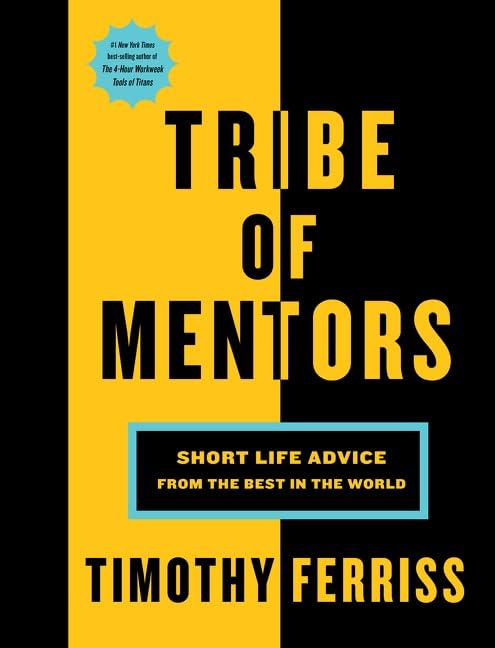

In one sentence
Better questions produce better decisions. Ferriss uses a common questionnaire to create a “distributed mentor” whose value lies in comparing many perspectives, extracting recurring principles, and testing the advice that fits one’s circumstances—not in finding one universal formula.
Overview
The book grew from Ferriss’s attempt in 2017 to seek guidance from people he admired. Its central device is a standardized set of 11 questions, many adapted from rapid-fire questions on his podcast. Contributors discuss influential books, habits or beliefs that improved their lives, costly mistakes, handling overwhelm, worthwhile investments, career advice, and what they would put on a billboard for millions to see.
Core ideas
Question design is a force multiplier
Vague goals invite vague reflection. Ferriss’s method is to turn uncertainty into specific prompts—for example, asking what changed someone’s life recently, what advice they would reject, or what they would do with limited resources. The questioning process is itself the transferable tool.
Use many mentors instead of searching for one perfect mentor
The contributors form a deliberately eclectic panel: elite performers, creators, business figures, investors, and public intellectuals. Comparing their answers exposes patterns that recur across fields while also showing where advice depends on personality, profession, or context.
Small practices often beat grand resolutions
Across the answers, practical routines, environmental changes, reading choices, deliberate discomfort, and systems for saying no tend to be more actionable than abstract exhortations. The useful unit is usually a behavior that can be tested, not an identity claim.
Books are a portable form of mentorship
Book recommendations receive unusual emphasis because contributors have sampled far more material than most readers. A strong reading list can provide models, vocabulary, and second-order perspectives without requiring direct access to the contributor.
Contradiction is information
Different contributors recommend opposing approaches to risk, discipline, productivity, social commitments, and work-life structure. Rather than resolving every disagreement, the collection encourages asking: for whom, under what conditions, and toward which goal does this advice work?
Advice should be converted into experiments
The book is most useful as a menu, not a prescription. Select one recommendation, define the desired outcome, set a short trial period, and keep what improves results. This guards against collecting inspiring ideas without changing behavior.
Practical takeaways
- Create your own recurring mentor questionnaire: influential books, recent behavior change, repeated mistake, current bottleneck, worthwhile investment, advice to ignore, and next experiment.
- When stuck, rewrite the problem as a precise question with a time horizon, constraint, and observable outcome.
- Build a personal reading queue from several contributors, but read enough to test whether a recommendation fits your actual problem.
- Separate principles from tactics: “protect attention” may generalize, while a particular morning routine may not.
- Use disagreement diagnostically. If two strong people disagree, identify the hidden variables—goals, resources, temperament, stage of career, or risk tolerance.
- Keep a decision journal: record the advice used, what you expected, what happened, and whether the advice should be retained.
Caveats and counterpoints
- This is an anthology rather than a sustained argument; the quality, depth, and relevance of responses vary, and the book does not establish that a contributor’s success was caused by the advice offered.
- The sample is highly selective: Ferriss chose people he considered worthy of asking, so the collection overrepresents visible, successful, articulate figures and underrepresents ordinary constraints, failure without recovery, and structural explanations.
- Short answers can make complex practices appear easy to transfer. Advice from an elite athlete, founder, artist, or investor may fail when applied outside its original environment.
- The book’s large volume encourages browsing and collecting. Its main failure mode is turning mentorship into consumption—highlighting ideas without running experiments or making decisions.
- The contributors sometimes contradict one another. That is a useful feature for comparison, but readers seeking a single productivity system may find the book diffuse.
Questions worth revisiting
- Which recurring recommendation appears across people whose fields and personalities differ?
- Which advice am I attracted to because it sounds impressive rather than because it addresses my bottleneck?
- What constraint or assumption made a contributor’s advice work for them?
- What is one recommendation I can test for seven days with a measurable outcome?
- Which question from the book should become part of my monthly review?
- What advice would I give if I had to make the problem simpler rather than more ambitious?
Return to this when…
Return when you need a fresh perspective on a specific decision, habit, reading list, or period of uncertainty. Do not read it straight through expecting a coherent program; use the question index or a current problem to sample several contributors, compare their answers, and choose one experiment.
Highlights
In the last five years, what have you become better at saying no to? What new realizations and/or approaches helped? I got a chance a couple of years ago to visit a security firm, one of those places that guard celebrities and protect their privacy—in other words, a business whose total job was to say no. The person who was giving me the tour told me that the business screens every incoming letter, solicitation, email, etc., and decides which ones get through to the client. “How many get through?” I asked. “Virtually none,” my friend said. I decided that I would look at incoming mail the same way that firm does. If I were the security professional tasked with protecting me from bogus, sociopathic, and clueless asks, which ones would I screen and dump into the trash? That has helped a lot.
My biggest shift came after listening to a successful CEO talk about his philosophy for hiring people. When his company grew and he ran out of time to interview people himself, he had his employees rate new candidates on a 1–10 scale. The only stipulation was they couldn’t choose 7. It immediately dawned on me how many invitations I was receiving that I would rate as a 7—speeches, weddings, coffees, even dates. If I thought something was a 7, there was a good chance I felt obligated to do it. But if I have to decide between a 6 or an 8, it’s a lot easier to quickly determine whether or not I should even consider it.
“People think focus means saying yes to the thing you’ve got to focus on. But that’s not what it means at all. It means saying no to the hundred other good ideas that there are. You have to pick carefully. I’m actually as proud of the things we haven’t done as the things I have done. Innovation is saying no to 1,000 things.” –STEVE JOBS Co-founder and former CEO of Apple
“Anyone who lives within their means suffers from a lack of imagination.” –OSCAR WILDE Irish writer, author of The Picture of Dorian Gray
I realized that I had to let people leave my life, never to return. Every relationship I have in my life, from family and friends to business partners, must be a voluntary relationship. My wife can leave at any time. Family members can call me or not. Business partners can decide to move on, and it’s all okay. But the same is true on my end. If I say I’m ready to move on and someone doesn’t accept that, now we have a problem. I remember trying to move on from a very close friend because he was displaying behaviors I wasn’t comfortable with. Soon after, I received a letter by certified mail, threatening me with a lawsuit for over a million dollars because of the demise of our “friendship.” It was ridiculous and it still is, so I actually framed the letter as a reminder of the necessity of letting people go and moving on.
I do not believe in work-life balance. I believe that if you view your work as a calling, it is a labor of love rather than laborious. When your work is a calling, you are not approaching the amount of hours you are working with a sense of dread or counting the minutes until the weekend. Your calling can become a life-affirming engagement that can provide its own balance and spiritual nourishment. Ironically, it takes hard work to achieve this. When you are in your 20s and 30s and want to have a remarkable, fulfilling career, you must work hard. If you don’t work harder than everyone else, you will not get ahead. Further, if you are looking for work-life balance in your 20s or 30s, you are likely in the wrong career. If you are doing something you love, you don’t want work-life balance.
Working as a writer on your own hours, it’s tempting to get into the romantic notion that you don’t play by society’s rules—you work from home in your underwear, you do your most inspired writing at 3 A.M., you never set an alarm, etc. I’ve always prided myself on doing things unconventionally, and I’m very physically lazy, so I was definitely a believer in the unconventional work schedule/environment. The only problem is that it doesn’t actually work well for me at all. I’d get stuff done when I had a deadline, but when I didn’t, I’d be horribly unproductive. I also found myself in a permanent state of kind of working. I was rarely in a long period of full work focus, and I was rarely just carefree off work. I realized at some point recently that there’s something to the “go to an office from nine to five” thing. I stopped writing from home and started putting clothes on and writing from a coffee shop. I started going to bed at a normal human hour and setting an alarm. And I’d try to compartmentalize, being dead serious about work until the late afternoon or early evening and then stopping entirely until the next day.
The people who matter most are always in competition for your time with both your work and with other people, and the Deathbed Test can be a good reminder that the only way to dedicate the proper amount of time to your key people is by saying no to a lot of other stuff and a lot of other people. The point of both the Epitaph Test and the Deathbed Test is that by the time you’re on your deathbed and your epitaph is being drafted, it’s too late to change anything—so we want to do whatever we can to access that magical end-of-life clarity before the end of life actually happens. Of course, actually saying no to your “no” list is a struggle of its own, and I’m still working on that—but having good mechanisms for defining what’s important has helped a lot.
I used to resent obstacles along the path, thinking, “If only that hadn’t happened life would be so good.” Then I suddenly realized, life is the obstacles. There is no underlying path. Our role here is to get better at navigating those obstacles. I strive to find calm, measured responses and to see hindrances as a chance to problem-solve. Often I fall back into old frustrations, but if I remind myself, this is a chance to step up, I can reframe conflicts as a chance to experiment with solutions.
“It’s not how well you play the game, it’s deciding what game you want to play.”—Kwame Appiah. This quote separates striving from strategy and reminds me to take a macro view of what I’m doing, like in a video game where you can zoom out and you suddenly see you’ve been running around in one corner of the maze. It loosens someone’s relationship to the game, too, helping to separate having ambition from being ambitious, or accessing hustle without becoming a hustler. Second, the Buddhist novelist George Saunders said in an interview that he has an image of people’s “nectar in decaying containers.” That image haunts me. When I think of it on a given morning, it allows me to see the Buddha nature flowing through all these lovely, flawed, living, and slowly dying creatures we encounter every day. My three-year-old daughter’s three-year-old self is so temporary. Buddhists observe that we’re all on fire. It’s so beautiful to sometimes tune in and see the flickering. What is the book (or books) you’ve given most as a gift, and why? Or what are one to three books that have greatly influenced your life? Sam Barondes’ book Making Sense of People has had a big impact on my thinking, and I sometimes give a copy to people in the midst of hiring someone
When you feel overwhelmed or unfocused, what do you do? What questions do you ask yourself? I ask myself “what would be the worst thing” about that outcome not going the way I want? I had started using it out loud with my kids, and recently my eight-year-old daughter started asking it back to me. I really like to be punctual. We were late to drop her at school and I was impatient, so she asked me, “Dad, what exactly would be the worst thing about being late?” It completely shifted my mindset in the moment. I like the question because it often surfaces a hidden assumption.
Life will go faster than you know. It will be tempting to live a life that impresses others. But this is the wrong path. The right path is to know that life is short, every day is a gift, and you have certain gifts. Happiness is about understanding that the gift of life should be honored every day by offering your gifts to the world. Don’t let yourself define what matters by the dogma of other people’s thoughts. And even more important, don’t let the thoughts of self-doubt and chattering self-criticism in your own mind slow you down. You will likely be your own worst critic. Be kind to yourself in your own mind. Let your mind show you the same kindness that you aspire to show others.
When you feel overwhelmed or unfocused, what do you do? What questions do you ask yourself? I step back . . . and slow down . . . and ask the five whys. And when I am done, I also ask if I am afraid of something but too afraid to admit it. We are drawn to the simplicity of jumping to conclusions. We are all ignorant in some way all of the time. So, I have come to learn that what we need are methods to counteract our ignorance. The five whys is a good way of slowing down and improving decision quality. The most important thing is that it lets me get into a mental space about “what” is going right or wrong rather than “who” is right or wrong. Let’s take an example: Say we miss the sales target for a quarter. It can often become tempting to figure out “whose” fault it was: Did Sales fail to execute? Do we have a marketing problem? Is the product not differentiated enough? If you are not very, very careful, you can contribute to an environment where people will point fingers at each other and lose their ability to truly learn from the problem. So, instead, I find it helpful to slow down. If I am by myself, I write the five whys on paper. If I am in a group, I write the questions down one at a time on a whiteboard: Q: Why did we miss our $1M sales target this quarter? A: We made fewer sales calls than planned. Q: Why did we make fewer sales calls than planned? A: We had fewer leads to work this month. Q: Why did we have fewer leads this month? A: We sent fewer email outreaches than planned. Q: Why did we send fewer outreach emails than planned? A: We were short-staffed. Q: Why were we short-staffed? A: We didn’t plan around the fact that two people were on vacation. In this example, it would be very tempting to answer at the “surface” level and try to figure out if it’s a “sales problem” or a “marketing problem” or a “product problem.” But before that happens, I find it is better to be focused on honoring the discovery of the truth rather than determining who is to blame. Going very slow in this exercise is helpful, because it can cause people to turn off their “lizard brains” and fight-or-flight instincts and shift their thinking to their rational brains and
“If you are distressed by anything external, the pain is not due to the thing itself, but to your estimate of it; and this you have the power to revoke at any moment.”
Advice I’d give: Make sure you have something every day you’re looking forward to. Maybe it’s your job, maybe it’s a basketball game after work or a voice lesson or your writing group, maybe it’s a date. But have something every day that lights you up. It’ll keep your soul hungry to create more of these moments. Advice to ignore: A little part of me dies every time someone tells me they’ve taken a job as a “steppingstone” to something else, when they clearly aren’t invested in it. You have one life to live. Time is valuable. If you’re using steppingstones, you’re also likely relying on someone else’s path or definition of success. Make your own. What are bad recommendations you hear in your profession or area of expertise? Too often, aspiring artists put pressure on themselves to make their creative work their only source of income. In my experience, it’s a road to misery. If art is your sole source of income, then there’s unrelenting pressure on that art, and mercenary pressure is the enemy of the creative elves inside you trying to get the work done. Having another stream of income drains the pressure on your creative engine. If nothing comes of your art, you still have an ironclad plan to support yourself. As a result, your creative soul feels lighter and free to do its best work. I’m a personal practitioner of this: Even after three books and a hefty movie deal, I still tutor kids and help them with their college applications. My friends can’t understand it, but it’s the only way I know how to write without feeling like it’s a matter of life and death. In the last five years, what have you become better at saying no to? I’m convinced that the reason Hollywood movies are often so terrible is because everyone is working on a thousand projects at once. No one is giving anything their full focus. Working on The School for Good and Evil has taught me to be patient. When I’m writing the book, that’s all I’m working on and I say no to everything else, no matter how lucrative. Do I miss opportunities? Sure. But it means that when the books hit shelves, I know that I’ve left everything on the page and that they’re the absolute best I could have done, which gives them the greatest chance to survive through time. And, inevitably, because I’m committing to maximum quality, better opportunities arise to replace the ones I’ve passed up. When you feel overwhelmed or unfocused, what do you do? Feeling overwhelmed usually means one of two things: either my blood’s trapped in my head and I need to go exercise, or, more likely, I’ve overcommitted myself and my brain knows there’s no way I can reasonably get done everything I’ve set out to do. Usually the solution is to take a deep breath, look at the calendar, and start canceling things or moving deadlines until the paralysis evaporates. Feeling unfocused, on the other hand, usually means I haven’t
When you feel overwhelmed or unfocused, what do you do? Feeling overwhelmed usually means one of two things: either my blood’s trapped in my head and I need to go exercise, or, more likely, I’ve overcommitted myself and my brain knows there’s no way I can reasonably get done everything I’ve set out to do. Usually the solution is to take a deep breath, look at the calendar, and start canceling things or moving deadlines until the paralysis evaporates. Feeling unfocused, on the other hand, usually means I haven’t quite locked into whatever I’m working on yet—that a part of me still thinks I can pull the ripcord and bail. It usually happens in the first three months of writing a new book. In the end, a lack of focus is usually just fear: fear that whatever project I’m attempting will go nowhere or fail miserably. Early on, I used to give in to that fear. Four books later, I know it’s just a ghost, and I can blow right through it without looking back.
the last five years, what have you become better at saying no to? The first no is by far the easiest and cleanest. Declining a request is uncomfortable, so it’s tempting to equivocate, say you’ll hear someone out before deciding, or agree to a smaller version of the request, even when you’re confident that you would rather not engage at all. As soon as you open that door, however, you’ve almost always ensured at least one more request that you’ll have to accept or decline in the future and thus haven’t saved yourself the discomfort at all. Worse still, you’ve crossed a psychological boundary by establishing yourself to the asker as someone who is interested in the type of request being made. Research shows we’re remarkably committed to maintaining a consistent sense of external identity, even if we only established it to begin with out of politeness. The asker will see this as an opportunity to press harder, or ask you about similar requests that come up in the future, and you’ll have even more discomfort declining those requests versus if you had simply declined the first one. They may even start handing out your contact information to other people in their network, multiplying the problem.
In the last five years, what have you become better at saying no to? I have become better at saying no to things and people (including friends and family) that drain my energy. This isn’t easy, especially if you are a people-pleaser. When I am straightforward and sincere about my needs, I find that no one is offended when I say no. Those who are offended perhaps don’t value my needs.
“Grudges are for those who insist that they are owed something; forgiveness, however, is for those who are substantial enough to move on.”
“Learning to ignore things is one of the great paths to inner peace.”
“Look for a partner you’ll try to impress daily, and one who will try to impress you.” Over the last couple decades, I’ve noticed that the best, most enduring partnerships in business (and in life) are among people who are constantly growing together.
I have several
“Whenever there is any doubt, there is no doubt.” The line is from the inimitable David Mamet, a quote from Ronin, one of my all-time favorite movies. A laconic reminder to always be decisive in battle and in business, and at a most basic level, to trust your gut. In my line of work, this often enough translates to “fire early,” too. When you aren’t sure about a key employee or a co-founder, odds are exceedingly low your mind will be changed for the better.
What’s helped with saying no to others is asking myself first if I’m saying yes out of guilt or fear. If so, then it’s a polite no.
“If you must play, decide on three things at the start: the rules of the game, the stakes, and the quitting time.” –CHINESE PROVERB
“There is nothing that the busy man is less busy with than living; there is nothing harder to learn.” –SENECA
Persistence matters more than talent. The student with straight As is irrelevant if the student sitting next to him with Bs has more passion.
When you feel overwhelmed or unfocused, what do you do? Whenever I’m feeling like I need to prioritize what I’m doing or overthinking a particular situation that is making me anxious, I try to remember this great exchange in the film Bridge of Spies. Tom Hanks, who plays a lawyer, asks his client, who is being accused of being a spy, “Aren’t you worried?” His answer: “Would it help?” I always think, “Would it help?” That is the pivotal question that I ask myself every day. If you put everything through that prism, it is a remarkably effective way to cut through the clutter.
One distraction I’ve learned to avoid is consuming media that’s just telling me things I already know and agree with (for example, about politics). That stuff can be addictive because it feels so validating—it’s like venting with a friend—but you’re not learning from it, and over time, I think indulging that impulse makes you less able to tolerate other perspectives. So I broke my addiction by, essentially, reminding myself how much time I was wasting not learning anything.
First, seek out dissenting opinions. Always try to find people who disagree with you, who can honestly and productively play devil’s advocate. Challenge yourself to truly listen to people who have differing ideas and opinions than you do. Stay out of political bubbles and echo chambers as much as possible. Feel good about really hearing those who disagree with you. Try to change your mind about one thing every day. The fact is that when two extreme opinions meet, the truth lies generally somewhere in the middle. Without exposure to the other side, you will naturally drift toward the extremes and away from the truth of the matter. Don’t be afraid of being wrong. Because being wrong is just an opportunity to find more of the truth. Second, stay flexible and be open to opportunities as they come your way. Most of the successful people I know did not know exactly what they wanted to do coming right out of college, and they changed their focus over the course of their careers. Be open to what the world brings your way. Don’t be afraid to change jobs or careers, no matter how much time you have already put into something. There is no urgency to have it all figured out. And feeling like you have it all figured out can make you stuck and close-minded to change.
Poker has taught me to disconnect failure from outcomes. Just because I lose doesn’t mean I failed, and just because I won doesn’t mean I succeeded—not when you define success and failure around making good decisions that will win in the long run. What matters is the decisions I made along the way, and every decision failure is an opportunity to learn and adjust my strategy going forward. By doing this, losing becomes a less emotional experience and more an opportunity to explore and learn.
“The first rule of any technology used in a business is that automation applied to an efficient operation will magnify the efficiency. The second is that automation applied to an inefficient operation will magnify the inefficiency.” –BILL GATES
What is an unusual habit or an absurd thing that you love? In the old television show Candid Camera—reprised by Ashton Kutcher’s Punk’d in more recent times—unsuspecting people were videotaped coping in real time with an insane prearranged situation, usually to great ensuing hilarity. I get endless delight covertly “ambushing” unsuspecting strangers with random acts of kindness. So, for example, after ordering my iced latte, I’ll give a Starbucks barista a $20 bill and tell him to comp the person after the person behind me for whatever he or she wants, and to give that person the change as well. I don’t do the person behind me, who might suspect that I was the mystery benefactor. Then I sip my latte from afar and watch the confusion give way to smiles when the random beneficiary realizes the unexpected bounty. Sometimes the person leaves all the change as a tip. Sometimes he or she will pay it forward and “gift” the next person a free coffee. But the beneficiary always leaves smiling broadly, and I know that I’ve unleashed a positive ripple effect into that person’s community and to anyone he or she encounters that day. Spreading magic!
In the last five years, what have you become better at saying no to? I say no to just about everything public. I say no to more than 99 percent of professional opportunities that people approach me with. A core operating principle is that there is no better investment than in my own learning process, and so I only engage in partnerships that will challenge and improve me. I am exponentially better when I am all in than when I am 99 percent in, so I only engage with what inspires me to be all in. And I only team with people I have love for, or who I believe I could have love for.
I change my physiology. If I am near waves, I go surf them. If not, a short, intense kettlebell workout, a bike ride, a swim, a cold shower or ice plunge, Wim Hof or heart rate variability breathing [see Adam Robinson, for a description]. It’s remarkable how the mind follows the body. Honestly, I think a lack of understanding or desire to understand that simple evolutionary reality is what inhibits so many people from rapidly improving their lives.
“I notice increasing reluctance on the part of marketing executives to use judgment. They are coming to rely too much on research, and they use it as a drunkard uses a lamp post: for support, rather than for illumination.”—David Ogilvy
Pay close attention to what you’re spending your time on. Time and attention are very different things. They’re your most precious resources moving forward. Just like you walk through the air and you swim through the water, you work through your attention. It’s the medium of work. While people often say there’s not enough time, remember that you’ll always have less attention than time. Full attention is where you do your best work, and everyone’s going to be looking to rip it from you. Protect and preserve it.
“Raise capital to launch a software/services business.” No, bootstrap. As in life, we form business habits early on. If you raise money, you’ll get good at spending money. If you bootstrap, you’ll be forced to get good at making money. If there’s one habit/skill an entrepreneur should practice, it’s making money. So force yourself into it.
If the ask is more than a week away, I almost always say no, regardless of what is it. Exceptions include family things I need to attend, and a conference or two I really want to speak at, but other than that, if the “yes” would tie me to something further than a week or so out, it’s almost always a no.
I keep it simple and direct. Unless there are special circumstances, I always explain why and say something like, “Thanks for the invitation, but I just can’t commit to anything more than a day or so in advance. I need to keep my schedule open for me and the people I work with on a regular basis. Best bet is to hit me up a day or two before you wanted to get together. If I’m available we can set up a time.”
This is loosely modeled on Warren Buffet’s purported “can I get a meeting with Warren” policy, as I wrote about on Signal v. Noise. I’ve simply realized that the further out the yes, the more I regret the moment when it comes due. Because there’s no cost now, it’s simply too easy to say yes about something deep in the future. Further, a future “yes” ultimately means that the past controls your schedule. By the time you get around to later, your calendar is already filled with prior engagements. That limits what’s possible in the moment. Few things bother me more than wanting to actually say yes to something today but being blocked by a previous yes I said weeks or months ago.
“All courses of action are risky, so prudence is not in avoiding danger (it’s impossible), but calculating risk and acting decisively. Make mistakes of ambition and not mistakes of sloth. Develop the strength to do bold things, not the strength to suffer.” –NICCOLÒ MACHIAVELLI