
In one sentence
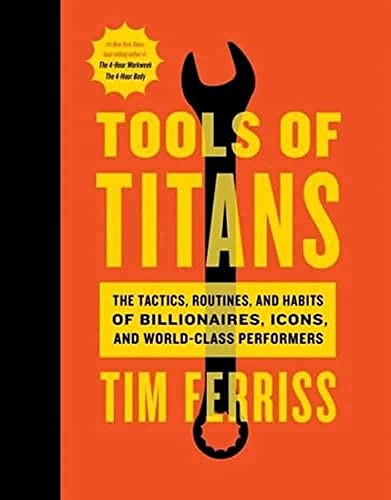
Ferriss’s central proposition is methodological rather than theoretical: study people who perform unusually well, extract specific behaviors and mental models, and test the most promising ones yourself. The book does not claim that one universal routine produces success; it presents a large, sometimes contradictory menu of experiments.
Overview
Tools of Titans distills material from The Tim Ferriss Show, whose guests include entrepreneurs, investors, athletes, artists, scientists, military leaders, and other high performers. Its three sections—Healthy, Wealthy, and Wise—cover physical practices, business and decision-making, and learning, creativity, philosophy, and resilience. Ferriss explicitly frames the book as something to browse, annotate, and return to rather than read linearly.
Core ideas
Treat advice as an experiment
The useful unit is not admiration for a successful person but a testable intervention: change one behavior, define what improvement would look like, and observe the result. Ferriss repeatedly favors questions, protocols, and small experiments over abstract inspiration.
Extract principles from outliers—but do not copy blindly
The guests are valuable because they have often developed unusual solutions under demanding conditions. Their tactics may reveal possibilities, but context matters: a billionaire’s calendar, an athlete’s diet, or a founder’s risk tolerance may not transfer directly to ordinary circumstances.
Small routines can stabilize attention and energy
Across the interviews, recurring practices include deliberate morning routines, exercise, meditation or reflection, controlled information intake, journaling, and protecting focused work. The broader lesson is to design defaults that reduce repeated decision-making.
Use fear and reversibility to improve decisions
Ferriss highlights tools such as defining the worst realistic outcome, identifying ways to prevent or repair it, and distinguishing reversible from irreversible choices. This reframes many decisions from emotionally overwhelming commitments into bounded experiments.
Ask better questions
High-leverage questions recur throughout the book: What are you unusually good at? What advice would you give your younger self? What failure taught you most? Which purchase or habit has most improved your life? Questions expose assumptions and produce reusable patterns across domains.
Wealth is partly a design problem
The Wealthy section emphasizes leverage, selective commitments, automation, delegation, distribution, and building systems that reduce dependence on constant personal effort. Money is treated not only as an accumulation goal but as a means of buying autonomy and attention.
Meaning and performance are not identical
The Wise section broadens the frame beyond productivity. Learning, creativity, relationships, philosophy, and confronting mortality help determine what success is for. The book’s strongest implication is that optimization without a chosen direction can merely make a person more efficient at the wrong life.
Practical takeaways
- Use the book as a reference: begin with a current problem, then search for a tactic rather than reading every entry in order.
- Choose one experiment at a time. Write down the expected benefit, cost, duration, and stop condition before adopting it.
- Build a personal “minimum effective dose” routine: a few practices that reliably improve sleep, energy, focus, or mood.
- For a difficult decision, write the worst plausible outcome, prevention steps, recovery steps, and the cost of inaction.
- Separate principles from celebrity packaging. Ask what mechanism might explain a guest’s tactic and whether that mechanism applies to your situation.
- Maintain a personal index of useful questions, books, people, protocols, and failed experiments so the material becomes cumulative rather than inspirational only.
- Prefer reversible trials: pilot a schedule, subscription, delegation arrangement, or workflow before making it permanent.
- Define “wealthy” and “wise” independently of status—e.g., control of time, meaningful work, health, relationships, and intellectual growth.
Caveats and counterpoints
- The book is an edited anthology, not a controlled study or unified theory. Advice is often anecdotal and may reflect Ferriss’s selection and framing of interview material.
- Survivorship bias is substantial: the guests are unusually successful, so their habits may be consequences of success, irrelevant to it, or effective only with resources and opportunities unavailable to most readers.
- The interviews produce unresolved contradictions—different guests advocate opposite routines, diets, work patterns, or philosophies. Ferriss generally preserves the tension rather than settling it empirically.
- Some health, supplement, performance, and psychedelic-related suggestions require expert evaluation and may carry meaningful risks; the book should not substitute for medical or psychological guidance.
- The title and framing can overemphasize billionaires and exceptional performers, even though many useful ideas concern ordinary practices such as reflection, prioritization, and deliberate practice.
- The density is both strength and weakness: without a selection process, readers may collect tactics without changing behavior or may mistake novelty for effectiveness.
Questions worth revisiting
- Which current problem would make the book most useful as a targeted reference?
- What is one reversible experiment I can run for two weeks?
- Which admired person’s advice depends on circumstances I do not share?
- What is my personal definition of Healthy, Wealthy, and Wise?
- Which routine improves my results enough to justify its time and complexity?
- Where am I optimizing for status, busyness, or novelty instead of a clearly chosen outcome?
- What evidence would make me stop using a tactic that initially feels promising?
Return to this when…
Return when you need a menu of experiments, a decision-making prompt, a routine reset, or a new angle on health, work, learning, and meaning. It is especially useful to revisit selectively after identifying a concrete problem; it is less useful as a cover-to-cover source of one coherent productivity system.