
In one sentence
A better life is built less by discovering perfect answers than by acting honestly, tolerating uncertainty and loss, accepting responsibility, and repeatedly choosing meaningful behavior. Livingston’s “truths” are practical heuristics, not universal laws: their value lies in interrupting familiar habits of avoidance, resentment, fear, and wishful thinking.
Overview
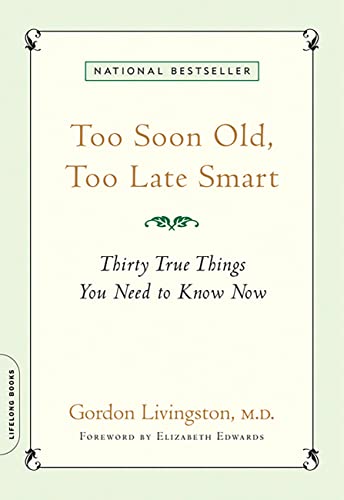
The book consists of thirty short, loosely connected reflections rooted in Livingston’s work as a psychiatrist and in his experiences as a physician, soldier, parent, and bereaved father. Its recurring subjects are relationships, happiness, illness, grief, aging, courage, self-knowledge, and change. Representative principles include “we are what we do,” the idea that relationships are governed by the less-invested person, the warning that perfection blocks progress, and the claim that harmful events often unfold faster than beneficial change.
Core ideas
Behavior reveals character
Identity is not merely intention or self-description; it is repeatedly enacted. If you want to become more reliable, loving, brave, or disciplined, practice the corresponding behavior instead of waiting to feel transformed.
Relationships require mutual investment
When one person cares substantially less, that person has disproportionate leverage. The implication is not to manipulate harder, but to recognize asymmetry early and stop confusing persistence with reciprocity.
Good enough is often wiser than perfect
Perfectionism delays decisions, raises the cost of action, and turns ordinary imperfection into evidence of failure. Progress usually comes from choosing a workable option and revising it.
Patience is part of reality-testing
Constructive change, trust, recovery, and grief generally take time. Expecting immediate improvement encourages impulsive decisions and makes temporary discomfort look like proof that nothing can change.
Loss must be faced, not rhetorically conquered
Livingston treats grief and misfortune as unavoidable features of life, not puzzles that optimism can solve. Adaptation means carrying the loss while recovering the capacity to love, act, and anticipate.
Self-deception offers short-term comfort at long-term cost
Lying to oneself—about a relationship, motive, illness, responsibility, or limitation—preserves an unstable situation. Honest appraisal may hurt immediately but gives action a firmer basis.
Fear frequently misidentifies the danger
People may fear embarrassment, rejection, uncertainty, or happiness more intensely than the consequences of stagnation. Courage is therefore selective risk-taking, not the absence of fear.
Happiness depends on engagement
The book links well-being to having meaningful activity, loving connection, and something to anticipate. Happiness is presented less as a mood to obtain than as a by-product of participation and commitment.
Practical takeaways
- Ask: “What am I doing repeatedly?” Treat the answer as stronger evidence of your priorities than your intentions.
- In an important relationship, assess reciprocity directly: who initiates, repairs, sacrifices, and plans?
- Replace an impossible standard with a concrete next step that is good enough to test.
- When distressed, distinguish an irreversible loss from a painful but changeable circumstance.
- Name the fact you are avoiding, the emotion it produces, and the action that honest acknowledgment permits.
- Do not make permanent decisions solely to end temporary uncertainty or discomfort.
- Take one bounded risk that serves a value—speaking plainly, asking for help, beginning, leaving, or reconnecting.
- Build a week containing all three: purposeful work, contact with someone you love, and a future event worth anticipating.
Caveats and counterpoints
- The book’s aphoristic format can make complex psychological and relational problems sound more generalizable than they are. Its principles work best as prompts for reflection, not as diagnostic rules.
- Some claims are deliberately blunt. For example, emphasizing responsibility or the interpersonal costs of self-destructive behavior may provoke action in some readers but may feel shaming or clinically inadequate for people facing severe depression, trauma, addiction, or suicidal risk.
- The advice is grounded in an older clinician’s perspective and includes Vietnam-era and autobiographical framing; readers may find parts dated or culturally narrow.
- A serious review praised the book’s warmth and hard-earned wisdom, while reader criticism has focused on preachiness, loose connections between chapter titles and essays, and reliance on platitude-like formulations. The book’s usefulness therefore depends heavily on whether its compressed style feels clarifying or oversimplifying.
- Bibliographic records describe substantially different lengths across editions—roughly 160–192 pages for the original/smaller editions and 304 pages for the later Hachette edition, which includes a foreword—so pagination and supplementary material should not be assumed.
Questions worth revisiting
- Which repeated behavior most clearly contradicts the person I say I want to be?
- Where am I mistaking persistence for mutual commitment?
- What would “good enough for now” look like in a decision I keep postponing?
- What loss or limitation am I trying to defeat instead of learning to live alongside?
- Which fear is protecting me from embarrassment but costing me a larger opportunity?
- What truth would change my next action if I admitted it without self-punishment?
- What activity, relationship, and future possibility currently give my life structure?
Return to this when…
Return to these notes during relational uncertainty, grief, major transitions, or periods of avoidance. The most useful reread is not for inspiration but for choosing one honest, finite action—especially when waiting for certainty has become the main obstacle.
Highlights
our age. The frantic attempts to overcome this ennui
The three components of happiness are something to do, someone to love, and something to look forward to. Think about it. If we have useful work, sustaining relationships, and the promise of pleasure, it is hard to be unhappy.
A currently more common example of a diagnostic fad is adult Attention Deficit Disorder (ADD). Disorganized, daydreaming procrastinators now have a medical explanation for their inattention AND an effective treatment: stimulant drugs. People uniformly report that their spirits are better and that they get more done when taking an amphetamine. To which I can only reply, “Me, too.”
The problem with perfectionists and their preoccupation with control is that the qualities that make them effective in their work can render them insufferable in their personal lives. I treat a lot of engineers and accountants and computer programmers. To be less controlling in their jobs would render them ineffective. The best one can hope for is to introduce them to the paradox of perfection: in some settings, notably in our intimate relationships, we gain control only by relinquishing it.
People with compulsive character structures are vulnerable to depression, as is anyone who seeks perfection in an imperfect world. It is often puzzling to such people that approaches that make them successful in their work are so poorly received by those they live with. Obsessive people put a strong emphasis on control. Anything that threatens this sense of being in charge induces anxiety. This leads inevitably to efforts to reassert control, in effect redoubling the behaviors that produced the problem in the first place. The resultant conflict produces feelings of frustration and discouragement that further reinforce a sense of failure.
When, in 2002, the Washington, D.C. area endured three weeks of random sniper attacks, there was a virtual panic, with people altering their lives and school systems canceling field trips and keeping children indoors. “If we can save one life the precautions are worth it,” was a common refrain. No one pointed out that the logical extension of this philosophy would be to never leave home again.
References
- Too Soon Old, Too Late Smart by Gordon Livingston | Open Library
- Too Soon Old, Too Late Smart: Thirty True Things You Need to Know Now - Gordon Livingston - Google Books
- Too Soon Old, Too Late Smart by Gordon Livingston, MD & Elizabeth Edwards | Hachette Book Group
- openlibrary.org
- goodreads.com
- openlibrary.org
- books.apple.com
- books.google.com
- Too Soon Old, Too Late Smart: Thirty True Things You Need to Know Now by Gordon Livingston
- Too Soon Old, Too Late Smart: Thirty True Things You Need to Know Now by Gordon Livingston MD | Goodreads
- play.google.com
- openlibrary.org