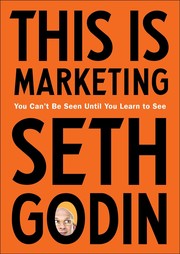

In one sentence
Marketing is not primarily advertising, persuasion, or attention capture. It is the coordinated work of seeing people clearly, serving a specific audience, earning trust, and making change possible. The strongest marketing begins with empathy and positioning, then compounds through permission, identity, connection, and consistency.
Overview
Published in 2018, This Is Marketing consolidates themes from Godin’s earlier work—permission, tribes, remarkable products, stories, and status—into a broad philosophy of ethical, audience-centered marketing. Its central move is from “How do we reach everyone?” to “Who specifically can we serve, and what change do they seek?” The book is brisk and conceptual rather than a detailed campaign manual.
Core ideas
Marketing is about change
A marketer helps people move from their current state to a preferred one. The product matters, but the deeper offer is often a transformation: confidence, belonging, convenience, status, safety, or progress. Marketing should therefore solve someone else’s problem rather than merely extract value for the seller.
Start with the smallest viable audience
Do not design for an abstract mass market. Identify the smallest group with a shared worldview, urgent enough need, and enough connection to support the offer. Specificity makes the product, language, distribution, and story more relevant; growth can follow after genuine fit is established.
Learn to see the audience’s worldview
People interpret products through existing beliefs about identity, status, affiliation, and what people like them do. Effective positioning fits—or thoughtfully challenges—those beliefs. The task is not to impose a story from outside, but to understand the story customers already tell themselves.
Trust and permission compound
Attention obtained through interruption or spam is weak and easily lost. Trust grows when a marketer makes and keeps promises, shows up consistently, and earns permission to remain in the customer’s world. This makes marketing a long-term relationship and operational discipline, not just a communications function.
Tension drives decisions
People act when there is a meaningful gap between what is and what could be. Marketing can make that tension visible, but it should connect to a real desired change rather than manufacture fear or confusion. A clear promise, credible proof, and an accessible next step help resolve the tension.
Identity and belonging are powerful levers
Purchases often signal membership, taste, aspiration, or status. Products spread when they help people express who they are—or who they hope to become—and when the audience can see itself as a community. This is why “for whom” and “not for whom” are strategic decisions.
Emotional labor is part of the job
Good marketing requires doing the patient, human work that may not produce an immediate payoff: listening, responding, keeping promises, handling disappointment, and maintaining connection. Emotional labor is not decorative; it is part of delivering the value the brand claims to offer.
Ethical marketing is selective, not universal
Godin treats exclusion as necessary: an offering cannot be deeply meaningful to everyone. Choosing a specific audience is not automatically elitist; it becomes problematic when the marketer exploits vulnerability, misrepresents the offer, or treats people merely as targets.
Practical takeaways
- Define the change your offer is meant to create, in the customer’s terms.
- Write a concrete description of your smallest viable audience: shared worldview, current frustration, desired future, and existing alternatives.
- Decide explicitly who the product is not for; use that boundary to sharpen positioning.
- Replace attention metrics with evidence of trust and behavior: repeat use, referrals, permission, retention, and progress toward the customer’s goal.
- Describe the customer’s existing worldview before writing copy or choosing channels.
- Make one promise you can reliably keep, then design the product and customer experience around fulfilling it.
- Use tension to clarify a real problem and desired outcome—not to create unnecessary anxiety.
- Treat every interaction as evidence of the brand’s character; consistency is part of the marketing.
Caveats and counterpoints
- The book is more philosophical than operational. It offers mental models and prompts, but relatively little on budgeting, attribution, experimentation, channel mechanics, sales compensation, or managing large-scale performance marketing.
- Its ethical framing is persuasive but partly normative: the claim that marketing can make the world better depends on the quality of the product, the truthfulness of the promise, and the marketer’s power relative to the audience.
- A smallest-viable-audience strategy may be difficult for businesses with fixed costs, regulatory obligations, network effects, or investor expectations for rapid scale. Narrow positioning can also become too narrow if the audience’s willingness to pay is assumed rather than tested.
- Stories, identity, and status explain some decisions but can overshadow functional quality, price, distribution, habit, and competitive dynamics. The framework should complement—not replace—customer research and controlled measurement.
- Some readers find the short, aphoristic chapters repetitive or loosely connected; the book can feel like a compilation of related essays rather than a tightly cumulative argument.
Questions worth revisiting
- What specific change does my product help someone make?
- Who is the smallest audience for whom this change would be both important and credible?
- What worldview, identity, or social signal shapes that audience’s decision?
- What permission have I actually earned—and what would make people withdraw it?
- Which part of the customer experience proves or disproves my promise?
- Am I creating useful tension around a real gap, or manipulating anxiety?
- What evidence would show that I am building trust rather than merely generating attention?
- Where might Godin’s audience-first advice conflict with my need for scale, profitability, accessibility, or measurable short-term results?
Return to this when…
Return when you are making a product, brand, or campaign feel too broad, too interruptive, or too focused on the seller’s goals. The most useful refreshers are: smallest viable audience, worldview-based positioning, trust as a delivered promise, and marketing as helping people make a meaningful change.
Highlights
The magic of ads is a trap that keeps us from building a useful story For a long time, the most efficient way for a commercial enterprise to make large-scale change was simple: buy ads. Ads worked. Ads were a bargain. Ads paid for themselves. Besides, they were fun to make. You could buy a lot all at once. They made you (or your brand) a little famous. And they were reliable: money spent equaled sales made. Is it any wonder that, pretty quickly, marketers decided that advertising was what they did? For most of my lifetime, marketing was advertising. And then it wasn’t true anymore. Which means you’ll need to become a marketer instead. That means seeing what others see. Building tension. Aligning with tribes. Creating ideas that spread. It means doing the hard work of becoming driven by the market and working with (your part of) that market.
The lock and the key It doesn’t make any sense to make a key and then run around looking for a lock to open. The only productive solution is to find a lock and then fashion a key. It’s easier to make products and services for the customers you seek to serve than it is to find customers for your products and services.
Marketing in five steps The first step is to invent a thing worth making, with a story worth telling, and a contribution worth talking about. The second step is to design and build it in a way that a few people will particularly benefit from and care about. The third step is to tell a story that matches the built-in narrative and dreams of that tiny group of people, the smallest viable market. The fourth step is the one everyone gets excited about: spread the word. The last step is often overlooked: show up—regularly, consistently, and generously, for years and years—to organize and lead and build confidence in the change you seek to make. To earn permission to follow up and to earn enrollment to teach. As marketers, we get to consistently do the work to help the idea spread from person to person, engaging a tribe as you make change happen.
Things marketers know Committed, creative people can change the world (in fact, they’re the only ones who do). You can do it right now, and you can make more change than you can possibly imagine. You cannot change everyone; therefore, asking, “Who’s it for?” can focus your actions and help you deal with the nonbelievers (in your head and in the outside world). Change is best made with intent. “What’s it for?” is the posture of work that matters. Human beings tell themselves stories. Those stories, as far as each of us is concerned, are completely and totally true, and it’s foolish to try to persuade them (or us) otherwise. We can group people into stereotyped groups that often (but not always) tell themselves similar stories, groups that make similar decisions based on their perceived status and other needs. What you say isn’t nearly as important as what others say about you.
I sat in the sun for an hour, thinking hard about this problem. I felt like all my work as a marketer had led me to this moment. So I changed just one thing about the process. One thing that doubled the percentage of glasses sold. Here’s what I did: I took all the glasses off the table. For the rest of the people in line, after they put on the sample glasses, we said, “Here are your new glasses. If they work and you like them, please pay us three dollars. If you don’t want them, please give them back.” That’s it. We changed the story from “Here’s an opportunity to shop, to look good, to regain your sight, to enjoy the process, to feel ownership from beginning to end” to “Do you want us to take away what you have, or do you want to pay to keep the glasses that are already working for you?” Desire for gain versus avoidance of loss.
That riff about the quarter-inch drill bit Harvard marketing professor Theodore Levitt famously said, “People don’t want to buy a quarter-inch drill bit. They want a quarter-inch hole.” The lesson is that the drill bit is merely a feature, a means to an end, but what people truly want is the hole it makes. But that doesn’t go nearly far enough. No one wants a hole. What people want is the shelf that will go on the wall once they drill the hole. Actually, what they want is how they’ll feel once they see how uncluttered everything is, when they put their stuff on the shelf that went on the wall, now that there’s a quarter-inch hole. But wait . . . They also want the satisfaction of knowing they did it themselves. Or perhaps the increase in status they’ll get when their spouse admires the work. Or the peace of mind that comes from knowing that the bedroom isn’t a mess, and that it feels safe and clean. “People don’t want to buy a quarter-inch drill bit. They want to feel safe and respected.”
People don’t want what you make They want what it will do for them. They want the way it will make them feel. And there aren’t that many feelings to choose from.
Shun the nonbelievers! There’s a filter bubble. It’s easy to surround ourselves with nothing but news we agree with. We can spend our days believing that everyone shares our worldview, believes what we believe, and wants what we want. Until we start marketing to the masses. When we seek to serve the largest possible audience, that audience will turn us down. The chorus of “no” will become deafening. And the feedback may be direct, personal, and specific. In the face of so much rejection, it’s easy to sand off the edges and fit in. Fit in all the way. Fit in more than anyone else. Resist. It’s not for them. It’s for the smallest viable audience, the folks you originally set out to serve.
“It’s not for you” We’re not supposed to say that. We’re certainly not supposed to want to say that. But we must. “It’s not for you” shows the ability to respect someone enough that you’re not going to waste their time, pander to them, or insist that they change their beliefs. It shows respect for those you seek to serve, to say to them, “I made this for you. Not for the other folks, but for you.” Two sides of the same coin. It’s the freedom to ignore the critics who don’t get the joke, the privilege of polishing your story for those that most need to hear it. . . . This is where you will find work that you can be proud of. Because it doesn’t matter what people you’re not seeking to serve think. What matters is whether you’ve changed the people who trust you, the people who have connected with you, the people you seek to serve. We know that every best-selling book on Amazon has at least a few one-star reviews. It’s impossible to create work that both matters and pleases everyone.
The simple marketing promise Here’s a template, a three-sentence marketing promise you can run with: My product is for people who believe _________________. I will focus on people who want _________________. I promise that engaging with what I make will help you get _________________. And you thought that all you were here to do was sell soap.
Better isn’t up to you There are more than 250 models of motorcycles available for sale in Cleveland. Can you name them? No one can, not even a motorcycle collector. And the same thing is true for ketchup, for insurance brokers, for churches. So, how do we process this, remember this, choose a product? We remember the best one. Best for what? And that’s the key question. Best for us. If we care about sustainability and price, then our brain has a slot for our favorite brand, and it’s the one that’s the best at sustainability and price. No surprise. But our neighbor, the one who cares far more about status within the group and luxury, has a very different brand in mind. Which is not surprising, because we’re humans, not machines. Your job as a marketer is to find a spot on the map with edges that (some) people want to find. Not a selfish, unique selling proposition, done to maximize your market share, but a generous beacon, a signal flare sent up so that people who are looking for you can easily find you. We’re this, not that.
The marketing of dog food Dog food must be getting better. More nutritious and of course, delicious. Americans spent more than twenty-four billion dollars on dog food last year. The average price has skyrocketed, and so has the gourmet nature of ingredients, like sweet potatoes, elk, and free-range bison. And yet, I’ve never seen a dog buy dog food. Have you? Dog food might be getting more delicious as it gets more expensive, but we actually have no idea. We have no clue whether dogs enjoy it more, because we’re not dogs. But we can be sure that dog owners like it more. Because dog food is for dog owners. It’s for the way it makes them feel, the satisfaction of taking care of an animal that responds with loyalty and affection, the status of buying a luxury good, and the generosity of sharing it. Some dog owners want to spend more on the dog food they buy. Some want gluten-free dog food, loaded with high-value placebos. But let’s not get confused about who all this innovation is for. It’s not for the dogs. It’s for us.
Not everyone will be interested. But if you do your job right, enough people will. This is the lock and the key. You’re not running around grabbing every conceivable lock to try out your key. Instead, you’re finding people (the lock), and since you are curious about their dreams and desires, you will create a key just for them, one they’ll happily trade attention for. A lifeguard doesn’t have to spend much time pitching to the drowning person. When you show up with a life buoy, if the drowning person understands what’s at stake, you don’t have to run ads to get them to hold on to it.
Here are some axes for you to choose from. Because you know your space far better than I do, I’m sure you can come up with some others. Speed Price Performance Ingredients Purity Sustainability Obviousness Maintenance costs Safety Edginess Distribution Network effect Imminence Visibility Trendiness Privacy Professionalism Difficulty Elitism Danger Experimental Limited Incomplete After you pick an attribute with two extremes for the X-axis, find a different attribute and use it for the Y-axis. Plot the options your customer has on this chart. Now you have a map of how the alternatives stack up. A map that a busy human being can use to find the solution to her problem.
Today we take it all for granted. FedEx actually does deliver more than 99 percent of its packages on time. Cars don’t spontaneously break. Makeup doesn’t often cause blindness. Your web browser rarely crashes, the electricity almost never goes out, and air travel has never been safer. And yet we still talk about being very good at our craft as if it’s some sort of bizarre exception. Plenty of people are good at what you do. Very good at it. Perhaps as good at it as you are. Full credit for the work you’ve done and the skill you possess. But it’s not enough. Quality, the quality of meeting specifications, is required but no longer sufficient. If you can’t deliver quality yet, this book isn’t much help to you. If you can, great, congratulations. Now, let’s set that aside for a minute and remember that nearly everyone else can too.
Here’s the list, the foundational list, a shared vocabulary that each of us chooses from when expressing our dreams and fears: Adventure Affection Avoiding new things Belonging Community Control Creativity Delight Freedom of expression Freedom of movement Friendship Good looks Health Learning new things Luxury Nostalgia Obedience Participation Peace of mind Physical activity Power Reassurance Reliability Respect Revenge Romance Safety Security Sex Strength Sympathy Tension You could probably add ten more. But it’s unlikely you could add fifty more. This core basket of dreams and desires means that marketers, like artists, don’t need many colors to paint an original masterpiece. And this is where we begin: with assertions.
tactics. Don’t begin with what you know how to do or some sort of distraction about your mission. Instead, begin with dreams and fears, with emotional states, and with the change your customers seek. Nobody needs your product It doesn’t make sense to say “people need a white leather wallet,” because: People don’t need a wallet. They might want one, but that’s different. People might decide that they want a white leather wallet, but they don’t want it because it’s white or because it’s leather; they want it because of how it will make them feel. That’s what they’re buying: a feeling, not a wallet. Identify that feeling before you spend time making a wallet. Marketers make change. We change people from one emotional state to another. We take people on a journey; we help them become the person they’ve
Always be testing It’s tempting to make a boring product or service for everyone. Boring because boring is beyond criticism. It meets spec. It causes no tension. Everyone, because if everyone is happy then no one is unhappy. The problem is that the marketplace of people who are happy with boring is static. They aren’t looking for better. New and boring don’t easily coexist, and so the people who are happy with boring aren’t looking for you. They’re actively avoiding you, in fact. The ever-faster cycles that require us to always be testing, to resist creating boredom, are driven by the fact that the only people we can serve are curious, dissatisfied, or bored. Everyone else can opt out and refuse to pay attention. The good news is that two extraordinary things have happened, massive shifts in the way everything is sold to everyone: It’s cheaper and faster than ever to create a prototype or a limited run. That’s true for nonprofits, as well as for manufacturers or service businesses. It’s cheaper and faster than ever to find the early adopters, to engage with people who want to hear from you. This means it’s on each of us to make an assertion. Outline a promise. Choose your extremes, find the people you seek to change, and show up with your offer. Call it a test if you want to. But it’s real life. The real life of engaging with what’s possible, and of working with people who want to make a change. Always be seeking, connecting, solving, asserting, believing, seeing, and yes, testing. The other way to read this is: always be wrong. Well, not always. Sometimes you’ll be right. But most of the time, you’ll be wrong. That’s okay.
If you had to charge ten times as much What’s the difference between a thirty-dollar massage and a three hundred-dollar one? What could make a book worth two hundred dollars? Or a hotel room worth fifteen hundred dollars? What could cause someone to give five hundred dollars to charity instead of fifty dollars? “More of the same” is the wrong answer. In order to dramatically increase the size of your audience or the price that you charge, you’ll need to do more than simply work more hours or interrupt more people. We don’t pay ten times extra for more words, a bigger order of French fries, or a louder stereo. Instead, it’s a different extreme, a different story, a different sort of scarcity.
The alternative is to seek a path, not a miracle. And that path begins with customer traction. Here’s what I want to know about your VC–backed Silicon Valley startup: How many people outside of HQ use it every day? How often are they sending you suggestions to make it better? Here’s what else I want to know: How many people are insisting that their friends and colleagues use it? As in right now. Do they love it? Do they love themselves more because they love you? That restaurant you just opened: How many people come back night after night to eat there, bringing new friends each time? Or that booth at the farmers’ market, or the nonprofit you’re starting, or your local babysitting service. Who would miss it if it were gone? If you can’t succeed in the small, why do you believe you will succeed in the large?
The fax machine was remarkable. It spread not because of a clever ad campaign, but because users chose to talk about it. Why? Because the fax machine works better if your colleagues have one too. Bob Metcalfe saw this firsthand when he invented Ethernet. 3Com’s original offering permitted three users to hook up their PCs and share a printer. That’s a marginal benefit, not much to talk about. But once users began to share data, everything changed. Now, you were in one of two states: in the network or off the network. And if you were isolated, off the network, that was painful. The more people joined the network, the more people talked about the network. That made isolation even more painful. The original slide behind Metcalfe’s Law had just two lines on it. The straight line shows that the cost of adding each person to the network goes up slowly. The curved line, though, shows that the value of adding one more person to the network is exponentially greater.
When we find the empathy to say, “I’m sorry, this isn’t for you, here’s the phone number of my competitor,” then we also find the freedom to do work that matters.
A pattern interrupt, on the other hand, requires some sort of jolt. Tension is created, and energy is diverted to consider this new input. Is it something worth considering? Most of the time, for most of those you seek to reach, the answer is no. The answer is no because the patterns are established, time is precious, and risk is something to be feared. If you want someone who has never hired a gardener to hire you to be their gardener, you’re asking for a pattern interrupt. If you are trying to secure a five thousand-dollar donation from a wealthy person who habitually makes hundred-dollar donations to charity, you face the same challenge. The pattern requires undoing before you can earn forward motion. When life interferes, new patterns are established. This is why it’s so profitable to market to new dads, engaged women, and people who have recently moved. They don’t have a pattern to match, so it’s all an interrupt. On the other hand, the purchasing manager at a typical organization has been taught that matching the pattern is the best way to keep a steady job with no surprises. The best time to market a new app is when the platform is brand new. When you market to someone who doesn’t have a pattern yet, you don’t have to persuade them that their old choices were mistakes.
Why is Nigerian spam so sloppy? If you’ve gotten an email from a prince offering to split millions of dollars with you, you may have noticed all the misspellings and other telltale clues that it can’t possibly be real. Why would these sophisticated scammers make such an obvious mistake? Because it’s not for you. Because they’re sending a signal to people who are skeptical, careful, and well-informed: go away. The purpose of the email is to send a signal. A signal to the greedy and the gullible. Because putting anyone else into the process just wastes the scammer’s time. They’d rather lose you at the beginning than invest in you and lose you at the end.
Since advertising is faster, cheaper, and more measurable than ever before, why isn’t this the focus of all our marketing? Why isn’t this the beginning and end of the discussion? Because online advertising is also the most ignored advertising ever created. It’s not unusual to run an ad in front of a hundred thousand people and get not a single click. It’s not unusual for an entire ad campaign to start, run, and finish without making any impact on the culture. Advertising is unearned media. It’s bought and paid for. And the people you seek to reach know it. They’re suspicious. They’re inundated. They’re exhausted. You didn’t pay the recipient to run that ad, but you want the recipient to pay you with their attention. So you’re ignored. It’s not that advertising can’t work. It’s simply that it’s not the right answer for everyone, at least in this moment.
Jay Levinson famously said, “Don’t change your ads when you’re tired of them. Don’t change them when your employees are tired of them. Don’t even change them when your friends are tired of them. Change them when your accountant is tired of them.” We can expand
The baker who charges two dollars a loaf has to sell twenty-one loaves for every loaf the luxury baker sells at three dollars. Twenty-one times as many is the difference between a few customers an hour or a line out the door. “But,” we say, “our customers would prefer to pay the lower price.” Perhaps. But how do they value the sparkling clean shop, with plenty of well-paid and helpful staff, a new sign in the window, and a local baseball team with new jerseys with your logo on them? How do they value the handsome shopping bag that comes with every loaf, not to mention the free samples of the little butter cookies you call punitions? How does it make them feel to tell their friends that they’re eating the same bread that’s served at the fancy restaurant down the street? Better to apologize for the price once than to have to excuse a hundred small slights again and again. Price is a signal.
“Cheap” is another way to say “scared” Unless you’ve found an extraordinary new way to deliver your service or product, racing to be the cheapest probably means that you’re not investing sufficiently in change. When you’re the cheapest, you’re not promising change. You’re promising the same, but cheaper. The race to the bottom is tempting, because nothing is easier to sell than cheaper. It requires no new calculations or deep thinking on the part of your customer. It’s not cultural or emotional. It’s simply cheaper. Low price is the last refuge of a marketer who has run out of generous ideas.
Permission doesn’t have to be a one-way broadcast medium. The internet means you can treat different people differently, and it demands that you figure out how to let your permission base choose what they hear and in what format. If it sounds like you need humility and patience to do permission marketing, that’s because it does. That’s why so few companies do it properly. The best shortcut, in this case, is no shortcut at all. How many people would reach out and wonder (or complain) if you didn’t send out that next email blast? That’s a metric worth measuring and increasing. Once you earn permission, you can educate. You have enrollment. You can take your time and tell a story. Day by day, drip by drip, you can engage with people. Don’t just talk at them; communicate the information that they want.
There’s a half-life at work. For any tribal behavior that’s not energetically maintained, half of the activity will disappear. Every day, every month, every year—it’s not clear what the half-life for a given movement is, but you can expect that it will fade. The alternative is to reinvest. To have the guts to sit with those you have instead of always being distracted to chase the next thing. The best marketers are farmers, not hunters. Plant, tend, plow, fertilize, weed, repeat. Let someone else race around after shiny objects.
The tyranny of perfect Perfect closes the door. It asserts that we’re done, that this is the best we can do. Worse, perfect forbids us to try. To seek perfection and not reach it is a failure.
The possibility of better Better opens the door. Better challenges us to see what’s there and begs us to imagine how we could improve on that. Better invites us in and gives us a chance to seek dramatic improvement on behalf of those we seek to serve.
The magic of good enough Good enough isn’t an excuse or a shortcut. Good enough leads to engagement. Engagement leads to trust. Trust gives us a chance to see (if we choose to look). And seeing allows us to learn. Learning allows us to make a promise. And a promise might earn enrollment. And enrollment is precisely what we need to achieve better. Ship your work. It’s good enough. Then make it better.
Crossing the Chasm by Geoff Moore The Long Tail: Why the Future of Business Is Selling Less of More by Chris Anderson My Life in Advertising and Scientific Advertising by Claude Hopkins Ogilvy on Advertising by David Ogilvy Adcreep by Mark Bartholomew Who Do You Want Your Customers to Become? (A short modern classic by Michael Schrage.) Creating Customer Evangelists: How Loyal Customers Become a Volunteer Salesforce by Jackie Huba and Ben McConnell The New Rules of Marketing and PR: How to Use Social Media, Online Video, Mobile Applications, Blogs, News Releases, and Viral Marketing to Reach Buyers Directly by David Meerman Scott Secrets of Closing the Sale (Zig Ziglar’s book is as much about marketing as sales.) Positioning: The Battle for Your Mind by Jack Trout and Al Ries Purple Cow: Transform Your Business by Being Remarkable by Seth Godin Tribes: We Need You to Lead Us by Seth Godin All Marketers are Liars by Seth Godin (Of all my marketing-related books, this is the one that’s the most on point.) Unleashing the Ideavirus: Stop Marketing AT People! Turn Your Ideas into Epidemics by Helping Your Customers Do the Marketing for You (One more from me.) Direct Mail Copy That Sells by Herschell Gordon Lewis (One of his many classic books on copywriting.) A New Brand World: Eight Principles for Achieving Brand Leadership in the Twenty-First Century by Scott Bedbury and Stephen Fenichell The Culting of Brands: Turn Your Customers into True Believers by Douglas Atkin (An overlooked gem.) Selling the Dream by Guy Kawasaki (His best book.) The Four Steps to the Epiphany by Steve Blank (A startup book with essential marketing insight.) The Tipping Point: How Little Things Can Make a Big Difference by Malcolm Gladwell Marketing: A Love Story: How to Matter to Your Customers (Bernadette Jiwa is brilliant and I recommend all her books.) Syrup by Max Barry (The best marketing novel ever written.) Free: The Future of a Radical Price by Chris Anderson Rocket Surgery Made Easy by Steve Krug (A surprising book about testing.) The Guerrilla Marketing Handbook by Jay Levinson and Seth Godin The Regis Touch by Regis McKenna New Rules for the New Economy by Kevin Kelly Talking to Humans: Success Starts with Understanding Your Customers by Giff Constable (An extended blog post about talking to customers.) The Tom Peters Seminar: Crazy Times Call for Crazy Organizations by Tom Peters The Pursuit of Wow! Every Person’s Guide to Topsy-Turvy Times by Tom Peters Start with Why by Simon Sinek The Experience Economy, Updated Edition by Joseph Pine and James Gilmore Meaningful Work by Shawn Askinosie The Ultimate Question 2.0: How Net Promoter Companies Thrive in a Customer-Driven World by Fred Reichheld Business Model Generation (On How to Build a Business That Matches the Marketing You Want to Do) by Alexander Osterwalder and Yves Pigneur The War of Art and Do the Work by Steve Pressfield (On why you might be having a hard time doing what you know will work.)
A Simple Marketing Worksheet Who’s it for? What’s it for? What is the worldview of the audience you’re seeking to reach? What are they afraid of? What story will you tell? Is it true? What change are you seeking to make? How will it change their status? How will you reach the early adopters and neophiliacs? Why will they tell their friends? What will they tell their friends? Where’s the network effect that will propel this forward? What asset are you building? Are you proud of it?
References
- This Is Marketing by Seth Godin: 9780525540830 | PenguinRandomHouse.com: Books
- This is marketing | WorldCat.org
- This Is Marketing by Seth Godin | Just Start With
- skool.com
- conservativebooksociety.com
- “This is Marketing,” by Seth Godin
- talktechmarketing.com
- simonandschuster.com
- BOOK REVIEW: This is Marketing by Seth Godin < Melinda J. Irvine
- penguin.co.uk
- christinefitzgibbon.com
- pmnorthstar.in