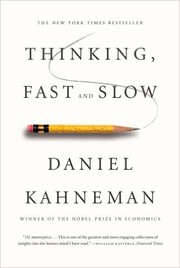

In one sentence
Human judgment is systematically shaped by two interacting modes: rapid, associative intuition and slower, effortful reasoning. Because intuition often produces confident answers before deliberate checking begins, people need procedures—not merely good intentions—to recognize bias, use statistics, and improve important decisions.
Overview
The book moves from the System 1/System 2 framework to attention, judgmental heuristics, overconfidence, prospect theory, framing, and the distinction between the experiencing self and the remembering self. Kahneman’s larger argument is not that intuition is useless, but that it is dependable mainly where people receive consistent feedback in a stable environment.
Core ideas
Two modes of thought
System 1 is fast, automatic, associative, and low-effort; System 2 is slower, capacity-limited, and capable of rule-based reasoning. System 2 often accepts System 1’s initial impression instead of auditing it. Treat the distinction as a useful model of mental processes, not necessarily as two discrete brain modules.
Substitution and coherence
When a difficult question is presented, the mind often answers an easier related question without noticing the substitution. Because System 1 prefers coherent stories, a vivid explanation can feel more persuasive than a statistically better one.
Heuristics and predictable bias
Availability, anchoring, representativeness, and affect can make judgments efficient but systematically distorted. Common errors include neglecting base rates, excessive confidence in small samples, anchoring on arbitrary numbers, and mistaking familiarity for truth.
Regression to the mean
Extreme outcomes are often followed by less extreme ones because luck and random variation tend to moderate. People commonly invent causal explanations for this movement, then misinterpret praise, punishment, or training effects.
Overconfidence and the illusion of understanding
People construct tidy causal narratives from limited evidence and judge forecasts by how plausible they sounded, not by their calibration. A compelling story can therefore coexist with poor prediction.
Prospect theory
Choices depend on a reference point, not only on final wealth. Losses generally weigh more heavily than equivalent gains; people may become risk-averse over gains and risk-seeking over losses. Framing the same outcome differently can change preferences.
The planning fallacy
Projects are commonly planned from an inside view—focusing on the particular plan and its optimistic assumptions—while ignoring comparable cases. The outside view asks what happened to similar projects and uses that distribution as an anchor.
Noise versus bias
Judgment can be distorted by systematic bias, but also by unwanted variability: different people, or the same person at different times, can reach inconsistent conclusions. Structured procedures and independent judgments can reduce both.
Practical takeaways
- For consequential forecasts, begin with a reference class: What happened in comparable cases? Then adjust only with clearly justified evidence.
- Separate data collection from interpretation. Write down the forecast, assumptions, confidence level, and decision rule before outcomes are known.
- Use base rates and natural frequencies when assessing probabilities; do not let a vivid case replace the underlying rate.
- Treat confidence as a claim that should be calibrated over time, not as evidence that a judgment is correct.
- For hiring, evaluation, diagnosis, or lending, use consistent criteria, independent initial judgments, and an explicit aggregation method before group discussion.
- Slow down selectively: deliberate review is most valuable when stakes are high, feedback is delayed, the environment is unstable, or the decision involves unfamiliar probabilities.
- Remember that intuition can be expert skill when the environment is regular and feedback is rapid and reliable; suppressing intuition everywhere would be a mistake.
Caveats and counterpoints
- The System 1/System 2 vocabulary is memorable but can oversimplify cognition; actual thought processes are more interconnected than the book’s two-system presentation suggests.
- Some prominent findings discussed in the book—especially parts of the priming literature—have encountered replication failures and methodological criticism. Kahneman acknowledged placing too much faith in some underpowered studies. The book is best read as an influential synthesis and historical guide, not as a current verdict on every experiment it cites.
- The book’s demonstrations can make biases feel universal and individually obvious, but effect sizes and boundary conditions vary across tasks, populations, environments, and incentive structures.
- Bias-awareness alone rarely fixes judgment. Decision hygiene—reference classes, checklists, independent estimates, aggregation, and feedback—is more actionable than trying to become intuitively unbiased.
Questions worth revisiting
- Which decisions in my life rely on an inside view when a reference class is available?
- Where am I confusing a coherent explanation with a well-supported prediction?
- Which of my recurring judgments should be standardized or separated into independent assessments?
- What feedback would reveal whether my confidence is calibrated?
- When has intuition worked well for me—and was that environment stable, repetitive, and feedback-rich?
Return to this when…
Return to the chapters on heuristics, regression to the mean, overconfidence, the planning fallacy, and prospect theory when reviewing a major forecast, project plan, evaluation process, or emotionally framed choice. Revisit the caveats before treating any individual study or bias as settled science.
Highlights
The psychologist Mihaly Csikszentmihalyi (pronounced six-cent-mihaly) has done more than anyone else to study this state of effortless attending, and the name he proposed for it, flow, has become part of the language. People who experience flow describe it as “a state of effortless concentration so deep that they lose their sense of time, of themselves, of their problems,” and their descriptions of the joy of that state are so compelling that Csikszentmihalyi has called it an “optimal experience.” Many activities can induce a sense of flow, from painting to racing motorcycles—and for some fortunate authors I know, even writing a book is often an optimal experience. Flow neatly separates the two forms of effort: concentration on the task and the deliberate control of attention. Riding a motorcycle at 150 miles an hour and playing a competitive game of chess are certainly very effortful. In a state of flow, however, maintaining focused attention on these absorbing activities requires no exertion of self-control, thereby freeing resources to be directed to the task at hand.
Half the participants were told to nod their head up and down while others were told to shake it side to side. The messages they heard were radio editorials. Those who nodded (a yes gesture) tended to accept the message they heard, but those who shook their head tended to reject it. Again, there was no awareness, just a habitual connection between an attitude of rejection or acceptance and its common physical expression. You can see why the common admonition to “act calm and kind regardless of how you feel” is very good advice: you are likely to be rewarded by actually feeling calm and kind.
The figure suggests that a sentence that is printed in a clear font, or has been repeated, or has been primed, will be fluently processed with cognitive ease. Hearing a speaker when you are in a good mood, or even when you have a pencil stuck crosswise in your mouth to make you “smile,” also induces cognitive ease. Conversely, you experience cognitive strain when you read instructions in a poor font, or in faint colors, or worded in complicated language, or when you are in a bad mood, and even when you frown.
“How many animals of each kind did Moses take into the ark?” The number of people who detect what is wrong with this question is so small that it has been dubbed the “Moses illusion.” Moses took no animals into the ark; Noah did. Like the incident of the wincing soup eater, the Moses illusion is readily explained by norm theory. The idea of animals going into the ark sets up a biblical context, and Moses is not abnormal in that context. You did not positively expect him, but the mention of his name is not surprising. It also helps that Moses and Noah have the same vowel sound and number of syllables. As with the triads that produce cognitive ease, you unconsciously detect associative coherence between “Moses” and “ark” and so quickly accept the question. Replace Moses with George W. Bush in this sentence and you will have a poor political joke but no illusion.
“When the second applicant also turned out to be an old friend of mine, I wasn’t quite as surprised. Very little repetition is needed for a new experience to feel normal!”
If an earlier sentence had been “They were floating gently down the river,” you would have imagined an altogether different scene. When you have just been thinking of a river, the word bank is not associated with money.
You meet a woman named Joan at a party and find her personable and easy to talk to. Now her name comes up as someone who could be asked to contribute to a charity. What do you know about Joan’s generosity? The correct answer is that you know virtually nothing, because there is little reason to believe that people who are agreeable in social situations are also generous contributors to charities. But you like Joan and you will retrieve the feeling of liking her when you think of her. You also like generosity and generous people. By association, you are now predisposed to believe that Joan is generous. And now that you believe she is generous, you probably like Joan even better than you did earlier, because you have added generosity to her pleasant attributes.
“They made that big decision on the basis of a good report from one consultant. WYSIATI—what you see is all there is. They did not seem to realize how little information they had.”
“Evaluating people as attractive or not is a basic assessment. You do that automatically whether or not you want to, and it influences you.”
“There are circuits in the brain that evaluate dominance from the shape of the face. He looks the part for a leadership role.”
We started from a fact that calls for a cause: the incidence of kidney cancer varies widely across counties and the differences are systematic. The explanation I offered is statistical: extreme outcomes (both high and low) are more likely to be found in small than in large samples. This explanation is not causal.
The incidence of cancer is not truly lower or higher than normal in a county with a small population, it just appears to be so in a particular year because of an accident of sampling. If we repeat the analysis next year, we will observe the same general pattern of extreme results in the small samples, but the counties where cancer was common last year will not necessarily have a high incidence this year. If this is the case, the differences between dense and rural counties do not really count as facts: they are what scientists call artifacts, observations that are produced entirely by some aspect of the method of research—in this case, by differences in sample size.
Large samples are more precise than small samples. Small samples yield extreme results more often than large samples do.
The message about the poll contains information of two kinds: the story and the source of the story. Naturally, you focus on the story rather than on the reliability of the results. When the reliability is obviously low, however, the message will be discredited. If you are told that “a partisan group has conducted a flawed and biased poll to show that the elderly support the president…” you will of course reject the findings of the poll, and they will not become part of what you believe.
Analysis of thousands of sequences of shots led to a disappointing conclusion: there is no such thing as a hot hand in professional basketball, either in shooting from the field or scoring from the foul line. Of course, some players are more accurate than others, but the sequence of successes and missed shots satisfies all tests of randomness. The hot hand is entirely in the eye of the beholders, who are consistently too quick to perceive order and causality in randomness. The hot hand is a massive and widespread cognitive illusion.
We are far too willing to reject the belief that much of what we see in life is random.
“The sample of observations is too small to make any inferences. Let’s not follow the law of small numbers.”
If you are asked whether Gandhi was more than 114 years old when he died you will end up with a much higher estimate of his age at death than you would if the anchoring question referred to death at 35. If you consider how much you should pay for a house, you will be influenced by the asking price. The same house will appear more valuable if its listing price is high than if it is low, even if you are determined to resist the influence of this number; and so on—the list of anchoring effects is endless. Any number that you are asked to consider as a possible solution to an estimation problem will induce an anchoring effect.
This question requires intensity matching: the respondents are asked, in effect, to find the dollar amount of a contribution that matches the intensity of their feelings about the plight of the seabirds. Some of the visitors were first asked an anchoring question, such as, “Would you be willing to pay $5…,” before the point-blank question of how much they would contribute. When no anchor was mentioned, the visitors at the Exploratorium—generally an environmentally sensitive crowd—said they were willing to pay $64, on average. When the anchoring amount was only $5, contributions averaged $20. When the anchor was a rather extravagant $400, the willingness to pay rose to an average of $143. The difference between the high-anchor and low-anchor groups was $123. The anchoring effect was above 30%, indicating that increasing the initial request by $100 brought a return of $30 in average willingness to pay.
“Our aim in the negotiation is to get them anchored on this number.”
A dramatic event temporarily increases the availability of its category. A plane crash that attracts media coverage will temporarily alter your feelings about the safety of flying. Accidents are on your mind, for a while, after you see a car burning at the side of the road, and the world is for a while a more dangerous place.
“Because of the coincidence of two planes crashing last month, she now prefers to take the train. That’s silly. The risk hasn’t really changed; it is an availability bias.”
“The CEO has had several successes in a row, so failure doesn’t come easily to her mind. The availability bias is making her overconfident.”
The Alar tale illustrates a basic limitation in the ability of our mind to deal with small risks: we either ignore them altogether or give them far too much weight—nothing in between. Every parent who has stayed up waiting for a teenage daughter who is late from a party will recognize the feeling. You may know that there is really (almost) nothing to worry about, but you cannot help images of disaster from coming to mind.
As Slovic has argued, the amount of concern is not adequately sensitive to the probability of harm; you are imagining the numerator—the tragic story you saw on the news—and not thinking about the denominator. Sunstein has coined the phrase “probability neglect” to describe the pattern. The combination of probability neglect with the social mechanisms of availability cascades inevitably leads to gross exaggeration of minor threats, sometimes with important consequences.
“The lawn is well trimmed, the receptionist looks competent, and the furniture is attractive, but this doesn’t mean it is a well-managed company. I hope the board does not go by representativeness.”
To appreciate the role of plausibility, consider the following questions: Which alternative is more probable? Mark has hair. Mark has blond hair. and Which alternative is more probable? Jane is a teacher. Jane is a teacher and walks to work. The two questions have the same logical structure as the Linda problem, but they cause no fallacy, because the more detailed outcome is only more detailed—it is not more plausible, or more coherent, or a better story. The evaluation of plausibility and coherence does not suggest and answer to the probability question. In the absence of a competing intuition, logic prevails.
“They added a cheap gift to the expensive product, and made the whole deal less attractive. Less is more in this case.”
“They constructed a very complicated scenario and insisted on calling it highly probable. It is not—it is only a plausible story.”
“Perhaps his second interview was less impressive than the first because he was afraid of disappointing us, but more likely it was his first that was unusually good.”
“Our screening procedure is good but not perfect, so we should anticipate regression. We shouldn’t be surprised that the very best candidates often fail to meet our expectations.”