
In one sentence
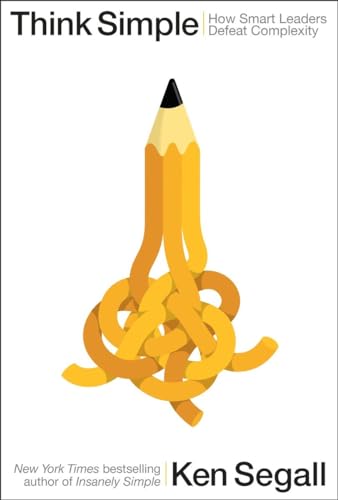
Simplicity is not merely an aesthetic preference or a matter of removing features. It is a leadership discipline: organizations become simpler when leaders establish a clear mission, align people around shared values, make deliberate choices, and protect focus from bureaucratic or commercial drift. Segall presents simplicity as a competitive advantage, especially when customers experience the result as effortless.
Overview
Published in 2016, Think Simple follows Segall’s earlier Apple-centered book, Insanely Simple. Its scope is broader: Segall draws on his twelve years working with Steve Jobs and interviews with more than 40 leaders from companies including Whole Foods, Ben & Jerry’s, The Container Store, Intel, HyundaiCard, StubHub, DirecTV, and Kofola. The chapter structure moves from the difficulty of making simplicity appear natural to mission, culture, leadership, teams, branding, scale, product and service design, customer affection, intuition, and practical ways to simplify.
Core ideas
Simple outcomes require difficult work
The customer usually sees an easy choice, clear message, or effortless product—not the editing, prioritization, coordination, and trade-offs behind it. Simplicity therefore means absorbing complexity inside the organization rather than exporting it to customers or employees.
Mission is a filter
A clear reason for being helps an organization decide what belongs and what does not. Without a strong mission, growth produces disconnected initiatives, extra offerings, and internal arguments over priorities.
Culture turns simplicity into a habit
A mission alone is insufficient. Shared values and norms help people make consistent decisions without adding layers of approval. Culture simplifies by giving employees a common basis for judgment.
Leaders must model and defend focus
Segall treats the CEO and senior leaders as crucial to simplification. Leaders have to make clear choices, stay close to important work, resist consensus-building for its own sake, and prevent complexity from returning through politics or organizational expansion.
Teams should be small, capable, and aligned
The relevant question is not how many people can participate, but who is genuinely needed to solve the problem. Hiring for judgment and cultural fit reduces coordination costs; a larger organization must work harder to preserve this clarity.
Brand coherence reduces decision friction
A strong brand gives employees and customers a shared expectation of what the company stands for. Consistent identity can simplify product, marketing, service, and growth decisions—but only when the underlying experience supports the promise.
Simplification is also about choices and design
Fewer, clearer options can make products and services easier to understand and use. The principle applies beyond visual design to menus, processes, retail environments, communication, and organizational structure.
Emotion and intuition matter, but are not substitutes for evidence
Segall argues that simplicity can create affection and loyalty, and that leaders sometimes need intuition to make bold choices. This is a case for judgment alongside data—not a universal reason to disregard research, measurement, or expert analysis.
Practical takeaways
- Write a one-sentence mission that can actually reject projects, features, or customer requests.
- List the decisions your organization repeatedly revisits; clarify the principle or owner that should settle each one.
- For every customer-facing complexity, ask whether the organization can absorb more of the burden internally.
- Audit meetings and approval chains: remove attendees and steps that add information neither improves nor decides.
- Define a small set of non-negotiable cultural values, then use them explicitly in hiring and evaluation.
- Review the portfolio for offerings that dilute the brand or consume disproportionate attention.
- Distinguish genuine simplification from concealment: a clean interface or message is valuable only if the underlying service works.
- Use intuition for consequential choices when evidence is incomplete, but test the decision with disconfirming data and customer feedback.
Caveats and counterpoints
- The book is strongly shaped by Segall’s admiration for Apple and Steve Jobs. Library Journal found the Apple material sometimes overwhelms the broader organizational argument, so readers should treat Apple as one case rather than a universal template.
- Its evidence is primarily illustrative: executive interviews and company stories rather than comparative research or a rigorous causal test of whether simplicity produces superior performance.
- The advice is more diagnostic than procedural. It offers principles and examples, but not a detailed implementation system for measuring complexity, managing trade-offs, or deciding when added process is justified.
- The intuition-versus-data theme is contestable. In safety-critical, highly regulated, or technically complex settings, simplification can remove necessary safeguards; the book’s preference for decisiveness should be balanced with domain expertise and structured analysis.
- The book’s own breadth can feel repetitive, and some reviewers considered it less focused and more promotional than Segall’s earlier Apple book.
Questions worth revisiting
- Where does our organization export complexity to customers, frontline employees, or partners?
- What is our clearest statement of purpose—and what would we stop doing if we took it seriously?
- Which organizational rules protect quality, and which merely preserve history or status?
- Are we simplifying the underlying experience or only making a complicated system look cleaner?
- When should intuition override data in our context, and what safeguards should accompany that choice?
- Which examples in the book depend on unusually strong founders or CEOs and therefore may not transfer easily?
Return to this when…
Return to these notes when a product, team, or strategy is accumulating options, approvals, messages, or exceptions. The most useful reminder is that simplicity is not “less effort”; it is concentrated effort spent deciding what matters and shielding others from everything that does not.
Highlights
My previous book, Insanely Simple, was based on observations gained from twelve years working as Steve Jobs’s advertising agency creative director, first with NeXT and then with Apple. I saw firsthand that Steve looked at everything through the lens of simplicity. His obsession with simplicity was not only visible in Apple’s products, but you could see it in the way the company organized, innovated, advertised, sold at retail, and provided customer service. In practice, simplicity was Steve’s most powerful business weapon. It helped Apple distinguish its products and create entirely new product categories, and it put distance between Apple and its competitors. But, while Apple is a terrific example of a company that has been propelled by the power of simplicity, it is hardly alone.
Be prepared, because you may well encounter resistance as you put the theories into practice. Try not to let the naysayers depress you, and certainly don’t let them sway you. There will always be people uncomfortable with change and those who will work to thwart you, consciously or subconsciously. This is where you may need to channel a bit of Steve Jobs. There were principles on which Steve would never compromise. Simplicity was one of them, and his belief in simplicity helped turn Apple into such a spectacular success. That kind of tenacity will serve you well.
Sinek offers what he calls “the world’s simplest idea.” He observes that the most inspiring companies communicate the “why” of what they do, rather than just hype a product and tell people how it works. Companies that have a mission—those that stand for something—make a deeper and more lasting impression on their customers. By communicating the why, they gain importance and relevance—and an advantage over their competitors.
Ask anyone on the street what Nike stands for and you’ll hear about celebrating athletics. Ask about BMW and you’ll hear about performance and luxury. Ask about Apple and you’ll hear about innovation and design. However, if you ask people about Dell and Microsoft, you’ll probably get a hundred different answers. Even worse, you could ask that question inside those companies and still be left wondering.
Wilhite further points out that while Jobs believed in protecting the company’s mission and values, he didn’t spend much time pontificating about those things. He preferred to let the products express the company’s values. You know, Steve never did an interview about Steve. Never. Not one time. He did interviews about products. He talked about ideas and connecting consumers to ideas. That was his mission, and he never lost focus.
People say to me, “It must be hard running a big business.” I say, “Look, to be honest, I don’t run a big business. I run a tiny business. Apple is a big business. I have thirteen hundred employees—that’s bigger than a café but nowhere near as big as Apple.” A lot of people think they have a more complex business than they have. More times than not, they actually create the complexity in their mind. I don’t think many businesses are complex at all, other than that which their CEOs or founders make them to be.
We just have to keep saying, “What is our purpose?” Well, our purpose is to find people who want to sell their property, put a great proposition forward, present their property to the world well, get the best price, and move forward. When you break it down to a simple purpose, all of a sudden it becomes manageable.
John quotes Tom Peters, author of In Search of Excellence, who said, “If not excellence, then what? If not excellence now, then when?” If you’re not committing to excellence, John explains, you’re actually committing to mediocrity. When you look at it in black and white, those are the only choices. One example of his commitment
Why aren’t other brands like Apple? It’s because they don’t have the courage of a Steve Jobs to make the right decisions. Steve didn’t make decisions based on testing and research. He relied on his values. Having those strong values made his decisions much simpler.
They are already trying to copy us—but they don’t have our DNA. So they don’t really understand what we are doing. I could probably open up my entire business plan to them and it wouldn’t really matter. They’ve hired designers and marketers, and in some cases they’ve even hired people away from Hyundai Card. But if you don’t have the DNA and you don’t have the vision, copying another company is pointless.
When Steve Jobs showed the first iPhone, it was cool because of its design and functionality—but also because Steve Jobs and Apple had earned respect for their values and all they’d accomplished. Another company could copy the iPhone and create a good product, but that alone wouldn’t make it cool.
What makes employees happiest and most fulfilled is when their personal values align with the company’s values. If there is a significant gap between those values, says Dave, people aren’t going to be happy in their work. Without that level of personal satisfaction, they won’t do the job you want them to do.
Over the years, some analysts have advised Whole Foods to grow further by broadening its food selection (read: loosen standards). But the company doesn’t stray from its pledge to sell only food that’s good for people and for the world. “Pure ingredients most of the time” just won’t cut it. “No” is an easy answer when your values are strong.
There is power in the simplicity of leading with mission, values, and culture. I believe there’s a next-level simplicity around using those things as your organizing principles in business and really sticking to it. There’s a power and clarity to that, which Whole Foods has.
Without a champion, simplicity is no match for the forces of complexity that are forever nipping at its heels. Fortunately, champions of simplicity do exist.
He also embraces the power of routine. He once thought routine was a killer of creativity and spontaneity but has come to believe the saying that “routine sets you free.” By creating a weekly schedule that sets aside regular times for group meetings, one-on-one meetings, client meetings, etc., John ensures that he has the personal time and space to think about innovation within McGrath.
Guys went off to World War II—many came back and started businesses, and they felt that the militaristic approach was the proper way to do that. That may be a good way to run the military, but it’s a terrible way to run a business.
You can get a good sense of a company’s culture by the way it structures meetings and the frequency with which it holds those meetings. It’s probably no surprise that the leaders in this book, fans of simplicity all, prefer a more casual work environment. “Less meeting, more doing” is a common theme. As the leader, Kip offers only one rule for meetings at The Container Store: Use time efficiently. Having a meeting agenda is a good idea, and those who attend a meeting are expected to contribute. What’s missing from his style of leadership is the intimidation factor. Kip has tried to create an atmosphere where people feel safe sharing new ideas and believe their thoughts are valued.
You can take six months to make the perfect decision, or you can take six days to make a good decision. You may reach a perfect decision in six months, but by that time it won’t be relevant. You have to make quick decisions, then act on them quickly.
When Brian reflected on projects that have achieved the best results at Westpac, he realized that they have all been instances in which he had the opportunity to give personal direction. Ideas come from many people in his organization, but people are energized when the leader takes part. It creates focus and discourages people from trying to do too many things at once.
To me, one very key element of simplicity is the top-down clarity of a simple goal—and the value that gives to the teams who are trying to solve the problem, to help them focus their efforts and come up with creative solutions.
If you want to be just a good company, you can be leader-driven or collaborative. But to be a great company, you need a good leader and a top-down-driven organization.
Input is valuable, but you need a captain on the bridge. You don’t need ten captains to point the direction a company should be sailing. Steve Jobs had people to tell him what course to take, but he was the one who made the decisions.
Based on my own experience in technology marketing, I believe Jony accurately states the difference between Apple and others in the industry. In meetings with executives at Dell and Intel in the process of developing advertising, conversations about generating website clicks and boosting profits were far more common than talk about doing world-changing work.
In contrast, I never attended a single meeting at Apple that focused on jacking up profits. Our focus was doing our part to help create Steve’s intended outcome, which was winning the hearts of customers. In our dealings with Steve, there was never any question that profit was the consequence of excellent work, not the cause.
StubHub cofounder Jeff Fluhr’s take is that you can’t build a successful company if your priority is short-term revenue. He takes the long view—thinking about what consumers want, designing a product, and continuing to iterate, tweak, and evolve until the product delivers real value. That’s the natural order of things: create a product of value, and then value creates profit.
In certain situations it’s important to find someone who fills a certain skill set. But more often it’s about finding someone who’s got more of the nature and innate qualities you’re looking for—things like intelligence, curiosity, creativity, cultural fit, and work ethic. If you find someone who
Jobs sat silent for several beats and then came back with the statement that will be forever cemented in my head. He said, “Yeah, I have a problem with the work, but that’s not what really concerns me. What I can’t accept is that you were able to do this for so many years and still get up in the morning and look at yourself in the mirror.” I was stunned. It was the interview equivalent of a knockout. My meeting with Steve quickly came to a close.
There are two ways you can go with business associates—you can have a relationship or you can have an arrangement. In a relationship people tell each other what they think. It may not be comfortable all the time, but you learn from each other and you grow from it. An arrangement is something where people place greater value on their personal safety and security. They don’t tell the truth. They tell you what you want to hear.
Lou Carbone, an academic in the field of customer and employee experience, once wrote that the first 25 percent of any employee’s effort is devoted to basic productivity. This is the minimum effort required to do their job. If they don’t perform at this level, they’ll be fired. The remaining 75 percent of their effort is purely voluntary. How much of this extra effort employees give depends on how much they like what they’re selling, how they feel about their boss, their working conditions, the corporate mission, and so on.
Steve would start every new project by asking, “Who do I want in the boat with me on this one? If I’m in a crisis and I need help rowing the boat, who would I pick?” So he was very good at figuring out “who’s in.” And the fewer people he could get by with, the better it would be.
In any other situation he let people do their thing. He didn’t waste any time on it. He had no involvement. Zero. But he had such high standards, and he made his standards so clear to the people he empowered, they could think like him even if he wasn’t there. He said, “I’m going to spend a lot of time with you, because I want to teach you how I think. Once you understand that and you know my standards, you’ll be free as a bird. You’ll only come to me if there’s an issue, or when you want to ask my opinion about something.”
Defining a brand clearly is one of the simplest rules of marketing and, unsurprisingly, one of the most straightforward rules of simplicity. If you ensure that every action the company takes is “on brand,” you remove any confusion about who you are, what you do, and the value you provide. You give customers a clear choice between you and your competition.
Steve spent all his time on a few things. And he liked to focus on one thing at a time. When Apple set out to build a phone, he’d concentrate on the phone. He would spend whatever time it took to get it right. Many companies enter a variety of categories with a variety of products, but Steve just went deep on one at a time. He was almost binary that way—“We’ll do this first, and then we’ll do that next.” He stayed exceptionally focused.
At that time the iMac was just taking off as Apple’s hot new product, and the company’s recovery was only beginning. The idea of selling three thousand computers to Pepsi in one swoop was pretty darn tempting. The sales executive was giddy at the prospect, so he was taken aback when Wilhite gave him a quick and resounding “no.” He looked at me as if I were from Mars. So I explained to him, “What’s happening here is that Pepsi wants to use our brand equity, our product, as the prize behind door number three to help them sell more of their sugar water. We move three thousand iMacs, but we don’t get to tell anybody who we are, what we stand for, or why it matters. We don’t get to explain our value proposition in any way. We don’t get to say we’re the best computer for the Internet, best computer for design, nothing. We’re just a gift that you might get if you happen to buy the lucky can of Pepsi. So we’re not going to do this.” That put a damper on Mr. Salesman’s shot at glory. Believing that Wilhite was dismissing a huge marketing opportunity, he went straight to Jobs. Jobs not only backed Wilhite up but later thanked him for protecting the brand. I doubt there are many CEOs who would have declined the media exposure and revenue from the sale of three thousand computers at a time when we had just borrowed $150 million from Microsoft and were trying to reestablish our brand.
It was very clear who was responsible for what. “Don’t worry about her job, because I’m going to worry about her job. If she’s not doing her job, I will fire her. You worry about your job—because I’m going to worry about your job too.” I think the reason Steve took this fundamentally functional, simple approach was that it was the only way he could keep straight in his head who was doing what.
“We have to let go of this notion that for Apple to win, Microsoft has to lose. We have to embrace the notion that for Apple to win, Apple has to do a really good job. And if others are going to help us, that’s great.”
Steve’s new direction proved one of simplicity’s boldest claims: A company can excel by doing fewer things better.
He said, “The organization is clean and simple to understand, and very accountable. Everything just got simpler.” He summed it up by identifying his mantras: “Focus and simplicity.” There is something
“I think part of what made the Macintosh great was that the people working on it were musicians and poets and artists and zoologists and historians—who also happened to be the best computer scientists in the world.”
They run an ad campaign, or change pricing, or widen margins, or cut costs, or create new products with features they’d been missing. It’s like, “When all I have is a hammer, everything looks like a nail.”
my advertising life the best test has always been “Does it make a good T-shirt?” If people will wear those words with pride and those words point everyone toward a common goal, you know you’ve done a good job.
Throughout my research for this book, leader after leader talked about making decisions that, at the end of the day, were somewhat obvious. What makes them more effective is their ability to make those decisions out of confidence, even in the face of strong opposition.
This is what puts simplicity within the grasp of every leader. It’s not magic. Rather, it’s the result of experience, good sense, and logic—combined with the boldness to activate it.
What was really cool—and we never did this back in the Apple II days—were our weekly meetings. I mean, how often do people get the chance to work directly with the CEO of a company, put work in front of him, and have him simply say, “Give me that—that’s what I want”? There was no endless debate and no asking for a dozen other opinions. It was just “Do that.”
“Work-around,” of course, is just another term for complexity. And complexity has a way of breeding more complexity.
The key engineer on the team was a man named Kelly Johnson, who lived by the motto “Be quick, be quiet, be on time,” which is certainly good advice for any business. Even more appropriate for this book, his favorite maxim was “Keep it simple, stupid.” Very impressive for a man who engineered such complex technology.
Neil Hunt, chief product officer of Netflix, is a member of that group. He cites Schwartz’s thesis in describing the results of a Netflix experiment. The company tried adding a half-star option to the five-star rating system people use to rate films. The thinking was that a more accurate rating system would be more appealing to viewers. But when Netflix implemented the half-star format, the use of viewer ratings dropped by 11 percent. Too much choice had a negative effect.
I once heard a story about Steve Jobs—how in an early board meeting upon his return to the company, he had all the different Apple products up on a shelf. One by one, he started taking them off the shelf and putting them on the floor. Finally only a few were left, and he said, “Now this is what we’re going to do.”
Because the company competes in a fast-moving industry, one of Ted’s highest priorities was giving the company faster reflexes, which he did by streamlining the decision-making process. He explains: A decision might take more than a month at some companies. It takes only one day here. This is the greatest weapon we have. I often say that we are not competing with stupid people. Over time our competitors inevitably become a lot smarter. It is unreasonable to expect that they will make mistakes. The only way we can win the battle is to not only make good decisions but to move twice as fast as they do.
As an example, Ted tells the story of an opportunity that came the company’s way in 2012. Hyundai Card sometimes sponsors major concerts for its customers, and Lady Gaga had expressed a willingness to visit South Korea. The sponsorship for this event, Ted learned, would require an investment of more than a million dollars. In other companies it’s “I’ll talk to my boss,” and then “My boss will talk to his boss,” and so on. That kind of thing might drag on for weeks or months. To us it’s either yes or no. We are very crisp. We’re fast and simple. We came to a decision in two hours.
It’s very simple, he explains: People become attached to a brand that delivers value. Kip stresses that when he talks about value, he’s not necessarily talking about low price. He references retailer Stanley Marcus, of Neiman Marcus fame, who said that value is when a thing costs about 20 percent more than another but looks 200 percent better. It functions better, lasts longer, and all the while looks fantastic. Kip uses his favorite tie as an example of value. He bought it at Bergdorf Goodman, and it’s probably the most expensive tie he owns. But when he wears it, he gets tons of comments, which just makes him feel great. For him, it’s the emotional return on his investment that gives him the sense of value.
By definition, spreadsheets only tell you history, right? If you rely on facts to make decisions, you’ll reach the same conclusion everyone else makes based on those facts. You’ll just be moving toward the middle. If you want to differentiate or move to the future, you have to rely on your intuition. It’s like Steve Jobs said when he quoted Wayne Gretzky about skating to where the puck is going.
Think also about the names you put on products—they speak volumes about what you sell, giving customers something to relate to and remember. How well can you relate to a Blu-ray player called the Sony BDPS3200? Or a laptop called the ASUS E402MA? Again, see your offerings through the customer’s eyes. Every time you make things simpler for customers, you’re building love.
Steve Jobs never diminished the challenge of simplification. He talked about how hard it was to be simple. But in the same breath he said that once you achieve simplicity, “you can move mountains.” He wasn’t talking about himself. He was talking about you. The philosophy he expressed can be embraced by anyone, in any company, in any industry. To begin, you only need to put your stake in the ground. Best of luck moving your mountains.
References
- Think Simple: How Smart Leaders Defeat Complexity - Ken Segall - Google Books
- blinkist.com
- Think Simple: How Smart Leaders Defeat Complexity | Library Journal
- thebooksummaries.com
- kensegall.com
- goodbooksummary.com
- sobrief.com
- brieflane.com
- befreed.ai
- penguin.co.uk
- vitalsource.com
- Think Simple: How Smart Leaders Defeat Complexity by Ken Segall | Goodreads