
In one sentence
Successful trading is less about prediction or innate brilliance than about having a measurable edge, controlling risk, and executing a tested system consistently. Faith presents the Turtles as evidence that trading methods can be taught—but the book’s deeper point is that discipline, robustness, and emotional control determine whether an edge survives real markets.
Overview
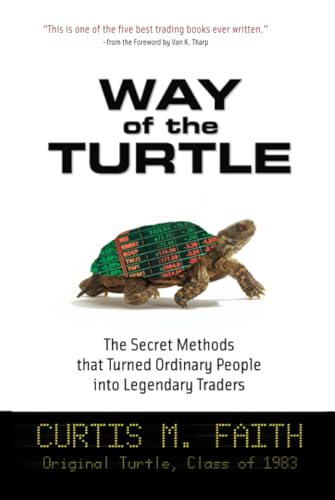
Dennis and Eckhardt recruited and trained traders to test whether trading ability was learned or innate. Faith, selected at nineteen, describes the experiment and explains the Turtle approach: trend following across liquid markets, predefined rules, volatility-based position sizing, diversification, stop-losses, and letting profitable trends run. The book then broadens into system design, backtesting, and trading psychology. The publisher’s contents emphasize the progression from the experiment to psychology, money management, entries, exits, diversification, risk limits, and testing.
Core ideas
Trade an edge, not a story
A trading edge is a repeatable tendency that produces favorable results over many trades—not a claim that the next trade is predictable. The Turtle mindset evaluates rules statistically and accepts that individual outcomes are uncertain.
Trend following accepts many small losses
Breakout systems often enter after a move has begun and therefore produce false starts. The method is designed to keep losses limited while remaining exposed to the relatively few sustained trends that can generate most of the profits.
Risk determines survival
Position size should reflect market volatility and account risk, rather than confidence or the nominal price of an asset. Volatility-based sizing attempts to make each position contribute a comparable amount of risk.
Diversification is a risk tool
Spreading exposure across markets and related-but-not-identical instruments can smooth results, provided correlations and total portfolio exposure are considered. Diversification does not eliminate losses; it reduces dependence on one market or trade.
Rules must be executable under stress
A profitable historical rule is useless if the trader abandons it during drawdowns. The system must specify entries, exits, sizing, and risk limits clearly enough to reduce improvisation when fear, greed, or recent losses distort judgment.
Backtests can lie
Historical testing is vulnerable to overfitting, look-ahead bias, survivorship bias, unrealistic fills, and ignoring slippage or commissions. Faith argues for simple, robust rules that perform acceptably across different periods and markets rather than rules optimized for one dataset.
The real test is implementation
The Turtle experiment supports the teachability of a method, but not the idea that anyone can easily become a successful trader. Capital, execution, temperament, changing market conditions, and the ability to endure extended drawdowns all matter.
Practical takeaways
- Write the trading rule before entering the trade: market, signal, position size, stop, and exit condition.
- Judge a strategy over a sufficiently large sample of trades; do not infer much from one winner or loser.
- Use risk per position and portfolio exposure limits so a normal losing streak does not become a catastrophic loss.
- Prefer simple rules with plausible rationale and broad historical robustness over highly optimized rules.
- Separate the validity of a system from the attractiveness of its recent performance.
- Treat drawdowns as part of the system’s expected distribution, not automatically as proof that the system has failed.
- When evaluating a backtest, include realistic transaction costs, slippage, liquidity constraints, and out-of-sample testing.
- Do not copy the Turtle rules mechanically without checking whether the instruments, leverage, liquidity, and market structure fit your circumstances.
Caveats and counterpoints
- The book is an insider’s retrospective by one prominent Turtle, so it should not be treated as a neutral or complete statistical evaluation of every participant’s results. Its account is also shaped by Faith’s own experience and interpretation.
- The historical success of the Turtles does not establish that the original rules will produce comparable returns today. Trend-following performance can vary substantially by market regime, and implementation costs can materially reduce results.
- The book’s marketing can make the experiment sound like proof that ordinary people can become legendary traders after brief training. A more defensible conclusion is narrower: explicit methods can teach parts of trading, while profitable implementation still requires capital, discipline, risk control, and persistence.
- The approach is primarily systematic trend following, not a universal framework for valuation investing, short-term discretionary trading, or personal financial planning.
Questions worth revisiting
- What is the smallest risk per trade that would let me follow the system through a plausible losing streak?
- Which parts of a strategy are genuinely robust, and which were chosen because they look good in hindsight?
- What evidence would show that a system has degraded rather than merely entered a normal drawdown?
- Can I define every decision mechanically enough that I would follow it after five consecutive losses?
- How would commissions, spreads, slippage, leverage, taxes, and liquidity change the backtested result?
- Am I seeking an edge, or merely searching for a prediction that confirms my existing market view?
Return to this when…
Return when designing or auditing a systematic trading strategy, especially for reminders about position sizing, drawdowns, diversification, backtest quality, and the psychological cost of following rules. It is most useful as a conceptual introduction to trend following—not as a current performance guarantee or a substitute for independent testing.
References
- Way of the Turtle: The Secret Methods that Turned Ordinary People into ... - Curtis Faith - Google Books
- goodreads.com
- goodreads.com
- Way of the Turtle: The Secret Methods that Turned Ordinary People into Legendary Traders
- book.douban.com
- dokumen.pub
- goodreads.com
- windsorpublishing.com
- zvab.com
- getabstract.com
- abnormalreturns.com
- tradelosstracker.com