
In one sentence
The central problem is not usually lack of talent or ideas but failure to consistently confront the internal force Pressfield calls Resistance. The practical answer is to “turn pro”: make the work a disciplined practice rather than a mood-dependent aspiration. Inspiration matters, but it is invited by sustained effort rather than awaited passively.
Overview
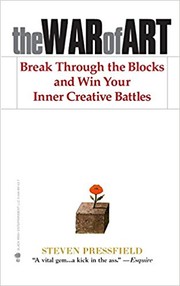
Published in 2002, the book is structured less like a conventional creativity manual than a motivational manifesto. It moves through three broad stages: identifying Resistance; contrasting the amateur with the professional; and describing the Muse, or a larger spiritual source of creative inspiration. Its intended targets include writers and artists, but Pressfield extends the framework to entrepreneurship, vocation, health, and other difficult commitments.
Core ideas
Resistance is the recurring enemy
Resistance is Pressfield’s name for the cluster of forces that prevent meaningful work: procrastination, rationalization, fear of failure, fear of success, distraction, perfectionism, and self-sabotage. It tends to intensify when the project matters most. Treating these reactions as predictable patterns can make them easier to recognize rather than mistake them for reliable judgments about the work.
The professional shows up
The professional does not wait to feel confident, inspired, or certain. They establish a routine, accept that the work will often be difficult, and return after rejection or a bad session. Professionalism here is primarily behavioral: regular attendance, persistence, humility toward the craft, and emotional separation from short-term results.
Amateur identity creates fragility
Pressfield contrasts the amateur, who treats creative work as an occasional wish or as a referendum on personal worth, with the professional, who treats it as a practice. This reduces the stakes of any single session: criticism becomes information, failure becomes part of the process, and routine becomes more dependable than enthusiasm.
Fear can indicate importance
In Pressfield’s framework, unusually strong fear or avoidance may signal that a project is personally significant—not that it should automatically be pursued. The useful diagnostic question is: what valuable work am I repeatedly finding reasons not to begin? The insight is motivational, not a sufficient basis for major life decisions.
Work first; inspiration follows
The book’s spiritual language describes creativity through the figure of the Muse. The operational lesson is more concrete: create conditions in which ideas can arrive by beginning, maintaining a practice, and completing drafts. Pressfield presents disciplined labor and openness to inspiration as complementary rather than opposed.
The battle metaphor is a tool, not a diagnosis
Calling avoidance “Resistance” can externalize shame and create urgency: the problem becomes something to confront rather than a fixed identity. But the metaphor should remain flexible. Avoidance may also reflect exhaustion, unclear goals, poor skills, depression, financial constraints, unsafe conditions, or a genuinely bad project—not merely an enemy to defeat.
Practical takeaways
- Define the specific work you are avoiding; “be creative” is too vague to resist effectively.
- Set a recurring start time and a modest minimum session. Measure attendance before judging quality.
- Expect Resistance to appear as apparently sensible alternatives: research, reorganizing, checking messages, or waiting for the right mood.
- Separate producing from evaluating. Drafting, revising, and judging are different activities with different demands.
- Use a professional’s question: “What is the next concrete action?” Then do that action before negotiating with yourself.
- Treat rejection and criticism as part of exposure to the work, not as proof that the work or your identity is worthless.
- Preserve enough flexibility to stop, change direction, or seek help when the obstacle is practical, psychological, or health-related rather than simple avoidance.
Caveats and counterpoints
- The book is an exhortation and mental model, not an evidence-based account of procrastination or creativity. Its confident personification of Resistance is rhetorically powerful but should not be mistaken for a clinical explanation.
- Its amateur/professional binary can oversimplify creative lives in which people have jobs, caregiving duties, disabilities, unstable resources, or changing levels of commitment. A routine is useful, but access and capacity matter.
- The later discussion of the Muse and higher spiritual forces will resonate with some readers and feel abstract or impractical to others; the book does not establish these ideas empirically.
- The war framing encourages courage and persistence, but relentless self-pressure can become counterproductive. Rest, play, collaboration, experimentation, and humane self-compassion are not necessarily forms of Resistance.
Questions worth revisiting
- What project do I repeatedly describe as important while avoiding a scheduled next step?
- Which form does Resistance take most often for me: distraction, perfectionism, research, self-criticism, or premature quitting?
- What would “turning pro” mean behaviorally in this particular practice—not symbolically?
- Am I avoiding the work, or am I responding to a real constraint, unclear brief, missing skill, or depleted capacity?
- What minimum routine would be sustainable for the next two weeks?
- Where would persistence help, and where would changing the project or asking for assistance be wiser?
Return to this when…
Return when you are stuck at the threshold of a meaningful project, especially when you already know the next step but keep converting it into preparation. Reread selectively for a behavioral reset—not as a substitute for craft instruction, mental-health care, rest, or solving external constraints.
Highlights
There’s a secret that real writers know that wannabe writers don’t, and the secret is this: It’s not the writing part that’s hard. What’s hard is sitting down to write. What keeps us from sitting down is Resistance.
The enemy is a very good teacher. —the Dalai Lama
Resistance will tell you anything to keep you from doing your work. It will perjure, fabricate, falsify; seduce, bully, cajole. Resistance is protean. It will assume any form, if that’s what it takes to deceive you. It will reason with you like a lawyer or jam a nine-millimeter in your face like a stickup man. Resistance has no conscience. It will pledge anything to get a deal, then double-cross you as soon as your back is turned. If you take Resistance at its word, you deserve everything you get. Resistance is always lying and always full of shit.
Resistance is like the Alien or the Terminator or the shark in Jaws. It cannot be reasoned with. It understands nothing but power.
Remember our rule of thumb: The more scared we are of a work or calling, the more sure we can be that we have to do it.
References
- The War of Art | Steven Pressfield
- Writing Wednesdays: It’s All About Resistance
- Books | Steven Pressfield
- stevenpressfield.com
- stevenpressfield.com
- podcasts.apple.com
- The War of Art Mini-Course, Part 5 | Steven Pressfield
- books.apple.com
- The War of Art: Break Through the Blocks and Win Your Inner Creative Battles - Steven Pressfield - Google Books
- penguinrandomhouse.com
- en.wikipedia.org
- stevenpressfield.com
- glasp.co
- en.wikipedia.org