
In one sentence
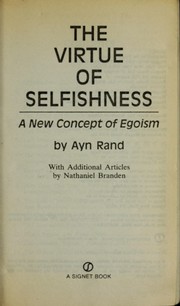
Rand argues that morality should take the individual’s rational, long-term life and flourishing as its standard. Proper “selfishness” means pursuing one’s objectively grounded interests—not whim, predation, or sacrificing others—and requires reason, independence, honesty, justice, integrity, productiveness, and pride. She extends this framework into a defense of individual rights and limited government.
Overview
This is an essay collection rather than a single sustained treatise. Its central sequence develops Rand’s ethics, then applies it to altruism, emergencies, conflicts of interest, pleasure, compromise, rights, government, racism, and the possibility of rational conduct within an irrational culture. The contents make the progression from moral theory to political and social implications clear.
Core ideas
“Selfishness” is a technical redefinition
Rand deliberately separates selfishness from brutishness, exploitation, and short-term gratification. In her usage, selfishness means concern with one’s own interests; ethics must then determine which interests are genuinely human and rational. This rhetorical redefinition is the book’s organizing provocation, but it also makes the argument easy to misunderstand outside Rand’s terminology.
Life is the standard of value
Rand’s argument begins with the claim that values exist for living beings and that human life—life maintained through conceptual thought and choice—provides the standard for judging moral values. Reason is therefore not merely a tool for satisfying desires; it is the basic means by which human beings identify and pursue the conditions of survival and flourishing.
Rational self-interest is not permission to do anything
The virtuous egoist does not follow every impulse. Rand’s ideal self-interest is long-range, reality-oriented, and disciplined. It rules out fraud, coercion, parasitism, and sacrificing one person to another because those practices conflict with the requirements of independent human life and productive cooperation.
Altruism is the principal opponent
Rand treats altruism not simply as kindness but as the doctrine that self-sacrifice is morally primary. She argues that this reverses the relationship between values and life, turning need into a claim on others and making moral worth depend on surrender. She distinguishes voluntary generosity from a duty to live for others.
Emergencies are exceptions, not the model of life
In Rand’s framework, disasters can justify extraordinary aid, but emergency situations should not define ordinary morality. The normal human context is production, cooperation, achievement, friendship, and love—not continual rescue. A practical implication is to resist ethical rules that treat every need as an unlimited demand on one’s time, resources, or values.
Rights protect the conditions of agency
The political essays connect egoism to individual rights: rights protect freedom of thought and action, especially against physical coercion. Government is assigned a limited retaliatory role—protecting people from force and fraud—rather than redistributing values or directing citizens’ lives. This is the bridge from Rand’s ethics to her defense of laissez-faire capitalism.
No intrinsic conflict among rational interests
Rand denies that rational people must fundamentally compete for the same moral goods. Conflicts often arise from irrational premises, force, scarcity created by bad institutions, or incompatible values. Her position does not deny everyday disagreement; it denies that human flourishing inherently requires one person’s sacrifice for another.
Compromise has a moral boundary
Rand distinguishes practical compromise over methods from compromise over principles. Negotiating a price or schedule can be rational; surrendering a fundamental value merely to avoid conflict is not. The useful question is whether the compromise preserves the goal and rests on voluntary agreement, rather than treating principle as a bargaining chip.
Practical takeaways
- When evaluating a purported duty, ask: whose value is being served, by what means, and at whose expense?
- Separate genuine generosity from guilt-driven self-erasure; helping someone can be valuable without being a universal moral obligation.
- Treat long-term interests, not immediate appetite or social approval, as the relevant measure of self-interest.
- Use the book’s compromise test: negotiate implementation when possible, but do not trade away a core principle simply to end disagreement.
- In political arguments, identify whether a proposal protects people from force or instead uses force to transfer responsibility, income, or direction from some people to others.
Caveats and counterpoints
- The book’s foundational move—from the requirements of human life to a specific moral code—is asserted more confidently than it is demonstrated; readers who reject Rand’s metaphysical starting points will not find the later conclusions compelled.
- Rand’s treatment of altruism can flatten important distinctions among self-sacrifice, care, solidarity, dependency, and ordinary moral obligation. Critics argue that people’s interests are often relational and interdependent rather than cleanly separable.
- Her account of rational self-interest gives relatively little attention to structural inequality, disability, caregiving, collective-action problems, and cases where voluntary exchange occurs under severely unequal conditions.
- The collection is polemical and repetitive by design. It is useful as a compact statement of Objectivist ethics, but not as a balanced survey of ethical theory or a substitute for engagement with opposing arguments.
- The book is commonly described as Rand’s work, but its contents are an anthology of essays associated with Objectivist publications; the exact edition can vary in pagination and presentation. Do not treat page references from another edition as applying to the user’s copy.
Questions worth revisiting
- Does Rand successfully justify the transition from “life as the standard of value” to objective moral rules?
- Can rational self-interest adequately explain duties to children, strangers, future generations, or people unable to reciprocate?
- When does voluntary generosity express a personal value, and when does it become morally required?
- Are rights defensible solely as protections against force, or do justice and freedom also require social or material conditions?
- Does Rand’s sharp opposition between egoism and altruism overlook forms of cooperation in which another person’s flourishing is part of one’s own good?
Return to this when…
Return to the opening essay for Rand’s basic ethical argument; the essays on emergencies, compromise, and rights for practical applications; and the final essays for her account of moral reasoning in a hostile culture. Revisit it when distinguishing principled self-interest from selfish impulse, coercive exploitation, or guilt-based self-denial.
Highlights
Altruism declares that any action taken for the benefit of others is good, and any action taken for one’s own benefit is evil. Thus the beneficiary of an action is the only criterion of moral value—and so long as that beneficiary is anybody other than oneself, anything goes. Hence the appalling immorality, the
and the life he has to live is his own. Man must choose his actions, values and goals by the
Man must choose his actions, values and goals by the standard of that which is proper to man—in order to achieve, maintain, fulfill and enjoy that ultimate value, that end in itself, which is his own life. Value is that which one acts to gain and/or keep—virtue is the act by which one gains and/or keeps it. The three cardinal values of the Objectivist ethics—the three values which, together, are the means to and the realization of one’s ultimate value, one’s own life—are: Reason, Purpose, Self-Esteem, with their three corresponding virtues: Rationality, Productiveness, Pride.
It means one’s acceptance of the responsibility of forming one’s own judgments and of living by the work of one’s own mind (which is the virtue of Independence). It means that one must never sacrifice one’s convictions to the opinions or wishes of others (which is the virtue of Integrity)—that one must never attempt to fake reality in any manner (which is the virtue of Honesty) —that one must never seek or grant the unearned and undeserved, neither in matter nor in spirit (which is the virtue of Justice).
The moral cannibalism of all hedonist and altruist doctrines lies in the premise that the happiness of one man necessitates the injury of another.
“the alleged shortcut to knowledge, which is faith, is only a short circuit destroying the mind.”
Humility is, of necessity, the basic virtue of a mystical morality; it is the only virtue possible to men who have renounced the mind. Pride has to be earned; it is the reward of effort and achievement; but to gain the virtue of humility, one has only to abstain from thinking—nothing else is demanded—and one will feel humble quickly enough.
For the rational, psychologically healthy man, the desire for pleasure is the desire to celebrate his control over reality. For the neurotic, the desire for pleasure is the desire to escape from reality.
There can be no compromise on basic principles or on fundamental issues. What would you regard as a “compromise” between life and death? Or between truth and falsehood? Or between reason and irrationality? Today, however, when people speak of “compromise,” what they mean is not a legitimate mutual concession or a trade, but precisely the betrayal of one’s principles—the unilateral surrender to any groundless, irrational claim.
The question “Doesn’t life require compromise?” is usually asked by those who fail to differentiate between a basic principle and some concrete, specific wish. Accepting a lesser job than one had wanted is not a “compromise.” Taking orders from one’s employer on how to do the work for which one is hired, is not a “compromise.” Failing to have a cake after one has eaten it, is not a “compromise.” Integrity does not consist of loyalty to one’s subjective whims, but of loyalty to rational principles. A “compromise” (in the unprincipled sense of that word) is not a breach of one’s comfort, but a breach of one’s convictions. A “compromise” does not consist of doing something one dislikes, but of doing something one knows to be evil. Accompanying one’s husband or wife to a concert, when one does not care for music, is not a “compromise”; surrendering to his or her irrational demands for social conformity, for pretended religious observance or for generosity toward boorish in-laws, is. Working for an employer who does not share one’s ideas, is not a “compromise”; pretending to share his ideas, is. Accepting a publisher’s suggestions to make changes in one’s manuscript, when one sees the rational validity of his suggestions, is not a “compromise”; making such changes in order to please him or to please “the public,” against one’s own judgment and standards, is.
There can be no compromise on moral principles. “In any compromise between food and poison, it is only death that can win. In any compromise between good and evil, it is only evil that can profit.” (Atlas Shrugged.) The next time you are tempted to ask: “Doesn’t life require compromise?” translate that question into its actual meaning: “Doesn’t life require the surrender of that which is true and good to that which is false and evil?” The answer is that that precisely is what life forbids—if one wishes to achieve anything but a stretch of tortured years spent in progressive self-destruction.
This last means that one need not launch into unprovoked moral denunciations or debates, but that one must speak up in situations where silence can objectively be taken to mean agreement with or sanction of evil. When one deals with irrational persons, where argument is futile, a mere “I don’t agree with you” is sufficient to negate any implication of moral sanction. When one deals with better people, a full statement of one’s views may be morally required. But in no case and in no situation may one permit one’s own values to be attacked or denounced, and keep silent.
Socialism may be established by force, as in the Union of Soviet Socialist Republics—or by vote, as in Nazi (National Socialist) Germany. The degree of socialization may be total, as in Russia—or partial, as in England. Theoretically, the differences are superficial; practically, they are only a matter of time. The basic principle, in all cases, is the same.
All previous systems had held that man’s life belongs to society, that society can dispose of him in any way it pleases, and that any freedom he enjoys is his only by favor, by the permission of society, which may be revoked at any time. The United States held that man’s life is his by right (which means: by moral principle and by his nature), that a right is the property of an individual, that society as such has no rights, and that the only moral purpose of a government is the protection of individual rights.
“The source of man’s rights is not divine law or congressional law, but the law of identity. A is A—and Man is Man. Rights are conditions of existence required by man’s nature for his proper survival. If man is to live on earth, it is right for him to use his mind, it is right to act on his own free judgment, it is right to work for his values and to keep the product of his work. If life on earth is his purpose, he has a right to live as a rational being: nature forbids him the irrational.” (Atlas Shrugged.)
Remember that rights are moral principles which define and protect a man’s freedom of action, but impose no obligations on other men. Private citizens are not a threat to one another’s rights or freedom. A private citizen who resorts to physical force and violates the rights of others is a criminal—and men have legal protection against him.
A society that robs an individual of the product of his effort, or enslaves him, or attempts to limit the freedom of his mind; or compels him to act against his own rational judgment—a society that sets up a conflict between its edicts and the requirements of man’s nature—is not, strictly speaking, a society, but a mob held together by institutionalized gang-rule. Such a society destroys all the values of human coexistence, has no possible justification and represents, not a source of benefits, but the deadliest threat to man’s survival. Life on a desert island is safer than and incomparably preferable to existence in Soviet Russia or Nazi Germany.
A private individual may do anything except that which is legally forbidden; a government official may do nothing except that which is legally permitted. This is the means of subordinating “might” to “right.” This is the American concept of “a government of laws and not of men.”
The “liberals” are guilty of the same contradiction, but in a different form. They advocate the sacrifice of all individual rights to unlimited majority rule—yet posture as defenders of the rights of minorities. But the smallest minority on earth is the individual. Those who deny individual rights, cannot claim to be defenders of minorities.
Instead of fighting for “color-blindness” in social and economic issues, they are proclaiming that “color-blindness” is evil and that “color” should be made a primary consideration. Instead of fighting for equal rights, they are demanding special race privileges They are demanding that racial quotas be established in regard to employment and that jobs be distributed on a racial basis, in proportion to the percentage of a given race among the local population. For instance, since Negroes constitute 25 per cent of the population of New York City, they demand 25 per cent of the jobs in a given establishment.
Racial quotas have been one of the worst evils of racist regimes. There were racial quotas in the universities of Czarist Russia, in the population of Russia’s major cities, etc. One of the accusations against the racists in this country is that some schools practice a secret system of racial quotas. It was regarded as a victory for justice when employment questionnaires ceased to inquire about an applicant’s race or religion. Today, it is not an oppressor, but an oppressed minority group that is demanding the establishment of racial quotas. (!) This particular demand was too much even for the “liberals.” Many of them denounced it—properly—with shocked indignation. Wrote The N. Y. Times (July 23, 1963): “The demonstrators are following a truly vicious principle in playing the ‘numbers game.’ A demand that 25 per cent (or any other percentage) of jobs be given to Negroes (or any other group) is wrong for one basic reason: it calls for a ‘quota system,’ which is in itself discriminatory.... This newspaper has long fought a religious quota in respect to judge-ships; we equally oppose a racial quota in respect to jobs from the most elevated to the most menial.”
A conformist is a man who declares, “It’s true because others believe it”—but an individualist is not a man who declares, “It’s true because I believe it.” An individualist declares, “I believe it because I see in reason that it’s true.”