
In one sentence
Kaczynski’s central claim is that the industrial-technological system—not merely particular machines, corporations, or policies—undermines human freedom by making individuals dependent on large-scale institutions. Because technology develops through interconnected systems and creates pressures for further expansion, he argues that reform cannot solve the basic problem; the system must eventually be dismantled. This is the work’s position, not an established conclusion.
Overview
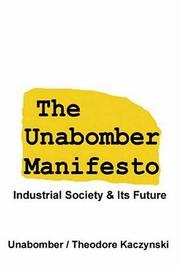
The text was originally a 35,000-word manifesto published in The Washington Post and The New York Times on September 19, 1995, after Kaczynski threatened to resume bombing unless it was printed. The book version catalogued here was issued by Jolly Roger Press in 1996 and is about 90 pages. The argument moves from diagnosis to proposed strategy: industrial society produces psychological dysfunction; technology limits meaningful choice; environmental destruction is structurally driven; and opponents should promote a long-term revolutionary movement rather than conventional political reform.
Core ideas
The “power process”
Kaczynski argues that people need more than comfort or entertainment: they need difficult but meaningful goals, autonomy in pursuing them, and a sense of completing something through their own effort. Industrial society allegedly replaces this process with artificial goals, status competition, consumption, and other “surrogate activities.”
Freedom is systemically constrained
The manifesto defines freedom less as formal legal rights than as practical self-direction. Since modern life depends on institutions, infrastructure, expertise, and regulation beyond individual control, people must conform to requirements generated by the system. Individual choice therefore exists inside increasingly narrow structural limits.
Technology has its own momentum
The target is not technology in the abstract but the industrial-technological system: mutually dependent institutions and technologies that require continued growth, coordination, and control. Kaczynski’s argument is that isolated reforms cannot reliably prevent new technologies from producing unintended social consequences or expanding institutional power.
Environmental damage is not accidental
Environmental destruction is presented as a consequence of industrial society’s demand for growth, energy, extraction, and management. The manifesto contrasts managed environments with “wild” nature and treats ecological protection as incompatible with many of the system’s core imperatives, rather than as a problem solvable only through better regulation.
“Leftism” as psychological and cultural analysis
Kaczynski uses “leftism” idiosyncratically to describe people he believes are oversocialized, insecure, and motivated by status, guilt, or feelings of inferiority. This section is less a careful political taxonomy than an attempt to explain why people may defend systems that frustrate autonomy. Its generalizations are among the manifesto’s weakest analytical features.
Revolution over reform
The proposed response is a long-term movement aimed at weakening and eventually eliminating industrial society. He recommends changing public attitudes, resisting technological expansion, and building conditions for systemic collapse or transformation. The text deliberately stays general about implementation, while its author’s own violent campaign makes the political proposal inseparable from terrorism and coercion.
Practical takeaways
- Use the “power process” as a diagnostic question: am I pursuing a difficult goal I chose, or mainly consuming substitutes for agency and accomplishment?
- Distinguish criticism of a technology from criticism of the institutions and dependencies required to operate it at scale.
- When evaluating technological progress, ask who controls the system, which forms of dependence it creates, and whether its effects can realistically be reversed.
- Treat the manifesto as a provocative framework for analyzing autonomy, environmental limits, and technological power—not as a reliable account of psychology, politics, or history.
- The text is useful for generating questions about unintended consequences, but its conclusions often move from plausible criticism to sweeping inevitability without sufficient evidence.
Caveats and counterpoints
- The manifesto’s historical and psychological claims are asserted more often than demonstrated. Its “power process” theory is suggestive but not a developed or empirically tested account of human motivation.
- Its definition of “leftism” is broad, polemical, and politically idiosyncratic; it should not be confused with standard scholarly descriptions of left-wing politics.
- The argument tends to treat “technology” and “industrial society” as highly unified systems, underplaying differences among technologies, institutions, cultures, and possible forms of democratic control.
- Kaczynski presents reform as fundamentally inadequate, but the text gives limited evidence for why partial reforms, regulation, or alternative institutional arrangements must fail.
- The manifesto’s intellectual claims cannot be separated from its author’s campaign of bombings, which killed three people and injured 23.
Questions worth revisiting
- Which parts of the power-process argument could be tested independently of Kaczynski’s broader anti-technology conclusions?
- Are autonomy and meaningful work necessarily incompatible with advanced technology, or can institutions distribute control more widely?
- Which technologies genuinely increase dependence, and which might expand individual capability or collective freedom?
- Does environmental protection require dismantling industrial systems, or can technological systems be redesigned around limits and democratic accountability?
- Where does the manifesto identify real structural problems, and where does its revolutionary conclusion exceed its evidence?
Return to this when…
Return to this manifesto when thinking about technology criticism, automation, ecological limits, alienation, or the trade-off between convenience and autonomy. Pair it with a serious account of technological change and political economy; its strongest value is as a sharply framed provocation, not as a balanced or comprehensive theory.
References
- books.google.com
- libcat.weber.edu
- PAPER ASSAILS INDUSTRIAL-TECHNOLOGICAL SYSTEM' - The Washington Post
- How publishing a 35,000-word manifesto led to the Unabomber - The Washington Post
- washingtonpost.com
- commons.wikimedia.org
- search.worldcat.org
- alarumbooks.com
- thetedkarchive.com
- unabombermanifesto.net
- vault.fbi.gov
- en.wikipedia.org