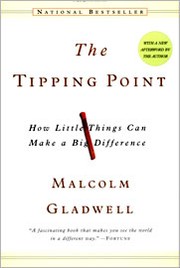

In one sentence
Large-scale social change can result from small, strategically placed interventions when three conditions align: influential transmitters spread an idea, the message is sufficiently memorable, and the surrounding environment makes adoption easier. Gladwell presents this as a framework for understanding—and sometimes engineering—social “epidemics.”
Overview
The book applies an epidemic metaphor to trends, products, behaviors, and public problems. Its central framework is the Law of the Few, the Stickiness Factor, and the Power of Context. Examples include Hush Puppies’ revival, Paul Revere’s warning network, Sesame Street and Blue’s Clues, New York crime, smoking, teen suicide, and word-of-mouth campaigns.
Core ideas
The tipping point
A tipping point is the threshold at which a change becomes self-propagating: after enough favorable conditions accumulate, growth can appear sudden and disproportionate to the original input. The metaphor emphasizes nonlinear change, not merely steady accumulation.
The Law of the Few
Gladwell argues that contagious social change often depends on a small number of unusually effective participants. Connectors link otherwise separate social circles; Mavens acquire and share useful information; Salesmen persuade people who are initially unconvinced. Their functions differ, but an epidemic may require all three.
The Stickiness Factor
A message must not only reach people; it must remain in memory and influence behavior. Gladwell uses children’s television and direct-marketing examples to argue that small changes in presentation, repetition, structure, or audience fit can make communication substantially more effective.
The Power of Context
Behavior is shaped by immediate surroundings, social norms, and situational cues. Small environmental changes—such as reducing visible disorder or changing how a setting signals acceptable conduct—can alter behavior at scale. This challenges explanations that rely only on individual character or broad social trends.
Networks are not just large numbers
A large audience does not guarantee diffusion. What matters is how information moves through a network: whether people bridge groups, trust the messenger, repeat the message, and encounter conditions favorable to adoption. Reach, credibility, and timing interact.
Small interventions can have ethical ambiguity
The same mechanisms can spread education, public-health information, fashion, crime, suicide, or manipulation. The book’s framework is therefore descriptive and strategic rather than inherently benevolent: making something contagious does not establish that it is worthwhile.
Practical takeaways
- When trying to spread an idea, diagnose the bottleneck: insufficient reach, weak memorability, low persuasion, or an unfavorable environment.
- Find people who bridge communities rather than merely people with large audiences. Look separately for information-rich advisers and trusted persuaders.
- Test the message in the form people will actually encounter it; clarity and memorability may matter more than adding more information.
- Change the setting as well as the person. Defaults, cues, visibility, friction, and social proof can shift behavior without changing underlying preferences.
- Treat striking case studies as hypotheses or design prompts, not universal laws. Check whether the same mechanism operates in your population and context.
- For harmful contagion, intervene at multiple points: limit transmission opportunities, reduce reinforcement, alter cues, and provide credible alternatives.
Caveats and counterpoints
- The book is journalistic popular sociology, not a systematic scientific review. Its examples are vivid, but the causal claims are not always supported by controlled evidence; one review specifically notes that evidence for the social roles of Connectors, Mavens, and Salesmen is often anecdotal.
- Gladwell’s framework can overstate suddenness and the influence of exceptional individuals. Many social changes also depend on institutions, resources, incentives, technology, demographics, and long-term accumulation.
- The epidemic analogy is useful but imperfect: ideas and behaviors are interpreted, resisted, modified, and deliberately transmitted, unlike biological pathogens.
- Several applications—especially crime, suicide, and disease—are contested or easy to oversimplify when reduced to a few causal levers. A serious reader should distinguish Gladwell’s interpretation from established consensus.
- The book’s examples date largely from the 1990s and earlier. Its concepts remain useful as heuristics, but modern digital platforms introduce algorithmic amplification and network dynamics that the original book does not fully address.
Questions worth revisiting
- Which of the three mechanisms—people, message, or context—is the real constraint in a change I want to produce?
- Am I mistaking correlation, a compelling narrative, or a memorable outlier for a general causal rule?
- Who are the actual bridge-builders, trusted experts, and persuaders in this particular network?
- What environmental change would make the desired behavior easier or the undesired behavior harder?
- What harms could result if this idea, campaign, or behavior became contagious?
- What evidence would show that the intervention worked beyond a temporary burst of attention?
Return to this when…
Return to this book when analyzing word-of-mouth growth, public-health communication, behavior change, marketing, organizational culture, or sudden shifts in social norms. Revisit the caveats whenever a neat case study seems to explain a complex problem too completely.
Highlights
These three characteristics—one, contagiousness; two, the fact that little causes can have big effects; and three, that change happens not gradually but at one dramatic moment —are the same three principles that define how measles moves through a grade school classroom or the flu attacks every winter. Of the three, the third trait—the idea that epidemics can rise or fall in one dramatic moment—is the most important, because it is the principle that makes sense of the first two and that permits the greatest insight into why modern change happens the way it does. The name given to that one dramatic moment in an epidemic when everything can change all at once is the Tipping Point.
Consider, for example, the following puzzle. I give you a large piece of paper, and I ask you to fold it over once, and then take that folded paper and fold it over again, and then again, and again, until you have refolded the original paper 50 times. How tall do you think the final stack is going to be? In answer to that question, most people will fold the sheet in their mind’s eye, and guess that the pile would be as thick as a phone book or, if they’re really courageous, they’ll say that it would be as tall as a refrigerator. But the real answer is that the height of the stack would approximate the distance to the sun. And if you folded it over one more time, the stack would be as high as the distance to the sun and back. This is an example of what in mathematics is called a geometric progression. Epidemics are another example of geometric progression: when a virus spreads through a population, it doubles and doubles again, until it has (figuratively) grown from a single sheet of paper all the way to the sun in fifty steps. As human beings we have a hard time with this kind of progression, because the end result—the effect—seems far out of proportion to the cause. To appreciate the power of epidemics, we have to abandon this expectation about proportionality.
Paul Revere’s ride is perhaps the most famous historical example of a word of mouth epidemic. A piece of extraordinary news traveled a long distance in a very short time, mobilizing an entire region to arms. Not all word of mouth epidemics are this sensational, of course. But it is safe to say that word of mouth is—even in this age of mass communications and multimillion dollar advertising campaigns—still the most important form of human communication. Think, for a moment, about the last expensive restaurant you went to, the last expensive piece of clothing you bought, and the last movie you saw. In how many of those cases was your decision about where to spend your money heavily influenced by the recommendation of a friend? There are plenty of advertising executives who think that precisely because of the sheer ubiquity of marketing efforts these days, word of mouth appeals have become the only kind of persuasion that most of us respond to anymore.
Six degrees of separation doesn’t mean that everyone is linked to everyone else in just six steps. It means that a very small number of people are linked to everyone else in a few steps, and the rest of us are linked to the world through those special few.
These people who link us up with the world, who bridge Omaha and Sharon, who introduce us to our social circles—these people on whom we rely more heavily than we realize—are Connectors, people with a special gift for bringing the world together.
Granovetter argues that it is because when it comes to finding out about new jobs—or, for that matter, new information, or new ideas—“weak ties” are always more important than strong ties. Your friends, after all, occupy the same world that you do. They might work with you, or live near you, and go to the same churches, schools, or parties. How much, then, would they know that you wouldn’t know? Your acquaintances, on the other hand, by definition occupy a very different world than you. They are much more likely to know something that you don’t. To capture this apparent paradox, Granovetter coined a marvelous phrase: the strength of weak ties. Acquaintances, in short, represent a source of social power, and the more acquaintances you have the more power ful you are.
Horchow’s daughter, Sally, told me a story of how she once took her father to a new Japanese restaurant where a friend of hers was a chef. Horchow liked the food, and so when he went home he turned on his computer, pulled up the names of acquaintances who lived nearby, and faxed them notes telling them of a wonderful new restaurant he had discovered and that they should try it. This is, in a nutshell, what word of mouth is. It’s not me telling you about a new restaurant with great food, and you telling a friend and that friend telling a friend. Word of mouth begins when somewhere along that chain, someone tells a person like Roger Horchow.
The word Maven comes from the Yiddish, and it means one who accumulates knowledge. In recent years, economists have spent a great deal of time studying Mavens, for the obvious reason that if marketplaces depend on information, the people with the most information must be the most important. For example, sometimes when a supermarket wants to increase sales of a given product, they’ll put a promotion sticker in front of it, saying something like “Everyday Low Price!” The price will stay the same. The product will just be featured more prominently. When they do that, supermarkets find that invariably the sales of the product will go through the roof, the same way they would if the product had actually been put on sale.
But the Stickiness Factor suggests something quite different. It suggests that the problem probably wasn’t with the overall conception of the message at all, and that maybe all the campaign needed was a little gold box. Sure enough, when Levanthal redid the experiment, one small change was sufficient to tip the vaccination rate up to 28 percent. It was simply including a map of the campus, with the university health building circled and the times that shots were available clearly listed.
The second interesting thing is that, of course, as seniors they must have already known where the health center was, and doubtless had visited it several times already. It is doubtful that any of them would ever actually have used the map. In other words, what the tetanus intervention needed in order to tip was not an avalanche of new or additional information. What it needed was a subtle but significant change in presentation. The students needed to know how to fit the tetanus stuff into their lives; the addition of the map and the times when the shots were available shifted the booklet from an abstract lesson in medical risk—a lesson no different from the countless other academic lessons they had received over their academic career—to a practical and personal piece of medical advice. And once the advice became practical and personal, it became memorable.
An adult considers constant repetition boring, because it requires reliving the same experience over and again. But to preschoolers repetition isn’t boring, because each time they watch something they are experiencing it in a completely different way. At CTW, the idea of learning through repetition was called the James Earl Jones effect. Blue’s Clues is essentially a show built around the James Earl Jones effect. Instead of running new episodes one after another, and then repeating them as reruns later in the seasons—like every other television show—Nickelodeon runs the same Blue’s Clues episode for five straight days, Monday through Friday, before going on to the next one. As you can imagine, this wasn’t an idea that came easily to Nickelodeon. Santomero and Anderson had to convince them. (It also helped that Nickelodeon didn’t have the money to produce a full season of Blue’s Clues shows.) “I had the pilot in my house, and at the time my daughter was three and a half and she kept watching it over and over again,” Anderson says. “I kept track. She watched it fourteen times without any lagging of enthusiasm.” When the pilot was taken out into the field for testing, the same thing happened. They
“For younger kids, repetition is really valuable. They demand it. When they see a show over and over again, they not only are understanding it better, which is a form of power, but just by predicting what is going to happen, I think they feel a real sense of affirmation and self worth. And Blue’s Clues doubles that feeling, because they also feel like they are participating in something. They feel like they are helping Steve.”
We all want to believe that the key to making an impact on someone lies with the inherent quality of the ideas we present. But in none of these cases did anyone substantially alter the content of what they were saying. Instead, they tipped the message by tinkering, on the margin, with the presentation of their ideas, by putting the Muppet behind the H U G, by mixing Big Bird with the adults, by repeating episodes and skits more than once, by having Steve pause just a second longer than normal after he asks a question, by putting a tiny gold box in the corner of the ad. The line between hostility and acceptance, in other words, between an epidemic that tips and one that does not, is sometimes a lot narrower than it seems. The creators of Sesame Street did not junk their entire show after the Philadelphia disaster. They just added Big Bird, and he made all the difference in the world. Howard Levanthal didn’t redouble his efforts to terrify his students into getting a tetanus shot. He just threw in a map and a set of appointment times. The Law of the Few says that there are exceptional people out there who are capable of starting epidemics. All you have to do is find them. The lesson of stickiness is the same. There is a simple way to package information that, under the right circumstances, can make it irresistible. All you have to do is find it.
Broken Windows theory and the Power of Context are one and the same. They are both based on the premise that an epidemic can be reversed, can be tipped, by tinkering with the smallest details of the immediate environment.
Then there is the example of the religious group known as the Hutterites, who for hundreds of years have lived in self sufficient agricultural colonies in Europe and, since the early twentieth century, in North America. The Hutterites (who came out of the same tradition as the Amish and the Mennonites) have a strict policy that every time a colony approaches 150, they split it in two and start a new one. “Keeping things under 150 just seems to be the best and most efficient way to manage a group of people,” Bill Gross, one of the leaders of a Hutterite colony outside Spokane told me. “When things get larger than that, people become strangers to one another.”
Wilbert “Bill” Gore—the late founder of the company—was no more influenced, of course, by the ideas of Robin Dunbar than the Hutterites were. Like them, he seems to have stumbled on the principle by trial and error. “We found again and again that things get clumsy at a hundred and fifty,” he told an interviewer some years ago, so 150 employees per plant became the company goal. In the electronics division of the company, that means that no plant was built larger than 50,000 square feet, since there was almost no way to put many more than 150 people in a building that size. “People used to ask me, how do you do your long term planning,” Hen said. “And I’d say, that’s easy, we put a hundred and fifty parking spaces in the lot, and when people start parking on the grass, we know it’s time to build a new plant.”
“The pressure that comes to bear if we are not efficient at a plant, if we are not creating good earnings for the company, the peer pressure is unbelievable,” Jim Buckley, a longtime associate of the firm, told me. “This is what you get when you have small teams, where everybody knows everybody. Peer pressure is much more powerful than a concept of a boss. Many, many times more powerful. People want to live up to what is expected of them.”
Gore doesn’t need formal management structures in its small plants—it doesn’t need the usual layers of middle and upper management—because in groups that small, informal personal relationships are more effective.
Transactive memory is part of what intimacy means. In fact, Wegner argues, it is the loss of this kind of joint memory that helps to make divorce so painful. “Divorced people who suffer depression and complain of cognitive dysfunction may be expressing the loss of their external memory systems,” he writes. “They once were able to discuss their experiences to reach a shared understanding....They once could count on access to a wide range of storage in their partner, and this, too, is gone....The loss of transactive memory feels like losing a part of one’s own mind.”
Moore’s argument is that the attitude of the Early Adopters and the attitude of the Early Majority are fundamentally incompatible.
The details that remained were made more specific. A man became a spy. Someone who looked Asian became Japanese. Sightseeing became espionage. The guidebook in the teacher’s hand became a camera. Finally, a process of assimilation took place: the story was changed so it made more sense to those spreading the rumor. “A Chinese teacher on a holiday was a concept that could not arise in the minds of most farmers, for they did not know that some American universities employ Chinese scholars on their staffs and that these scholars, like other teachers, are entitled to summer holidays,” Allport writes. “The novel situation was perforce assimilated in terms of the most available frames of reference.” And what were those frames of reference? In 1945, in rural Maine, at a time when virtually every family had a son or relative involved in the war effort, the only way to make sense of a story like that was to fit it into the context of the war. Thus did Asian become Japanese, guidebook become camera, and sightseeing become espionage. Psychologists have found that this process of distortion is nearly universal in the spread of rumors.
Lambesis, in other words, was piggy backing on social epidemics, associating Airwalk with each new trend wave that swept through youth culture. “It’s all about timing,” Gordon says. “You follow the trendsetters. You see what they are doing. It takes a year to produce those shoes. By the time the year goes, if your trend is the right trend, it’s going to hit those mainstream people at the right time. So if you see future technology as a trend—if you see enough trendsetters in enough cities buying things that are ergonomic in design, or shoes that are jacked up, or little Palm Pilots, and when you ask them to invent something, they’re all talking about flying cars of the future—that’s going to lead you to believe that within six months to a year everyone and
Whenever I look at an unopened bar of Ivory bath soap, I flip it over and burst out laughing. In the midst of all the product information, there is a line that says: “Questions? Comments? Call 1 800 395 9960.” Who on earth could ever have a question about Ivory soap? In fact, who on earth would ever have a question about Ivory soap so important that they felt compelled to call the company right away? The answer, of course, is that while most of us would never dial that number, a very small percentage of profoundly weird people may well feel compelled from time to time to call in with a question. These are people who feel passionate about soap. They are the soap Mavens, and if you are in the soap business you had better treat those soap Mavens well because they are the ones whom all their friends turn to for advice about soap. The Ivory soap 800 number is what I call a Maven trap — a way of efficiently figuring out who the Mavens are in a particular world — and how to set Maven traps is one of the central problems facing the modern marketplace. For the better part of a century, we defined influence in this country in the form of status. The most important influence in making up our minds, we were told, was the people who made the most money and who had the most education and who lived in the choicest neighborhoods. The virtue of this notion was that these kinds of people were easy to find: in fact, an entire industry in the marketing world was created around the convenient delivery of long lists of people who had graduate degrees, made lots of money, and lived in nice neighborhoods.
References
- The Tipping Point: How Little Things Can Make a Big Difference by Malcolm Gladwell
- Tipping the World Toward You - The Washington Post
- latimes.com
- goodreads.com
- betaglyph.com
- The Tipping Point Chapter 2 Summary & Analysis | SuperSummary
- tourolaw.edu
- goodreads.com
- steinsworth.com
- stern.nyu.edu
- kenthospitals.com
- challies.com