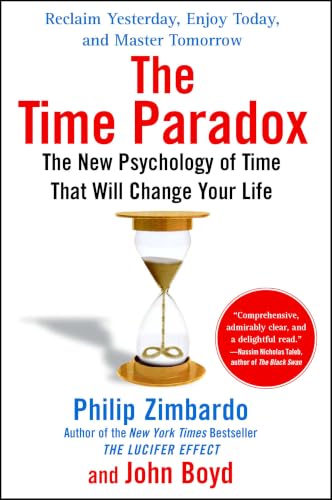

In one sentence
People do not merely experience time; they interpret life through habitual “time perspectives.” These partly unconscious orientations bias choices and behavior. The authors’ practical aim is to help readers recognize their dominant perspective, reduce maladaptive extremes, and switch perspectives deliberately to fit the situation.
Overview
The book combines psychological research, cultural and historical examples, the authors’ time-perspective questionnaire, and self-help exercises. Its central framework divides temporal experience into past, present, and future orientations, each with potentially useful and harmful forms. The proposed ideal is not constant present-moment awareness but a flexible blend: learn from a positive past, enjoy the present, plan for the future, and avoid being trapped by regret, fatalism, or excessive future sacrifice.
Core ideas
Time perspective is a learned bias
A time perspective is an often-unconscious way of organizing experience into temporal categories. It develops through personal history, social context, and culture, then influences what feels salient, rewarding, dangerous, or worth postponing. The “paradox” is that this influence is powerful while usually remaining unnoticed.
The main perspectives
Past-positive emphasizes continuity, gratitude, and good memories; past-negative emphasizes guilt, resentment, or unresolved injury. Present-hedonistic seeks novelty and immediate pleasure; present-fatalistic feels controlled by circumstances and expects little agency. Future-oriented people plan, save, delay gratification, and emphasize consequences. The book also discusses a future-transcendental orientation involving religious afterlife or concern for distant generations. These are dimensions, not rigid personality types.
Every perspective has trade-offs
Future orientation can support achievement and health habits but may produce stress, impatience, and neglected relationships. Present-hedonism can support play, creativity, sociability, and pleasure but can also encourage impulsivity. Past-positive can provide identity and resilience; past-negative can narrow attention around harm. Fatalism is especially associated with diminished agency, but the authors treat temporal biases as modifiable rather than fixed.
Balance means flexibility, not equal amounts
The authors’ preferred profile is broadly high in past-positive, sufficiently future-oriented to plan and persist, able to access present enjoyment, and low in past-negative and present-fatalistic tendencies. The deeper principle is switching perspectives when circumstances require it—for example, using future thinking for saving, present attention for intimacy, and past-positive reflection for identity.
Temporal framing affects major decisions
The framework is applied to procrastination, health behavior, money, relationships, education, aggression, risk, and cultural differences. A choice can look irrational in the present but sensible within someone’s perceived past or future. The authors therefore use time perspective as a lens for understanding behavior rather than treating decisions as isolated acts.
The practical method is awareness followed by deliberate rebalancing
Use the Zimbardo Time Perspective Inventory as a self-reflection tool, identify the perspective that dominates in a particular domain, notice its benefits and costs, and practice counterbalancing behaviors. Examples include recalling constructive past experiences, making future consequences vivid, scheduling enjoyable present activities, and challenging fatalistic interpretations. The goal is not to eliminate a perspective but to gain choice over when it governs behavior.
Practical takeaways
- When stuck, ask: “Am I over-weighting the past, immediate reward, present helplessness, or distant consequences?”
- Pair long-term goals with immediate rewards or enjoyable routines; future planning is easier when the present is not treated as pure sacrifice.
- Use past-positive memories as evidence of competence and continuity, but distinguish them from nostalgia that prevents adaptation.
- Translate fatalistic language into controllable next actions: identify one decision, habit, or environmental change still within your influence.
- For important choices, write one consequence for today, one for next month, and one for the more distant future.
- Treat the inventory as a prompt for reflection, not a diagnosis or a complete account of personality.
Caveats and counterpoints
- The book is a popular-psychology and self-help treatment, not a comprehensive review of every model of temporal cognition. Its claims are often broader and more confident than the underlying correlational research warrants.
- The Zimbardo Time Perspective Inventory measures tendencies along dimensions; categorical “types” are simplified teaching devices, and scores can depend on context, culture, wording, and current mood.
- Some applications—especially explanations of terrorism, national cultures, or complex social behavior—are interpretive and should not be treated as single-cause explanations. A serious review specifically notes the limits of inferring terrorists’ perspectives from necessarily restricted samples.
- The recommended balance is a useful heuristic, not a universally optimal formula. Trauma, poverty, disability, caregiving demands, and unsafe environments can constrain temporal flexibility in ways that individual mindset changes cannot solve.
Questions worth revisiting
- Which time perspective dominates when I am stressed, and which dominates when I feel secure?
- Where does future planning improve my life, and where does it become avoidance of the present?
- Which past experiences am I using as evidence about who I am—and are those memories selectively negative or positive?
- What would a small increase in agency look like in an area where I feel fatalistic?
- Which relationships or goals need more present attention rather than more planning?
Return to this when…
Return to the perspective inventory and the balance principle when making a major decision, changing a habit, recovering from regret, or noticing a recurring conflict between immediate pleasure and long-term aims.
Highlights
No man ever steps into the same river twice, for it’s not the same river and he’s not the same man.” —Heraclitus
Once you recognize that your investments of time have opportunity costs, you can become more conscious of how you make your choices about time, and learn to make happier ones.
A guy from the city is walking down a country road past a farm when he sees a farmer feeding pigs in a highly unusual manner. The farmer is standing under an apple tree, holding up an enormous pig so that the pig can eat as many apples as it wants. The farmer moves the pig from one apple to another until the pig is satisfied, then the farmer starts again with another pig. The city man watches the farmer feed his pigs in this way for some time. Finally, he can’t resist asking the farmer, “Excuse me. I can’t help notice how hard it is for you to lift and carry and feed these pigs one by one at the apple tree. Wouldn’t it save time if you just shook the tree and let the pigs eat what falls on the ground?” The farmer looks at the city guy with a puzzled expression and asks, “But what’s time to a pig?” What pigs are you carrying around that you need to let go of?
In general, the more cognitive processing you do within a given period, the more time you judge to have passed. For example, researchers at Rice University found that people judge sounds that increase or decrease in pitch to be longer than sounds of the same duration and constant pitch. The direction of change does not matter. The amount of change drives the effect.8 Simple changes in tone and volume can cause temporal illusions that lead people to believe that more time has passed than really has.
We universally deny death. Most important, we deny our own death. The Capuchin Crypt touches us precisely because it short-circuits a well-refined ability. Becker wrote: The idea of death, the fear of it, haunts the human animal like nothing else; it is a mainspring of human activity—activity designed largely to avoid the fatality of death, to overcome it by denying in some way that it is the final destiny for man.
Death is the end of a lifetime. Denial of death is a denial that time will end. If you deny that time ends, you are likely to treat time much differently than you would if you felt time to be scarce and of limited duration. If you imagine your life as infinite, you are unlikely to value time as more precious than gold and more likely to treat it as ordinary grains of sand on a beach. Ironically, denying death relieves anxiety and psychological stress, but it may also lead you to devalue life, so you may live less fully. This book is about living life fully, about squeezing life from every year, month, hour, minute, and second that you are allotted. We two authors have spent our lives observing how people spend time, and we want to help you get the most out of yours.
The fact that he suddenly seemed to want something different didn’t make sense. During a very memorable conversation, I asked my dad what had changed in his life from the time when he was my age to his current age of forty. He answered as honestly as he could, but people don’t always know why they change. Sometimes they just do. The best answer that he and I could come up with was that he had been resisting change for some time but could no longer do so and stay true to himself. That very day I resolved not to save all of my change until I turned forty. I resolved to have what I termed a little midlife crisis each day of my life in the hope of avoiding a larger one once I reached forty. I turned forty recently, and my strategy appears to have worked, to some extent. I have not avoided the changes that naturally accompany aging, but I have been better able to embrace the changes that occurred between eighteen and forty. I learned not to fight time but to surrender myself to it. I married later in life and have worked to welcome change in my marriage and myself. Although I’ve avoided the desire for sudden dramatic change, I continue to work on listening to my own advice in other areas. While I love fly-fishing, woodworking, traveling, and spending time with family and friends, sometimes my future time perspective still gets in the way.
References
- Book Praise – The Time Paradox
- The Time Paradox | Book by Philip Zimbardo, John Boyd | Official Publisher Page | Simon & Schuster
- adamtornhill.com
- goodreads.com
- An Overview of Time Perspective Types – The Time Paradox
- The Time Paradox: the new psychology of time that will change your life. | book review | In-Mind
- The Time Paradox: The New Psychology of Time That Will Change Your Life by Philip G. Zimbardo | Goodreads
- Time perspective - Philip G. Zimbardo
- goodreads.com
- books.google.com
- pmc.ncbi.nlm.nih.gov
- books.google.com