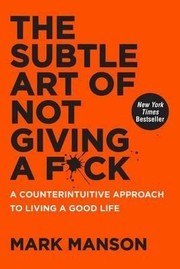
In one sentence
You cannot avoid caring, struggling, or facing problems; you can choose what deserves your limited attention. A better life comes from adopting honest, controllable values and accepting the discomfort, uncertainty, and responsibility that follow.
Overview
Manson’s central target is positivity-driven self-help that treats unpleasant feelings as defects. His alternative is selective concern: care deeply about a smaller number of meaningful values, accept that life is difficult, and stop treating comfort, popularity, success, or feeling good as reliable measures of a life well lived. “Not giving a fuck” means indifference to the unimportant—not apathy.
Core ideas
Choose what deserves your concern
Attention and emotional investment are limited. The practical question is not “How do I stop caring?” but “What is worth caring about?” Reserve concern for relationships, principles, and purposes that can guide action rather than for every opinion, comparison, or inconvenience.
Problems are unavoidable—and meaningful
Happiness is not a permanent state reached by removing difficulty. Struggle is built into worthwhile activities; the useful choice is which problems, sacrifices, and discomforts you are willing to accept. A goal without its associated costs is usually fantasy.
Responsibility is not the same as fault
You may not have caused a circumstance, but you still have responsibility for your response and next steps. This distinction is intended to replace helplessness with agency, not to deny injustice or assign blame to victims.
Values determine the quality of your life
Manson distinguishes durable, behavior-based values—such as honesty, learning, or integrity—from fragile external goals such as admiration, wealth, or always being right. Process-oriented values are more controllable and less dependent on circumstances.
Failure is information, not identity
Avoiding mistakes protects pride but prevents learning. Progress comes from acting, discovering what fails, adjusting, and repeating. The book’s broader point is that confidence is built through contact with reality, not through trying to feel confident first.
Limits and death clarify priorities
Human finitude places boundaries on time, ability, status, and control. Remembering those limits can expose trivial concerns and make chosen commitments more concrete, though the book treats mortality mainly as a philosophical clarifier rather than a clinical intervention.
Say no to protect your yes
Boundaries and rejection are not merely social risks; they reveal what you actually value. Accepting every demand produces diluted commitments and resentment. Meaningful commitments require excluding alternatives and tolerating others’ disappointment.
Practical takeaways
- List the recurring problems you currently face; ask which ones are worth having and which are generated by comparison, avoidance, or poor boundaries.
- Separate three categories: what you control, what you influence, and what you cannot control. Put effort primarily into the first two.
- When upset, ask: “What value is being threatened?” Then test whether that value is honest, controllable, and worth its cost.
- Replace outcome-only goals with behaviors you can practice: tell the truth, submit the work, train consistently, have the difficult conversation.
- Treat discomfort as a possible entry fee, not automatic evidence that you are on the wrong path.
- Practice a deliberate no each week to a demand, habit, or expectation that conflicts with a higher-priority commitment.
- After a failure, write down the specific decision, assumption, or skill that can be changed; avoid turning one event into a global verdict about yourself.
Caveats and counterpoints
- The book popularizes familiar Stoic, Buddhist, existentialist, and psychological themes in an accessible voice; it is not a systematic philosophical or psychological treatment.
- “Take responsibility” can be misread as “you caused your suffering.” Manson’s intended distinction is narrower: responsibility concerns response and action, while fault concerns causation. That distinction does not remove structural constraints, trauma, illness, or other people’s wrongdoing.
- The proposed “good values” are persuasive but not fully derived. Readers still have to judge conflicts among honesty, loyalty, compassion, ambition, safety, and justice.
- The profanity and contrarian framing create memorability, but they can make ordinary advice sound more revolutionary than it is; the book’s force depends heavily on rhetoric and anecdote.
- Acceptance of pain should not become romanticizing preventable harm or tolerating abusive situations. Some problems should be escaped, treated, delegated, or challenged rather than embraced.
Questions worth revisiting
- Which problems am I willing to accept in exchange for the life I want?
- What do I claim to value, and what does my calendar or spending show that I value?
- Which external metric—approval, status, appearance, money, being right—has too much control over my self-worth?
- Where am I confusing responsibility for my next action with blame for what happened?
- What important commitment requires me to disappoint someone or close off an alternative?
- What would change if I judged today by controllable behaviors rather than by mood or outcome?
Return to this when…
Return to the notes when you are overreacting to approval, avoiding a necessary difficulty, or feeling trapped by a problem. Revisit the values questions before making a major commitment; reread the caveats when “responsibility” starts sounding like self-blame or when acceptance starts resembling passivity.
Highlights
The world is constantly telling you that the path to a better life is more, more, more—buy more, own more, make more, fuck more, be more. You are constantly bombarded with messages to give a fuck about everything, all the time. Give a fuck about a new TV. Give a fuck about having a better vacation than your coworkers. Give a fuck about buying that new lawn ornament. Give a fuck about having the right kind of selfie stick. Why? My guess: because giving a fuck about more stuff is good for business. And while there’s nothing wrong with good business, the problem is that giving too many fucks is bad for your mental health. It causes you to become overly attached to the superficial and fake, to dedicate your life to chasing a mirage of happiness and satisfaction.
We joke online about “first-world problems,” but we really have become victims of our own success. Stress-related health issues, anxiety disorders, and cases of depression have skyrocketed over the past thirty years, despite the fact that everyone has a flat-screen TV and can have their groceries delivered. Our crisis is no longer material; it’s existential, it’s spiritual. We have so much fucking stuff and so many opportunities that we don’t even know what to give a fuck about anymore.
Because here’s the thing that’s wrong with all of the “How to Be Happy” shit that’s been shared eight million times on Facebook in the past few years—here’s what nobody realizes about all of this crap: The desire for more positive experience is itself a negative experience. And, paradoxically, the acceptance of one’s negative experience is itself a positive experience.
As the existential philosopher Albert Camus said (and I’m pretty sure he wasn’t on LSD at the time): “You will never be happy if you continue to search for what happiness consists of. You will never live if you are looking for the meaning of life.”
The problem with people who hand out fucks like ice cream at a goddamn summer camp is that they don’t have anything more fuck-worthy to dedicate their fucks to. If you find yourself consistently giving too many fucks about trivial shit that bothers you—your ex-boyfriend’s new Facebook picture, how quickly the batteries die in the TV remote, missing out on yet another two-for-one sale on hand sanitizer—chances are you don’t have much going on in your life to give a legitimate fuck about. And that’s your real problem. Not the hand sanitizer. Not the TV remote. I once heard an artist say that when a person has no problems, the mind automatically finds a way to invent some. I think what most people—especially educated, pampered middle-class white people—consider “life problems” are really just side effects of not having anything more important to worry about. It then follows that finding something important and meaningful in your life is perhaps the most productive use of your time and energy. Because if you don’t find that meaningful something, your fucks will be given to meaningless and frivolous causes.
We suffer for the simple reason that suffering is biologically useful. It is nature’s preferred agent for inspiring change. We have evolved to always live with a certain degree of dissatisfaction and insecurity, because it’s the mildly dissatisfied and insecure creature that’s going to do the most work to innovate and survive. We are wired to become dissatisfied with whatever we have and satisfied by only what we do not have. This constant dissatisfaction has kept our species fighting and striving, building and conquering. So no—our own pain and misery aren’t a bug of human evolution; they’re a feature.
Emotions Are Overrated Emotions evolved for one specific purpose: to help us live and reproduce a little bit better. That’s it. They’re feedback mechanisms telling us that something is either likely right or likely wrong for us—nothing more, nothing less. Much as the pain of touching a hot stove teaches you not to touch it again, the sadness of being alone teaches you not to do the things that made you feel so alone again. Emotions are simply biological signals designed to nudge you in the direction of beneficial change. Look, I don’t mean to make light of your midlife crisis or the fact that your drunk dad stole your bike when you were eight years old and you still haven’t gotten over it, but when it comes down to it, if you feel crappy it’s because your brain is telling you that there’s a problem that’s unaddressed or unresolved. In other words, negative emotions are a call to action. When you feel them, it’s because you’re supposed to do something.
Psychologists sometimes refer to this concept as the “hedonic treadmill”: the idea that we’re always working hard to change our life situation, but we actually never feel very different. This is why our problems are recursive and unavoidable. The person you marry is the person you fight with. The house you buy is the house you repair. The dream job you take is the job you stress over. Everything comes with an inherent sacrifice—whatever makes us feel good will also inevitably make us feel bad. What we gain is also what we lose. What creates our positive experiences will define our negative experiences. This is a difficult pill to swallow. We like the idea that there’s some form of ultimate happiness that can be attained. We like the idea that we can alleviate all of our suffering permanently. We like the idea that we can feel fulfilled and satisfied with our lives forever. But we cannot.
It’s strange that in an age when we are more connected than ever, entitlement seems to be at an all-time high. Something about recent technology seems to allow our insecurities to run amok like never before. The more freedom we’re given to express ourselves, the more we want to be free of having to deal with anyone who may disagree with us or upset us. The more exposed we are to opposing viewpoints, the more we seem to get upset that those other viewpoints exist. The easier and more problem-free our lives become, the more we seem to feel entitled for them to get even better.
This flood of extreme information has conditioned us to believe that exceptionalism is the new normal. And because we’re all quite average most of the time, the deluge of exceptional information drives us to feel pretty damn insecure and desperate, because clearly we are somehow not good enough. So more and more we feel the need to compensate through entitlement and addiction. We cope the only way we know how: either through self-aggrandizing or through other-aggrandizing.
Most self-help gurus ignore this deeper level of self-awareness as well. They take people who are miserable because they want to be rich, and then give them all sorts of advice on how to make more money, all the while ignoring important values-based questions: Why do they feel such a need to be rich in the first place? How are they choosing to measure success/failure for themselves? Is it not perhaps some particular value that’s the root cause of their unhappiness, and not the fact that they don’t drive a Bentley yet? Much of the advice out there operates at a shallow level of simply trying to make people feel good in the short term, while the real long-term problems never get solved. People’s perceptions and feelings may change, but the underlying values, and the metrics by which those values are assessed, stay the same. This is not real progress. This is just another way to achieve more highs.
When we feel that we’re choosing our problems, we feel empowered. When we feel that our problems are being forced upon us against our will, we feel victimized and miserable.
The current media environment both encourages and perpetuates these reactions because, after all, it’s good for business. The writer and media commentator Ryan Holiday refers to this as “outrage porn”: rather than report on real stories and real issues, the media find it much easier (and more profitable) to find something mildly offensive, broadcast it to a wide audience, generate outrage, and then broadcast that outrage back across the population in a way that outrages yet another part of the population. This triggers a kind of echo of bullshit pinging back and forth between two imaginary sides, meanwhile distracting everyone from real societal problems. It’s no wonder we’re more politically polarized than ever before.
There’s a famous Michael Jordan quote about him failing over and over and over again, and that’s why he succeeded. Well, I’m always wrong about everything, over and over and over again, and that’s why my life improves.
Growth is an endlessly iterative process. When we learn something new, we don’t go from “wrong” to “right.” Rather, we go from wrong to slightly less wrong. And when we learn something additional, we go from slightly less wrong to slightly less wrong than that, and then to even less wrong than that, and so on. We are always in the process of approaching truth and perfection without actually ever reaching truth or perfection.
Better values, as we saw, are process-oriented. Something like “Express myself honestly to others,” a metric for the value “honesty,” is never completely finished; it’s a problem that must continuously be reengaged. Every new conversation, every new relationship, brings new challenges and opportunities for honest expression. The value is an ongoing, lifelong process that defies completion. If your metric for the value “success by worldly standards” is “Buy a house and a nice car,” and you spend twenty years working your ass off to achieve it, once it’s achieved the metric has nothing left to give you. Then say hello to your midlife crisis, because the problem that drove you your entire adult life was just taken away from you. There are no other opportunities to keep growing and improving, and yet it’s growth that generates happiness, not a long list of arbitrary achievements.
Freedom grants the opportunity for greater meaning, but by itself there is nothing necessarily meaningful about it. Ultimately, the only way to achieve meaning and a sense of importance in one’s life is through a rejection of alternatives, a narrowing of freedom, a choice of commitment to one place, one belief, or (gulp) one person.
But more is not always better. In fact, the opposite is true. We are actually often happier with less. When we’re overloaded with opportunities and options, we suffer from what psychologists refer to as the paradox of choice. Basically, the more options we’re given, the less satisfied we become with whatever we choose, because we’re aware of all the other options we’re potentially forfeiting.
Becker died in 1974. His book The Denial of Death, would win the Pulitzer Prize and become one of the most influential intellectual works of the twentieth century, shaking up the fields of psychology and anthropology, while making profound philosophical claims that are still influential today.
Even Mark Twain, that hairy goofball who came in and left on Halley’s Comet, said, “The fear of death follows from the fear of life. A man who lives fully is prepared to die at any time.”
Bukowski once wrote, “We’re all going to die, all of us. What a circus! That alone should make us love each other, but it doesn’t. We are terrorized and flattened by life’s trivialities; we are eaten up by nothing.” Looking back on that night,
References
- en.wikipedia.org
- The Subtle Art of Not Giving a Fuck
- wordsandfiction.com
- The Responsibility/Fault Fallacy
- The Subtle Art of Not Giving a F*ck by Mark Manson — Review | Editors Reads
- successbooks.com
- kirkusreviews.com
- mentalhealthathome.org
- Personal Values: How to Know Who You Really Are
- reddit.com
- markmanson.net
- shortform.com