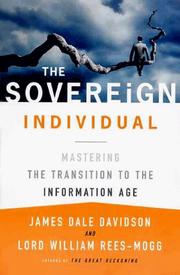

In one sentence
The book argues that technology changes the “logic of violence”: when wealth and productive capability become increasingly digital, portable, and difficult to tax or control territorially, large industrial-era states lose leverage. Sovereignty consequently shifts toward individuals, firms, jurisdictions, and virtual communities able to provide income, security, contracts, and identity competitively.
Overview
Published in 1997—the later Touchstone edition is catalogued as a 1999 publication—the book presents the Information Revolution as a fourth major stage of human society, comparable in importance to the Agricultural, medieval/feudal, and Industrial transformations. Its method is historical analogy: changes in technology alter the scale and organization of coercion, which in turn reshapes political institutions, economic life, morality, and social identity.
Core ideas
Megapolitics: technology sets the political possibilities
The authors look beneath elections and ideologies to material changes—especially communications, computation, miniaturization, and the declining effectiveness of territorial coercion. Their recurring question is not “What should governments do?” but “What can governments still do when capital, work, and information cross borders cheaply?”
The sovereign individual
A sovereign individual is not simply an independent-minded person; it is someone with enough skills, wealth, mobility, and technological access to bargain with governments rather than depend on one state. The ideal is financial and political autonomy, not merely personal freedom. The authors expect this status to begin with a small elite and expand unevenly.
The nation-state as an expensive monopoly
States are treated as providers of protection, law, infrastructure, and redistribution whose power historically rested on territorial control. If productive activity can occur in cyberspace, governments must compete for taxpayers and capital; jurisdictions that charge too much or provide too little may lose their most valuable residents and businesses.
Cyber-economy and cybermoney
The book anticipates a large economic realm beyond ordinary territorial regulation, with encrypted transactions, portable work, offshore finance, and privately controlled forms of money. It predicts that cybermoney would constrain governments’ ability to tax through inflation and that information work would replace the stable industrial “job” with a sequence of tasks or contracts.
Fragmented and competitive sovereignty
Rather than one sovereign authority governing a clearly bounded territory, the future may resemble medieval marches, merchant leagues, or overlapping jurisdictions. Cities, enclaves, firms, virtual communities, and security providers could supply only some governmental functions and compete for allegiance, contracts, and wealth.
Prosperity and inequality arrive together
Digital production could let talented people sell ideas globally and reduce the importance of inherited characteristics or location. But the same process erodes industrial-era redistribution and gives exceptional performers much greater rewards. The authors therefore foresee both expanded opportunity and extreme inequality, with a dangerous transition for people whose skills are less portable.
The state’s backlash
As taxation and monetary control weaken, governments and their beneficiaries will resist. The authors expect capital controls, censorship, coercion, inflation, protectionism, and political movements resembling neo-Luddism. They also anticipate decentralized criminal or quasi-state groups exploiting institutional decay.
Morality after citizenship
The book claims that moral expectations are adapted to particular economic systems. Industrial society emphasized mass solidarity, national identity, and obligations to the state; a more decentralized information economy would require new norms for contracts, security, affiliation, and responsibility. This is also where the authors’ preference for autonomy becomes most openly ideological.
Practical takeaways
- Use the book as a framework for asking which activities depend on physical location, centralized institutions, or easy taxation—and which can be made portable, remote, encrypted, or globally competitive.
- Treat financial independence as broader than net worth: the relevant question is how vulnerable your income, assets, identity, and livelihood are to one institution or jurisdiction.
- Invest in skills that produce differentiated judgment, trusted relationships, or digital output rather than relying exclusively on a fixed occupational title.
- When evaluating governments or platforms, compare the services they provide with the control, extraction, and dependency they impose; the book’s “customer of government” idea is a useful provocation even if its prediction is overstated.
- Expect transitions to create losers, backlash, and new coercive actors—not just liberation. Technological decentralization does not automatically produce benign institutions.
Caveats and counterpoints
- The book’s timing is badly overconfident. It frames the year 2000 as a civilizational turning point and predicts that by 2025 cyberspace would have no meaningful taxes or government; those claims did not occur in the form described.
- Its strongest prediction—that nation-states would largely cease to matter—has not been borne out. Digital commerce, cryptocurrencies, remote work, and global finance remain deeply dependent on state law, banking systems, infrastructure, identity documents, and enforcement.
- The authors underweight collective goods and public legitimacy. As Kirkus notes, their portrayal of the state as primarily coercive and extractive neglects functions many people value, including law, social insurance, public infrastructure, and community.
- The promised anonymity and meritocracy of cyberspace were too optimistic. Digital systems can reduce some forms of discrimination, but they also enable surveillance, platform gatekeeping, reputation scoring, algorithmic exclusion, and concentration of power.
- The book’s historical analogies are suggestive rather than predictive laws. Comparing the Information Revolution with gunpowder, the Reformation, or feudal decentralization illuminates institutional change, but does not establish that the same political outcomes must recur.
- The prose and political judgments are polemical. Kirkus regarded the work as original and thought-provoking but criticized its self-interest, ideological framing, and some sensational claims.
Questions worth revisiting
- Which parts of sovereignty can an individual realistically control without also depending on states, banks, platforms, employers, and infrastructure providers?
- Does digital mobility weaken government power, or does it give governments new ways to monitor, tax, sanction, and regulate individuals?
- If the information economy rewards scarce cognitive skills, what institutions should protect people whose work is automated or geographically immobile?
- Are virtual communities and private firms genuinely substitutes for citizenship, or do they rely on public legitimacy and legal enforcement they cannot provide themselves?
- Which of the book’s forecasts were structural insights, and which were artifacts of late-1990s enthusiasm about the Internet and fear of Y2K?
Return to this when…
Return to this book when thinking about digital assets, remote work, jurisdiction-shopping, crypto, platform power, privacy, taxation, or the political consequences of AI. Read it as a bold libertarian scenario and a source of useful questions—not as a reliable timetable or a demonstrated theory that states are disappearing.
Highlights
This is a situation with striking parallels in the past. Whenever technological change has divorced the old forms from the new moving forces of the economy, moral standards shift, and people begin to treat those in command of the old institutions with growing disdain. This widespread revulsion often comes into evidence well before people develop a new coherent ideology of change. So it was in the late fifteenth century, when the medieval Church was the predominant institution of feudalism.
The challenge it will pose will be all the greater because it will happen with incredible speed compared with anything seen in the past. Through all of human history from its earliest beginnings until now, there have been only three basic stages of economic life. (1) hunting-and-gathering societies; (2) agricultural societies; and (3) industrial societies. Now, looming over the horizon, is something entirely new, the fourth stage of social organization: information societies.
The good news is that the Information Revolution will liberate individuals as never before. For the first time, those who can educate themselves will be almost entirely free to invent their own work and realize the full benefits of their own productivity. Genius will be unleashed, freed from both the oppression of government and the drags of racial and ethnic prejudice. In the Information Society, no one who is truly able will be detained by the ill-formed opinions of others. It will not matter what most of the people on earth might think of your race, your looks, your age, your sexual proclivities, or the way you wear your hair. In the cybereconomy, they will never see you. The ugly, the fat, the old, the disabled will vie with the young and beautiful on equal terms in utterly color-blind anonymity on the new frontiers of cyberspace.
Ideas Become Wealth Merit, wherever it arises, will be rewarded as never before. In an environment where the greatest source of wealth will be the ideas you have in your head rather than physical capital alone, anyone who thinks clearly will potentially be rich. The Information Age will be the age of upward mobility.
The brightest, most successful and ambitious of these will emerge as truly Sovereign Individuals.
At the highest plateau of productivity, these Sovereign Individuals will compete and interact on terms that echo the relations among the gods in Greek myth. The elusive Mount Olympus of the next millennium will be in cyberspace-a realm without physical existence that will nonetheless develop what promises to be the world's largest economy by the second decade of the new millennium. By 2025, the cybereconomy will have many millions of participants. Some of them will be as rich as Bill Gates, worth over $10 billion each. The cyberpoor may be those with an income of less than $200,000 a year. There will be no cyberwelfare. No cybertaxes and no cybergovernment. The cybereconomy, rather than China, could well be the greatest economic phenomenon of the next thirty years.
After the turn of the millennium, much of the world’s commerce will migrate into the new realm of cyberspace, a region where governments will have no more dominion than they exercise over the bottom of the sea or the outer planets. In cyberspace, the threats of physical violence that have been the alpha and omega of politics since time immemorial will vanish. In cyberspace, the meek and the mighty will meet on equal terms. Cyberspace is the ultimate offshore jurisdiction. An economy with no taxes. Bermuda in the sky with diamonds.
In the Information Age, individuals will be able to use cybercurrencies and thus declare their monetary independence. When individuals can conduct their own monetary policies over the World Wide Web it will matter less or not at all that the state continues to control the industrial-era printing presses. Their importance for controlling the world’s wealth will be transcended by mathematical algorithms that have no physical existence. In the new millennium, cybermoney controlled by private markets will supersede fiat money issued by governments.
Businesses that offer services that facilitate the realization of autonomy by individuals will be subject to infiltration, sabotage, and disruption. Arbitrary forfeiture of property, already commonplace in the United States, where it occurs five thousand times a week, will become even more pervasive. Governments will violate human rights, censor the free flow of information, sabotage useful technologies, and worse.
For the same reasons that the late, departed Soviet Union tried in vain to suppress access to personal computers and Xerox machines, Western governments will seek to suppress the cybereconomy by totalitarian means.
The clash between the new and the old will shape the early years of the new millennium. We expect it to be a time of great danger and great reward, and a time of much diminished civility in some realms and unprecedented scope in others. Increasingly autonomous individuals and bankrupt, desperate governments will confront one another across a new divide. We expect to see a radical restructuring of the nature of sovereignty and the virtual death of politics before the transition is over. Instead of state domination and control of resources, you are destined to see the privatization of almost all services governments now provide. For inescapable reasons that we explore in this book, information technology will destroy the capacity of the state to charge more for its services than they are worth to you and other people who pay for them.