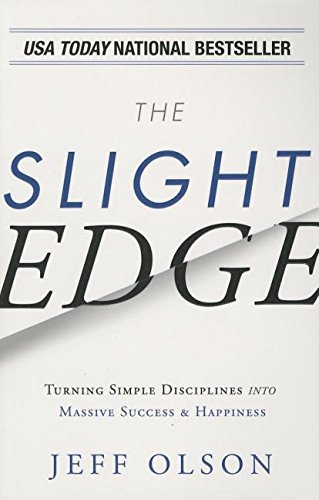

In one sentence
The central idea is that small, easy-to-do actions—performed consistently over time—compound into significant results. The same mechanism works negatively: repeatedly postponing simple beneficial actions gradually produces stagnation or decline. Olson presents this less as a productivity technique than as a way of interpreting choices, time, and progress.
Overview
The 2013 “8th Anniversary Edition” expands the original book and is organized in two parts: first, how the Slight Edge supposedly works; second, how to live it. Its progression moves from compounding and choice to mundane routines, delayed results, happiness, ripple effects, mentors, habits, goals, and a written implementation plan.
Core ideas
Compounding beats intensity
The meaningful unit of progress is not an occasional heroic effort but a repeatable behavior. Olson’s examples emphasize that small actions may appear irrelevant on any single day while becoming consequential through accumulation. The principle applies in both directions: constructive routines build capacity; neglect also compounds.
The difficult part is the invisible interval
Early results are often too small to notice, creating a temptation to quit. “Slow down to go fast” means accepting a delay between disciplined action and visible payoff. Time becomes an ally only if the behavior continues during this flat-looking phase.
Master the mundane
The behaviors that matter are usually unglamorous: reading, saving, practicing, following up, exercising, or maintaining relationships. Their simplicity is the trap—they are easy to do and equally easy to skip. The book’s recurring challenge is to respect ordinary actions rather than wait for a breakthrough.
Choice precedes habit
Olson frames daily behavior as a choice about which life path to reinforce. Repeated choices eventually become habits, and habits make future choices easier or harder. This shifts attention from dramatic goals to the routine decisions that make those goals plausible.
Build an environment for continuation
The later chapters recommend investing in yourself, learning from mentors, using supportive “allies,” cultivating habits, and reviewing goals. These are not separate success secrets so much as supports for keeping the small actions going. The contents explicitly place mentors, allies, habits, and a three-step dream process in the application section.
Success and happiness are connected but distinct
The expanded edition adds discussion of happiness and the “ripple effect,” suggesting that personal choices affect other people and that progress should not be postponed until a distant achievement. The book therefore treats the Slight Edge as a way to create both future results and a more constructive present orientation.
Practical takeaways
- Choose one or two “slight edge” behaviors that are small enough to perform even on a bad day; define them concretely rather than as vague intentions.
- Track consistency and leading behaviors, not only outcomes. A result may remain invisible while the underlying routine is working.
- Create a minimum version of important habits—for example, a short reading session or a brief practice block—so continuation is easier than avoidance.
- Review goals regularly and connect each goal to a recurring action. The book’s final chapters emphasize moving from aspiration to a specific implementation plan.
- Use mentors, books, and encouraging peers to reduce trial-and-error and protect the routine from discouragement.
- Apply the negative version of the model: identify small defaults—procrastination, overspending, skipped exercise, neglected communication—that are quietly compounding.
Caveats and counterpoints
- The book’s core proposition is useful as a behavioral reminder, but it can oversimplify success by emphasizing personal consistency while giving limited attention to luck, health, discrimination, economic conditions, caregiving, and unequal access to opportunity.
- Its case is primarily motivational and anecdotal rather than a rigorous empirical demonstration of one universal law. Treat “compounding” as a useful mental model, not a guarantee that every repeated action will produce exponential results.
- Consistency cannot substitute for strategy. A person can steadily repeat an ineffective, unsafe, or poorly chosen behavior; feedback, adaptation, and occasionally large interventions still matter.
- The book is deliberately repetitive. A contemporary review praised the central insight but judged that it was extended to book length, while reader criticism similarly describes the idea as underdeveloped relative to the length.
- The advice may work best for goals with controllable, accumulative inputs—skill practice, saving, fitness, or relationship maintenance—and less predictably for outcomes dominated by external gatekeepers or one-time events.
Questions worth revisiting
- Which small action, if repeated for a year, would make the largest difference in my current situation?
- What beneficial action is genuinely easy to do but easy for me to avoid?
- Where am I expecting a “quantum leap” instead of measuring faithful repetition?
- What evidence would tell me that my chosen routine is ineffective and needs revision?
- Which people, books, or environments make the desired behavior easier to sustain?
- What negative habit is compounding quietly in the opposite direction?
Return to this when…
Return to these notes when you are tempted to abandon a worthwhile routine because results are not yet visible, or when you need to distinguish a sustainable daily practice from a short-lived burst of motivation.
References
- The Slight Edge - Jeff Olson - Google Books
- barnesandnoble.com
- slightedge.com
- johndavidmann.com
- The Slight Edge Review and Summary - Alan Spicer - YouTube Certified Expert
- fictionroom.com
- books.google.com
- The Slight Edge Book Summary by Jeff Olson | Sumizeit
- 1hourguide.co.za
- goodreads.com
- goodreads.com
- fourthstream.com