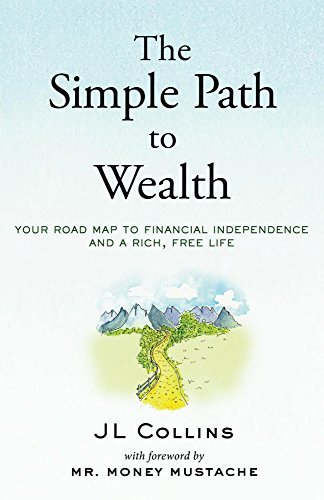
In one sentence
Financial freedom is achieved less through clever investing than through behavior: spend less than you earn, avoid destructive debt, invest the surplus consistently in low-cost broad-market index funds, and remain invested through market declines. Wealth matters chiefly because it buys autonomy, not because it enables consumption.
Overview
Collins presents a deliberately simple path aimed especially at people who do not want to become financial experts. The sequence is behavioral first—control spending, reject status consumption, and eliminate high-cost debt—then technical: use tax-advantaged accounts where appropriate, favor broad index funds over stock-picking and active management, and develop the emotional discipline to tolerate volatility. The book’s framework is rooted in the U.S. financial system and in the author’s letters to his daughter and earlier blog essays.
Core ideas
Money is a freedom tool
Collins treats money as a means of reducing dependence on employers and increasing the ability to choose how to spend one’s time. His idea of “F-you money” is a psychological threshold: enough assets to make refusal, career changes, or time off possible.
Savings rate matters more than investment cleverness
The central practical equation is: spend less than you earn, then invest the difference. A high savings rate both accelerates accumulation and lowers the amount of money needed to support your lifestyle in financial independence.
Debt can reverse the compounding engine
Consumer and high-interest debt compound against the borrower. Collins therefore treats debt elimination—especially costly, consumption-driven debt—as a prerequisite to investing, while presenting debt as a constraint on freedom rather than merely a mathematical liability.
Own the market, not a story
The preferred vehicle is a low-cost total-stock-market index fund, historically represented in the book by Vanguard’s VTSAX and its ETF equivalent. The logic is broad diversification, minimal fees, low turnover, and no need to predict which companies or professional managers will win.
Behavior beats optimization
The strategy only works if the investor can continue buying and holding during crashes. Market declines are presented as an unavoidable feature of owning stocks, not as evidence that the plan has failed. Panic selling is more dangerous than choosing a slightly imperfect allocation.
Accumulation and withdrawal are different phases
The book distinguishes aggressively accumulating assets from preserving and spending them in financial independence. It discusses adding bonds, withdrawal planning, and the commonly used 4% rule, which connects a portfolio target to annual spending rather than to an arbitrary wealth number.
Tax shelters and account placement matter
The revised material covers 401(k), 403(b), TSP, IRA, Roth, HSA, required minimum distributions, and withdrawal sequencing. The broader lesson is to use account types intentionally, not to treat every investment account as interchangeable.
Practical takeaways
- Calculate your annual spending; a rough independence target can be estimated by multiplying it by 25, while recognizing that this is a historical planning heuristic, not a guarantee.
- Eliminate high-interest debt and avoid lifestyle inflation before trying to optimize investments.
- Automate contributions to a diversified, low-cost index fund or a similarly simple diversified portfolio.
- Prefer a written asset-allocation and crash-response plan to predictions about the next recession or market winner.
- Use employer retirement plans and other tax-advantaged accounts where they fit your circumstances; account rules and tax treatment require current verification.
- Judge progress by savings rate, invested assets, and flexibility—not by income, possessions, or short-term portfolio performance.
Caveats and counterpoints
- The book’s strongest recommendation is U.S.-centric: a U.S. total-market fund is not the same as a globally diversified portfolio. Investors outside the United States, or those concerned about country concentration, may reasonably choose a global index approach.
- The heavy-equity strategy can experience severe and prolonged declines. It is unsuitable if the investor cannot tolerate large losses or needs the money soon.
- The 4% withdrawal framework is based on historical research and assumptions; future returns, inflation, taxes, fees, and retirement length may differ. It should not be treated as a guaranteed safe rate.
- The book favors simplicity over individualized planning. Families with irregular income, pensions, concentrated employer stock, major healthcare needs, estate concerns, or unusual tax situations may need more detailed advice.
- Some specific fund names, tax rules, withdrawal sequences, and allocation suggestions can become outdated. The 2025 revised and expanded edition updates the book, but readers should still verify current rules and fund details.
- Critics may find Collins too categorical about avoiding advisors, bonds, international diversification, real estate, or other approaches. The underlying behavioral principles are broader than every specific portfolio prescription.
Questions worth revisiting
- What annual spending level would make work optional for me?
- What debt, recurring expense, or lifestyle commitment most limits my freedom?
- Could I hold my chosen stock allocation through a 40–50% market decline?
- Am I using tax-advantaged accounts appropriately for my country and situation?
- Would a globally diversified index fund or target-date fund be simpler and better suited to me than a U.S.-only portfolio?
- What written rules will govern buying, rebalancing, and withdrawals when markets fall?
Return to this when…
Return when you need a behavioral reset: after market panic, lifestyle creep, temptation to pick stocks, or confusion caused by excessive financial-product complexity. The most durable refresher is the sequence: control spending, remove expensive debt, automate broad low-cost investing, and protect your ability to stay invested.
Highlights
“If you reach for a star, you might not get one. But you won’t come up with a hand full of mud either.” — Leo Burnett
“Simplicity is the keynote of all true elegance.” —Coco Chanel