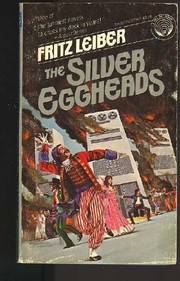

In one sentence
The novel satirizes the commercialization and mechanization of literature, but its sharper question is broader: if culture is produced according to formulas and consumed as packaged entertainment, what remains of authorship, originality, or human artistic purpose? Leiber’s answer is deliberately unstable and comic rather than programmatic.
Overview
First published in a shorter form in The Magazine of Fantasy & Science Fiction in 1959 and expanded to book length for its early-1960s publication, The Silver Eggheads centers on a literary future where publishers rely on “wordmills” to produce popular fiction. Human writers function largely as public-facing performers. After the machines are disrupted, the publishing world turns toward preserved brains—the titular “silver eggheads”—as a possible source of authentic literary production. The setup lets Leiber collide publishing commerce, literary prestige, automation, sexual comedy, and robot selfhood without becoming a conventional technological warning.
Core ideas
Automation does not eliminate taste; it industrializes it
The wordmills do not merely replace writers. They embody a whole system in which market research, formulas, branding, and reader appetite determine what counts as a successful book. The satire targets publishers and audiences as much as machines.
Authorship becomes performance
Human “authors” are treated as personalities and actors rather than makers. This reverses the usual science-fiction fear of machines becoming human: here, humans have already been reduced to machine-compatible roles.
The novel distrusts both mass culture and literary prestige
Leiber mocks formulaic popular fiction, but the “silver eggheads” also complicate any simple defense of the classics. Preserving great authors as usable intellectual resources turns literary reverence into another form of exploitation.
Robots are comic mirrors of human institutions
Characters such as Gaspard de la Nuit, Zane Gort, Miss Blushes, Nurse Bishop, and the publishers allow Leiber to project human desires, censorship, romance, vanity, and professional rivalry into mechanical bodies. The robots are not just devices; they expose the absurdity of supposedly human systems.
Prophecy is part of the joke, not the whole point
The premise now recalls automated text generation and synthetic media, which makes the book feel unexpectedly current. But its historical target is the mid-century publishing and paperback culture of mass production, celebrity authorship, Beat-era mannerisms, and commercial “wordwooze.”
Farce weakens and strengthens the satire
The book’s episodic, exuberant comedy can make its argument feel uneven; reviewers have found the expanded novel less focused than its central premise. Yet the excess is also characteristic of Leiber’s method: intellectual concerns arrive through slang, grotesque invention, sexual absurdity, and verbal play.
Practical takeaways
- When a cultural product feels standardized, examine the entire production system—not only the technology generating it.
- Distinguish authorship from author-branding: public identity, performance, and ownership may survive even after creative labor has been outsourced.
- Be suspicious of both technological utopianism and nostalgia for “real” art; prestige can be commodified just as easily as popular entertainment.
- A useful question for rereading: does Leiber believe human creativity is intrinsically special, or does he mainly enjoy showing how quickly every claim to specialness becomes theatrical?
- Notice where the novel’s dated gender politics and sexual comedy limit its critique. Some of its social satire has aged less well than its automation premise.
Caveats and counterpoints
- Publication details vary across catalogue records: the work appeared first as a shorter 1959 magazine version and later as an expanded book, commonly dated 1961 or 1962 depending on the edition and bibliography.
- The book’s reputation is mixed. Some readers value its anticipatory treatment of machine-written fiction and its wordplay; others find the expanded structure loose, the slang dated, and the treatment of women or sexuality uncomfortable.
- These notes summarize the work and published commentary; they do not assume access to the user’s particular edition or reproduce its full text.
Questions worth revisiting
- Does the novel ultimately oppose machine-made literature, or does it suggest that human literature was already formulaic and performative?
- Why make the surviving literary authorities preserved brains rather than living writers? What does this imply about canonization and intellectual property?
- Is Gaspard a satirical representative of literary culture, a sympathetic victim of it, or both?
- Where does the book’s comedy generate insight, and where does it merely date the novel?
- How much of the novel’s apparent prescience comes from genuinely anticipating AI, and how much comes from recognizing older patterns of commercial culture?
- Would the satire work differently if the machines were collaborators rather than replacements?
Return to this when…
Return to this book when thinking about AI-generated writing, celebrity authorship, publishing consolidation, or the difference between producing texts and making literature. It is especially useful as a reminder that anxieties about automated creativity long predate contemporary generative AI—and that the deeper concern is often economic and institutional, not merely technological.
Highlights
The weird suggestion made by one rogue humanist that this was due to wordwooze itself being completely unintelligible — verbal opium of zero meaningfulness and so providing no training in reading material with a content — never got into the news at all.
“A Russian once wrote a little story about how on a bet a man let himself be locked alone in a comfortable room for five years; the first three years he asked for many books, the fourth year he asked for the Gospels, the fifth year he asked for nothing. Our situation is his, intensified a thousandfold. How could you ever think that we would stoop to writing books for you, to working out combinations and permutations of your itches and hates?