
In one sentence
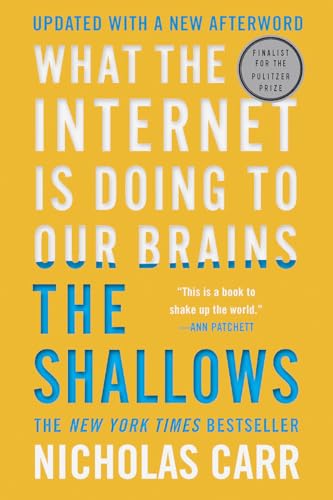
Carr’s central claim is that media are not neutral containers. By repeatedly shaping what we attend to and how we process information, they help shape the mind itself. The internet rewards speed, novelty, multitasking, and efficient retrieval; Carr argues that these habits can weaken the concentration, comprehension, memory, and reflective thought associated with deep reading.
Overview
The book begins with Carr’s worry that his own capacity for sustained reading has declined, extending the question raised in his 2008 essay “Is Google Making Us Stupid?” It then places the internet in a longer history of intellectual technologies: writing externalized memory, the clock encouraged measurement and scheduling, the map altered spatial understanding, and the printing press helped cultivate linear, solitary reading. Carr uses these examples to argue that tools change habits of mind, not merely the efficiency of tasks. He next surveys brain plasticity, attention, working memory, and studies of online reading and multitasking. The final chapters contrast shallow, fragmented browsing with deep reading and ask what may be lost when convenience becomes the dominant value.
Core ideas
The medium helps form the message—and the mind
Following media theorists such as Marshall McLuhan, Carr treats a technology’s structure as consequential. A medium that promotes links, alerts, search results, and rapid movement through text encourages different cognitive routines from a printed book’s relatively uninterrupted linear sequence.
Neuroplasticity cuts both ways
The brain adapts to repeated activity. Carr’s point is not that the internet permanently destroys a fixed “attention span,” but that frequent online habits strengthen scanning, switching, and stimulus-seeking pathways while making sustained concentration less practiced.
Distraction has a cognitive cost
Online reading often combines text with choices, links, advertisements, notifications, and competing tasks. Carr argues that switching consumes working memory and attention, reducing comprehension and making it harder to transfer information into durable understanding.
Information access is not the same as knowledge
Search engines make retrieval faster, but finding a relevant fragment does not guarantee context, judgment, synthesis, or memory. Carr worries that outsourcing recall and evaluation can leave users dependent on systems that supply information without helping them develop a coherent mental framework.
Deep reading is an acquired practice
Extended reading requires patience, inference, comparison, and reflection. Carr presents it as a culturally developed capability rather than an automatic human default—one that can be cultivated by print and undermined when attention is continually interrupted.
Technology brings real benefits, but benefits do not settle the trade-off
The internet expands access, speed, connectivity, and the ability to search across enormous bodies of material. Carr’s concern is opportunity cost: the same system that improves retrieval may make difficult, slow, integrative thinking less likely.
Practical takeaways
- Separate retrieval from understanding: after searching, close the browser and summarize the idea from memory in your own words.
- Protect blocks of uninterrupted reading for work that requires synthesis, argument, or imagination; do not treat all reading as interchangeable.
- Reduce unnecessary switching—especially notifications, open tabs, and simultaneous media—when comprehension matters.
- Use the internet deliberately: search with a question, evaluate sources, follow promising material deeply, then stop browsing.
- Keep some knowledge internal rather than outsourcing every fact to a device; remembered frameworks make later information easier to interpret.
- Judge digital tools by the cognitive task. Rapid scanning may suit discovery, while paper or distraction-free screens may better support sustained analysis.
Caveats and counterpoints
- Carr’s strongest evidence concerns distraction, divided attention, and the conditions of online reading; the broader claim that internet use is reshaping the brain in a generally harmful direction is more speculative. Contemporary reviews noted that the relevant neuroscience was still limited when the book appeared.
- The argument can overgeneralize from the design of early-2010s web use. Online reading is not uniformly shallow: readers can alternate between quick “grazing” and deliberate deep dives, and digital tools can support annotation, accessibility, collaboration, and serious research.
- Carr emphasizes harms more than distributional differences. Effects likely vary with task, prior knowledge, age, motivation, interface design, and whether a person is reading, creating, communicating, gaming, or multitasking.
- The book’s historical analogies are illuminating but not controlled experiments. A new medium may alter cognition, yet changes in education, work, social norms, and commercial attention markets also contribute to observed behavior.
- The book is best read as a cultural warning and a framework for noticing trade-offs—not as proof that digital technology inevitably makes people less intelligent.
Questions worth revisiting
- Which online activities genuinely improve my understanding, and which merely create the feeling of being informed?
- When I remember a source, do I remember its argument, or only where I can retrieve it?
- What kinds of work require deep reading, and have I given them an environment designed for it?
- Am I blaming “the internet” for problems caused more specifically by notifications, platform incentives, or poor task design?
- How might the book’s thesis change when applied to smartphones, algorithmic feeds, video, and generative AI rather than the web of 2010?
Return to this when…
Return to these notes when designing a reading or work environment, evaluating claims about attention and technology, or deciding whether a digital tool is improving understanding versus merely accelerating information retrieval.
Highlights
Whether I’m online or not, my mind now expects to take in information the way the Net distributes it: in a swiftly moving stream of particles. Once I was a scuba diver in the sea of words. Now I zip along the surface like a guy on a Jet Ski.
According to Sweller, current evidence suggests that “we can process no more than about two to four elements at any given time with the actual number probably being at the lower [rather] than the higher end of this scale.” Those elements that we are able to hold in working memory will, moreover, quickly vanish “unless we are able to refresh them by rehearsal.”
Imagine filling a bathtub with a thimble; that’s the challenge involved in transferring information from working memory into long-term memory. By regulating the velocity and intensity of information flow, media exert a strong influence on this process. When we read a book, the information faucet provides a steady drip, which we can control by the pace of our reading. Through our single-minded concentration on the text, we can transfer all or most of the information, thimbleful by thimbleful, into long-term memory and forge the rich associations essential to the creation of schemas. With the Net, we face many information faucets, all going full blast. Our little thimble overflows as we rush from one faucet to the next. We’re able to transfer only a small portion of the information to long-term memory, and what we do transfer is a jumble of drops from different faucets, not a continuous, coherent stream from one source.
Try reading a book while doing a crossword puzzle; that’s the intellectual environment of the Internet.
Navigating the Web requires a particularly intensive form of mental multitasking. In addition to flooding our working memory with information, the juggling imposes what brain scientists call “switching costs” on our cognition. Every time we shift our attention, our brain has to reorient itself, further taxing our mental resources. As Maggie Jackson explains in Distracted, her book on multitasking, “the brain takes time to change goals, remember the rules needed for the new task, and block out cognitive interference from the previous, still-vivid activity.”
The Roman philosopher Seneca may have put it best two thousand years ago: “To be everywhere is to be nowhere.”
When, in early 2009, Facebook responded to Twitter’s rapid growth by announcing that it was revamping its site to, as it put it, “increase the pace of the stream,” its founder and chief executive, Mark Zuckerberg, assured its quarter of a billion members that the company would “continue making the flow of information even faster.”
Google hasn’t been sitting still. To combat the upstarts, it has been revamping its search engine to ratchet up its speed. The quality of a page, as determined by the links coming into it, is no longer Google’s chief criterion in ranking search results. In fact, it’s now only one of two hundred different “signals” that the company monitors and measures, according to Amit Singhal, a top Google engineer.23 One of its major recent thrusts has been to place a greater priority on what it calls the “freshness” of the pages it recommends. Google not only identifies new or revised Web pages much more quickly than it used to—it now checks the most popular sites for updates every few seconds rather than every few days—but for many searches it skews its results to favor newer pages over older ones. In May 2009, the company introduced a new twist to its search service, allowing users to bypass considerations of quality entirely and have results ranked according to how recently the information was posted to the Web.
the task and the less they ended up learning. The findings indicate, van Nimwegen concluded, that as we “externalize” problem solving and other cognitive chores to our computers, we reduce our brain’s ability “to build stable knowledge structures”—schemas, in other words—that can later “be applied in new situations.”
A series of psychological studies over the past twenty years has revealed that after spending time in a quiet rural setting, close to nature, people exhibit greater attentiveness, stronger memory, and generally improved cognition. Their brains become both calmer and sharper. The reason, according to attention restoration theory, or ART, is that when people aren’t being bombarded by external stimuli, their brains can, in effect, relax. They no longer have to tax their working memories by processing a stream of bottom-up distractions. The resulting state of contemplativeness strengthens their ability to control their mind.
That’s the essence of Kubrick’s dark prophecy: as we come to rely on computers to mediate our understanding of the world, it is our own intelligence that flattens into artificial intelligence.
spot
References
- THE SHALLOWS | Kirkus Reviews
- theguardian.com
- Book Review: The Shallows: What the Internet is Doing to Our Brains by Nicholas Carr
- The Shallows: How the Internet Is Changing the Way We Think, Read and Remember by Nicholas Carr | Technology books | The Guardian
- goodreads.com
- researchgate.net
- seattlepi.com
- scholar.lib.vt.edu
- pbs.org
- k--b.org
- researchgate.net
- torontoreviewofbooks.com