
In one sentence
Financial security is built less by a lucky windfall than by repeatedly directing part of your income toward ownership, disciplined spending, productive investment, and protection from avoidable loss.
Overview
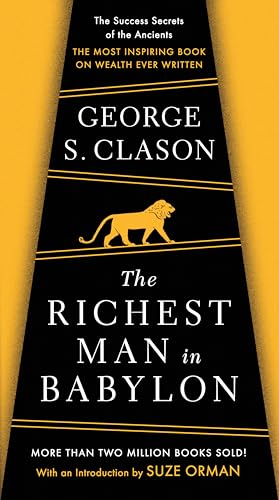
Clason presents money lessons as fictional conversations and stories involving workers, merchants, lenders, and rulers in Babylon. The central teacher, Arkad, explains how an ordinary person can become wealthy by changing daily habits. The book’s core frameworks are the Seven Cures for a Lean Purse and the Five Laws of Gold, supported by stories about debt, luck, investment, work, and trustworthy advice. The book was first published in 1926 and is structured as a collection of parables rather than a continuous narrative.
Core ideas
Pay yourself first
Automatically reserve at least one-tenth of every inflow for yourself before satisfying other spending. The point is to create a permanent surplus and make saving a default behavior, not an end-of-month aspiration.
Control expenses without confusing wants with needs
Income alone does not create wealth. Spending tends to expand to absorb available money, so distinguish essential obligations from desires and give each category a deliberate limit.
Make savings productive
Accumulated money should generate more money through investments or lending. Wealth grows when savings become income-producing assets rather than remaining idle or being consumed.
Protect principal from loss
The book treats avoiding ruin as more important than chasing spectacular returns. Understand an investment before committing, diversify rather than concentrating risk, and be especially wary of schemes promising unusually easy profits.
Use competent advice
Financial guidance should come from people with demonstrated experience in the specific area—not merely from someone who sounds confident or works near the subject. Advice is valuable only when the adviser’s incentives and competence are trustworthy.
Increase earning capacity
Saving becomes easier when skills, knowledge, judgment, and productivity improve. The book links wealth-building to a continuing effort to become more valuable and capable.
Treat debt as a plan, not a permanent condition
Debt repayment should be systematic and compatible with continued saving. The broader lesson is to regain control of future income rather than allowing past consumption to claim it indefinitely.
Consistency beats luck
Stories about luck contrast passive hope with preparation and action. Opportunity matters, but the book’s preferred response is to recognize it, act decisively, and have the discipline to keep the resulting gains.
Practical takeaways
- Set an automatic savings or investment transfer of a fixed percentage of income; 10% is the book’s memorable starting rule, not a universal prescription.
- Track recurring expenses for a month and label each as necessary, useful, or discretionary. Reduce the categories that expand without improving your priorities.
- Build a cash reserve before taking substantial investment risk, especially if income is unstable or high-interest debt remains.
- Before investing, write down how the investment makes money, what could cause a permanent loss, how liquid it is, and why the source of advice is qualified.
- Use a simple debt schedule that specifies the payment, interest cost, and payoff date while preserving some capacity to save.
- Choose one skill that can increase future income and invest time or money in improving it.
- Review the system periodically: savings rate, spending, debt, investment risk, and earning power.
Caveats and counterpoints
- The book is a principles-and-behavior guide, not a modern investing manual. It does not provide asset allocation, tax planning, retirement-account guidance, insurance analysis, or security-selection methods.
- The repeated 10% target is useful as a behavioral rule but may be too high for someone facing basic financial insecurity or too low for a specific retirement goal. A workable rate depends on income, obligations, location, age, risk, and time horizon.
- Its strong emphasis on individual discipline can understate structural constraints such as low wages, medical costs, discrimination, housing prices, predatory lending, and unequal access to investment opportunities.
- The Babylonian setting is a literary device for presenting advice, not evidence that the specific rules were literally discovered or practiced as described in ancient Babylon. The work is best read as twentieth-century financial self-help in historical costume.
- Parables make the lessons memorable but can imply that success follows reliably from correct behavior. Good habits improve odds; they do not eliminate market risk, economic shocks, or bad luck.
Questions worth revisiting
- What percentage of my income can I save automatically without relying on willpower?
- Which expenses are genuinely necessary, and which are recurring desires disguised as necessities?
- What is my current highest-cost debt, and what repayment plan would eliminate it?
- Do I understand the risks and fees of each investment I own?
- Whose financial advice do I trust, and what evidence shows that the adviser is competent and acting in my interest?
- Which skill or change in work could most improve my earning power over the next year?
- Am I protecting against a single catastrophic loss before pursuing higher returns?
Return to this when…
Return to the Seven Cures and Five Laws when your finances feel diffuse or reactive. The book is most useful as a short reset for saving, spending, debt, and investment behavior—not as a substitute for current, individualized financial planning.
Highlights
'you have learned your lessons well. You first learned to live upon less than you could earn. Next you learned to seek advice from those who were competent through their own experiences to give it. And, lastly, you have learned to make gold work for you.
If you desire to help thy friend, do so in a way that will not bring thy friend's burdens upon thyself."
References
- The Richest Man in Babylon: The Complete Original Edition Plus Bonus ... - George S. Clason - Google Books
- openlibrary.org
- en.wikipedia.org
- successbooks.com
- librivox.org
- The Richest Man in Babylon by George S. Clason - Book Summary & Frameworks (2026) | Find My Moat
- supersummary.com
- michaelryanmoney.com
- thebookshort.com
- en.wikisource.org
- bombayreads.com
- peopleandmedia.com