
In one sentence
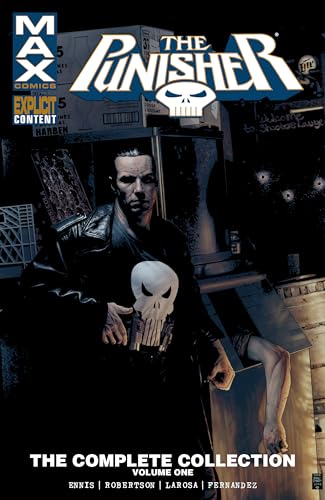
This is less a conventional Punisher story than a grotesque character study of Barracuda: a predator whose confidence, theatrical cruelty, and survival instinct make him both repellent and strangely compelling. Ennis uses him to satirize mercenary culture, American interventionism, corrupt power, and the macho fantasy of being impossible to kill. Marvel identifies the collection as the five-issue Punisher Presents: Barracuda MAX miniseries, written and illustrated by Garth Ennis and Goran Parł
Overview
The catalogue description appears to identify the 2020 trade paperback Punisher Presents: Barracuda MAX, which collects the 2007 five-issue miniseries—not the entire Ennis Punisher MAX run. Barracuda, previously maimed and apparently left for dead by Frank Castle, seeks the resources to retaliate. His path leads into the fictional Central American republic of Santa Morricone, where revolution, military force, criminal enterprise, and personal revenge collide. The Punisher is important to the premise but is not the story’s sustained center.
Core ideas
Barracuda as anti-Punisher
Frank Castle is driven by grim purpose and procedural violence; Barracuda is driven by appetite, vanity, improvisation, and pleasure. Both are highly effective killers, but the contrast exposes how much of the Punisher’s appeal depends on discipline and self-imposed limits.
Cruelty as performance
Barracuda does not merely commit violence; he performs dominance. His jokes, bravado, physical exaggeration, and refusal to acknowledge vulnerability turn brutality into spectacle. The humor is deliberately repulsive rather than comforting.
Political violence without moral cleanliness
The fictional revolution provides a setting in which governments, armies, insurgents, businessmen, and criminals all exploit instability. Ennis’s satire suggests that violence does not become noble simply because it is attached to a political cause.
The body as proof of survival
Barracuda’s mutilations make survival visible. His damaged body is not a sentimental symbol of suffering so much as evidence of monstrous resilience—and a challenge to the idea that punishment reliably produces justice.
MAX’s adult, unrestrained register
The MAX imprint permits explicit violence, sexual material, profanity, and harsher political cynicism. The book’s excess is part of its method, but it also creates a meaningful tension: satire can expose brutality while risking complicity in the spectacle it mocks.
Goran Parlov’s visual role
Parlov’s art supports the story’s uneasy blend of ugliness and comic exaggeration. Barracuda’s imposing physicality and the setting’s violent instability are made readable through a style that can shift from grim realism to grotesque caricature. Marvel credits Parlov as penciller and inker.
Practical takeaways
- Notice how the story distinguishes ideological conviction from the personal thrill of power.
- Ask whether making a villain entertaining weakens the satire—or makes the attraction of brutality harder to ignore.
- Compare Barracuda’s survival ethic with Frank Castle’s mission: both reject ordinary society, but only one treats violence as an identity and a joke.
- Pay attention to how revolutionary language and criminal self-interest overlap in the setting.
- Treat the book’s comedy cautiously: laughter is often being used to reveal moral numbness, not to make the violence harmless.
Caveats and counterpoints
- This identification is based on the supplied description and Marvel’s matching synopsis; “The Punisher MAX” is also used for several larger collected editions of Ennis’s run. The matching standalone book is Punisher Presents: Barracuda MAX (2020 trade paperback), collecting issues #1–5.
- The book is intentionally extreme. Its sexual violence, racialized exploitation, sadism, and political cynicism are not incidental content, and readers may reasonably find its comedy damaging, immature, or ethically evasive.
- Barracuda is the focus, so readers expecting a typical Frank Castle-led Punisher narrative may find the book unusually tangential.
- Interpretations of the book’s satire differ: some see the excess as an indictment of macho power fantasies, while others see it as reproducing the pleasures it claims to criticize. The latter concern is especially difficult to dismiss because the story foregrounds Barracuda’s charisma.
Questions worth revisiting
- Is Barracuda frightening because he is powerful, or because he treats morality and consequences as irrelevant games?
- Does the story successfully satirize imperial and mercenary violence, or does its own sensationalism blur that critique?
- Why does Ennis make Barracuda funny? What would change if the character were played entirely straight?
- How does the fictional setting affect the book’s politics—does it create useful distance, or make the critique less accountable?
- What, if anything, separates Frank Castle’s violence from Barracuda’s beyond motive and style?
Return to this when…
Return to these notes when reading other Garth Ennis Punisher stories, especially to compare the disciplined, mournful Frank Castle of the main MAX run with Barracuda’s exuberant amorality. Also revisit them when thinking about satire that condemns violence while deliberately making violent characters entertaining.