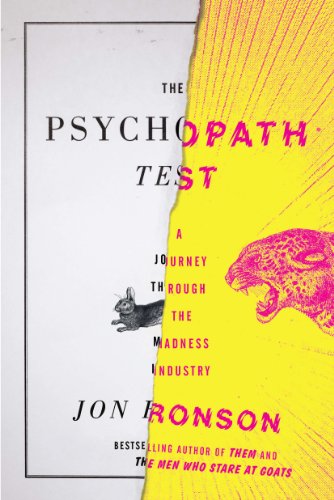

In one sentence
The book’s central concern is less “How do we identify psychopaths?” than “What happens when a powerful label, imperfect test, and institutional incentives combine?” Ronson treats psychopathy as a real and consequential construct while warning that the people applying it—and the systems rewarding its use—may be biased, overconfident, or attracted to sensational explanations.
Overview
Ronson’s investigation begins with a bizarre alleged hoax involving a mysterious book circulated among scientists, then leads him to Robert Hare and the Psychopathy Checklist-Revised (PCL-R). He learns how the checklist is used, visits institutions and prisoners, investigates controversial psychiatric practices, examines the profiling of business leaders, and considers how psychiatric categories shape ideas of sanity, danger, and responsibility.
Core ideas
A checklist is not a complete explanation
The PCL-R organizes traits and behaviors associated with psychopathy, but Ronson emphasizes the distance between a structured assessment and the popular fantasy of a simple personality test. Context, records, interviewer judgment, and interpretation matter; casually scoring oneself or others is not equivalent to a professional assessment.
Labels can become self-reinforcing
Once someone is classified as dangerous, manipulative, or insane, later behavior may be interpreted through that label. The book uses psychiatric and criminal-justice cases to show how diagnosis can affect treatment, credibility, confinement, and the possibility of being seen as ordinary or redeemable.
Institutions shape what counts as madness
Ronson looks beyond patients to psychiatrists, profilers, anti-psychiatry campaigners, corporations, and media organizations. His recurring point is that “madness” is not encountered in a neutral vacuum: professional authority, commercial interests, publicity, fear, and organizational culture influence which behaviors become alarming or actionable.
Psychopathy is often linked to power, not only crime
The book asks whether traits such as superficial charm, ruthlessness, grandiosity, manipulation, and lack of remorse can be rewarded in competitive institutions. Its treatment of executives is provocative rather than a population-level demonstration: success alone does not establish psychopathy, and the analogy between corporate harm and criminal psychopathy remains contested.
Comedy is an investigative method—and a limitation
Ronson’s self-deprecating, comic persona gives him access to eccentric and threatening subjects and makes complicated systems readable. Critics argue that the same style can flatten serious issues, create misleading connections, or substitute vivid anecdotes for deeper evidence.
The book questions certainty more than it rejects psychiatry
Ronson is suspicious of psychiatric authority and diagnostic expansion, but he does not simply argue that mental illness or psychopathy are inventions. His position is ambivalent: useful concepts can become dangerous when treated as infallible, applied outside their proper setting, or amplified by institutions seeking certainty.
Practical takeaways
- Treat personality labels as hypotheses requiring context and corroboration, not as explanations that end inquiry.
- Separate a person’s harmful actions from a dramatic diagnosis; moral judgment, risk assessment, and clinical diagnosis are different tasks.
- When an expert offers a neat explanation for disturbing behavior, ask what evidence would disconfirm it and who benefits from accepting it.
- Be cautious about importing clinical language into workplaces, politics, or ordinary relationships, where it can stigmatize and escalate conflict.
- Remember that a compelling anecdote demonstrates possibility, not prevalence or causation.
- Read the book primarily as narrative journalism and institutional criticism, not as a current textbook on psychopathy or a guide to diagnosing people.
Caveats and counterpoints
- The book is deliberately accessible and anecdotal, so it is not a systematic review of psychopathy research. Its memorable cases can distort the reader’s sense of frequency and representativeness.
- Ronson’s framing sometimes places very different phenomena—criminal violence, corporate ruthlessness, eccentricity, psychiatric diagnosis, and media sensationalism—within one narrative. The connections are suggestive, not always empirically established.
- The title is potentially misleading: the PCL-R is a clinician-administered assessment involving structured judgment and collateral information, not a casual internet quiz.
- Critics have found the book funny and engrossing but also underdeveloped in its deeper analysis, especially where serious psychiatric or legal issues are treated through comic reportage.
Questions worth revisiting
- Where does Ronson successfully distinguish psychopathy from antisocial behavior, narcissism, cruelty, eccentricity, or ordinary ambition—and where does he blur them?
- Which institutions in the book gain authority, money, status, or control from identifying psychopaths or expanding psychiatric categories?
- How should society balance protection from genuinely dangerous people with the risk of irreversible or self-confirming labels?
- Does Ronson’s comic narration increase empathy and skepticism, or does it turn vulnerable people into entertaining characters?
- What evidence would be needed to evaluate the claim that certain corporate environments select for psychopathic traits?
- After reading, which parts seem like durable arguments about institutions, and which depend on the early-2010s media and psychiatric context?
Return to this when…
Return to this book when thinking about diagnostic labels, expert authority, institutional incentives, corporate misconduct, psychiatric classification, or the difference between a vivid story and reliable evidence.
References
- The Psychopath Test by Jon Ronson – review | Health, mind and body books | The Guardian
- The Psychopath Test by Jon Ronson: 9781594485756 | PenguinRandomHouse.com: Books
- The Psychopath Test by Jon Ronson – review | Society books | The Guardian
- panmacmillan.com
- goodreads.com
- theguardian.com
- The Psychopath Test - This American Life
- theguardian.com
- en.wikipedia.org
- thinkr.org
- microcosmpublishing.com
- fliphtml5.com