
In one sentence
Human life is a unity of apparent opposites: joy is bound to sorrow, freedom to responsibility, giving to receiving, and individuality to belonging. Wisdom comes less from escaping these tensions than from inhabiting them consciously and compassionately.
Overview
The book is framed as the final day of Almustafa’s twelve-year stay in Orphalese. Before departing, he responds to questions from the townspeople in twenty-six short discourses, moving through intimate subjects—love, marriage, children, work, eating, reason, and friendship—and public or spiritual ones such as crime, laws, freedom, teaching, religion, beauty, and death. The plot is deliberately slight; the structure is a ceremonial sequence of questions and answers.
Core ideas
Paradox is the book’s basic method
Gibran repeatedly refuses simple either/or answers. Love can wound as well as enlarge; sorrow deepens joy; freedom without inward discipline can become another form of bondage. The aphorisms work by holding two truths together rather than resolving them.
Love without possession
Love is presented as a force that joins people while preserving their separateness. The central tension is between intimacy and control: closeness should not become ownership, and care should not erase the other person’s independent life.
Children, teaching, and generational humility
Parents are caretakers rather than owners of their children’s identities. More broadly, teaching is limited: one can offer understanding, example, and love, but cannot simply transfer one’s own inner life to another person.
Work as participation, not merely necessity
Work is treated as a way of joining oneself to the world and to other people. Its dignity depends on attention and connectedness, not only on wages, status, or external success.
Freedom and responsibility are inseparable
The book distrusts freedom understood as the absence of all limits. Inner fears, desires, habits, and social attachments can imprison people; genuine freedom requires recognizing these forces rather than blaming every constraint outside oneself.
Unity beneath social divisions
Gibran’s spiritual humanism treats individuals, nature, labor, suffering, and the divine as interrelated. This gives the book its inclusive appeal, but also makes its vision more universalizing than historically or politically specific.
A deliberately elevated literary voice
The solemn, biblical-sounding diction, repetitions, personifications, and balanced contrasts create the atmosphere of sacred instruction. Admirers experience this as lyrical clarity; critics have regarded it as sentimental, artificial, or overwrought. The work’s reception has remained sharply divided even while its popular influence has been enormous.
Practical takeaways
- When a feeling seems opposed to another—grief and gratitude, independence and intimacy—ask whether the opposition is actually part of the experience.
- In close relationships, distinguish love from possession and guidance from control.
- Treat advice as an offering, not a transfer of authority: other people must discover truths in their own lives.
- Notice whether work feels merely imposed or also connected to contribution, craft, and shared human purpose.
- Read the book slowly and selectively; its short chapters function more like meditations than like a continuous argument.
- Return to the passages that resist agreement. Gibran’s universal claims can be moving, but they may also flatten cultural, economic, or political differences.
Caveats and counterpoints
- The Prophet is philosophical fiction or prose poetry rather than a conventional novel; character psychology, plot, and social detail are intentionally minimal.
- Its spiritual language often speaks in universal terms—“humanity,” “love,” “freedom,” “the soul”—which can illuminate shared experience but can also obscure material conditions and unequal power.
- The book’s authority comes from prophetic rhetoric, not systematic reasoning. Its claims are evocative and interpretive rather than demonstrated.
- The positive popular response contrasts with substantial critical reservations about sentimentality and overwriting; both responses are important to understanding its place in literary culture.
Questions worth revisiting
- Which paradox in the book feels genuinely illuminating, and which feels too neatly stated?
- Does Gibran’s idea of love protect individuality, or does it understate the obligations created by intimacy?
- When does acceptance of suffering become wisdom, and when might it become resignation?
- What kinds of freedom are inward, and what kinds require changing social or political conditions?
- Does the prophet’s elevated voice invite reflection—or discourage questioning?
Return to this when…
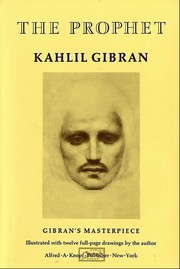
Return when you want a brief spiritual-literary meditation on relationships, vocation, grief, and mortality, especially during a transition. It is best reread in small sections rather than consumed as a single argument. First published by Alfred A. Knopf in September 1923, the book became Gibran’s defining work and a major example of popular mystical prose.