
In one sentence
A well-made “no” is not the opposite of agreement. It is a boundary rooted in a meaningful “yes”: first affirm what you need to protect, then state the limit clearly, and finally offer a path toward mutual accommodation. This lets you use power without treating the other person as an enemy.
Overview
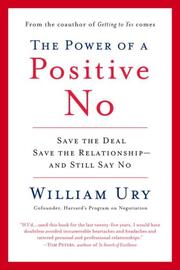
Ury organizes the book into three stages—Prepare, Deliver, and Follow Through—each containing three steps. The central formula is Yes! No. Yes?: affirm your underlying interest, assert the boundary, and propose a constructive outcome. The framework addresses the common “three-A trap”: accommodating when you should object, attacking instead of setting a boundary, or avoiding the issue altogether.
Core ideas
Find the deeper yes
A refusal becomes more durable when it serves something important: family time, integrity, safety, focus, self-respect, or another core priority. Ask, “What am I saying yes to by saying no?” This shifts the conversation from mere opposition to purposeful action.
Avoid accommodation, attack, and avoidance
Ury treats these as reactive responses to conflict. Accommodation sacrifices your interests; attack threatens the relationship; avoidance postpones the problem while it grows. A positive no aims to protect both the substance of your concern and the possibility of cooperation.
Prepare before speaking
The preparation sequence is: uncover your yes, empower your no, and respect your way to yes. “Empower” includes knowing your alternatives—what you will do if no agreement is reached—so your boundary is not dependent on the other person’s permission.
Deliver the three-part message
Express the underlying interest without accusation; assert a specific, matter-of-fact limit; then propose a practical alternative. The first yes is inward-facing, the no establishes the boundary, and the final yes invites the other person into a solution.
Expect resistance and follow through
A clear boundary can threaten another person’s interests, so pleading, anger, pressure, or bargaining may follow. Stay connected to the original priority, repeat the limit without escalating, and negotiate over alternatives rather than over whether your boundary exists.
A no creates space for better yeses
Ury extends the idea beyond interpersonal refusals: strategic focus requires rejecting competing demands so scarce time and attention can serve the priorities that matter most. Saying no is therefore also a method of creation, protection, and change.
Practical takeaways
- Before answering, pause and identify the interest or value you are protecting.
- State the boundary in concrete terms: what you will or will not do, and when.
- Use respect as a discipline, not as a reason to soften the limit beyond recognition.
- Offer an alternative only if it genuinely protects your core interest; do not turn every no into an obligation to solve the other person’s problem.
- Prepare a fallback plan before a difficult conversation. A boundary is easier to maintain when you know what you will do next.
- When challenged, repeat the core message calmly instead of adding increasingly elaborate explanations.
- Practice on low-stakes requests so the structure becomes natural before you need it in a high-conflict situation.
Caveats and counterpoints
- The method works best when the relationship allows dialogue and some room for alternatives. In abuse, coercion, retaliation, or serious power imbalance, safety and outside support may matter more than preserving a cooperative conversation.
- The three-part formula can sound artificial if delivered mechanically. The underlying priorities—clarity, respect, and follow-through—matter more than using exact wording.
- A positive no does not guarantee a positive response. The other party may reject the proposal, exploit your willingness to negotiate, or interpret any explanation as an opening to argue.
- Ury’s examples make the framework broadly applicable, but the book is primarily a practical negotiation guide rather than a systematic evaluation of when different communication styles work best.
- Respecting the relationship should not mean making the boundary conditional on the other person’s approval; the book’s strongest version of the method preserves self-respect as well as cooperation.
Questions worth revisiting
- What important yes—value, relationship, responsibility, or goal—would justify this no?
- Am I currently accommodating, attacking, or avoiding?
- What exactly is the boundary, stated without blame or excessive explanation?
- What alternative could meet the other person’s legitimate needs without sacrificing my central interest?
- What will I do if the other person refuses, pressures me, or ignores the boundary?
- Where might I be using “being nice” to avoid a necessary decision?
Return to this when…
Return to this book when you are overcommitted, preparing for a difficult refusal, negotiating a boundary at work or home, or repeatedly saying yes and feeling resentful afterward. The most useful refresher is the compact sequence: What am I protecting? What is my firm no? What constructive yes can I invite?