In one sentence
Successful technology companies are built by relentlessly finding product/market fit, recruiting unusually driven people, concentrating resources on the main constraint, and staying flexible as reality invalidates the original plan. Career success follows a similar logic: seek steep learning, visible responsibility, strong networks, and situations where your own decisions materially affect outcomes.
Overview
The collection is explicitly a selection of posts from 2007–2009, organized into startup, hiring, big-company, career/productivity, psychology, and miscellaneous sections—not a continuously argued manuscript. Its central startup claim is that market matters most: a strong team and good product cannot fully rescue a weak market, while the company’s job before product/market fit is experimentation and adaptation. Later sections extend this operating philosophy to hiring, turnarounds, careers, attention management, cognitive bias, age, and luck. The publisher says links and obsolete references were removed while the original formatting and much of the original text were retained.
Core ideas
Market first; product/market fit is the dividing line
Andreessen argues that market size and demand tend to dominate outcomes. Before product/market fit, the company should focus on discovering the right product for the right market; after fit, execution, scaling, and organizational problems become the main concerns. A polished product in a bad market is not enough.
The initial plan is a hypothesis, not a contract
A startup cannot reliably specify its winning product-market combination in advance because it is operating under uncertainty. Preserve the objective—building a valuable company—but be willing to change customer, product, positioning, or business model as evidence accumulates.
Funding is a survival and focus decision
Too little capital can end a promising company before it reaches fit; too much can create complacency, slower product work, and loss of urgency. The practical rule is to raise enough to survive meaningful uncertainty while keeping attention fixed on product and market rather than cash itself.
Hiring is selection, not character reform
Look for demonstrated achievement, current skills, self-motivation, and role-specific evidence. Use structured questions and practical exercises. Andreessen’s emphasis is blunt: a manager should expect imperfect hiring outcomes and correct mistakes rather than rationalize them indefinitely.
Executives require decisive management
When a senior leader is clearly failing, prolonged ambiguity damages the company and the person’s team. The collection favors clean accountability, rapid diagnosis, and—when necessary—a change in leadership over elaborate attempts to preserve a bad fit.
Big-company turnarounds begin with focus and truth
The turnaround essays recommend reducing noise, identifying the core business problem, confronting mediocrity and overstaffing, and restoring a credible path to winning. The advice assumes the leader has enough authority to make painful changes quickly.
Treat careers as portfolios of options
Rather than designing a fixed career decades ahead, seek opportunities with high learning, strong people, visible results, and increasing responsibility. Technical and communication skills compound, while work at a high-growth company can provide unusually dense experience and reputation—though the author presents these views as personal judgments, not universal rules.
Protect attention from low-value obligations
The productivity section favors minimizing meetings, defending uninterrupted work, simplifying email, using an anti-to-do list to record completed work, and avoiding rigid schedules when one has autonomy. The underlying model is that time and focus should be allocated to the few activities that create disproportionate value.
Practical takeaways
- Write down your current product/market hypothesis and the evidence that would falsify it.
- Ask whether your market is genuinely large and urgent, rather than merely interesting to you.
- Separate pre-product/market-fit work from post-fit scaling work; use different metrics and management habits.
- For every important hire, define observable evidence of competence and include a realistic work sample or simulation.
- Set an explicit review point for questionable hires and senior executives; do not let sunk costs become a management strategy.
- When evaluating a job, prioritize learning rate, quality of colleagues, scope of responsibility, and whether results will be visible.
- Reserve protected blocks for the work only you can do; batch or eliminate meetings and messages that do not require you.
- Track outcomes and completed work, not just busyness. Use the book’s bias discussion as a prompt to ask what evidence you are systematically ignoring.
Caveats and counterpoints
- This is an edited archive of blog posts, not a comprehensive or fully updated treatise. The official edition omits some popular posts and removes links or references that were obsolete in a live-web context.
- Many examples and recommendations reflect the late-2000s Silicon Valley software environment. They may transfer poorly to regulated industries, capital-intensive businesses, local services, nonprofits, or careers with limited autonomy.
- The market-first argument is useful but can be overstated: team quality, distribution, timing, execution, regulation, and financing can each be decisive. Treat it as a corrective to team/product romanticism, not a complete causal theory.
- The hiring advice relies heavily on achievement signals, technical currency, and high agency. Used mechanically, those filters can favor privilege, penalize nontraditional paths, and confuse confidence or pedigree with capability.
- The career advice strongly favors technical skills, high-growth companies, and visible risk. That is a value-laden strategy, not a neutral definition of a good life; stability, craft, service, family constraints, and nontechnical excellence may rationally matter more.
- The productivity system assumes substantial control over one’s calendar. It is less applicable to frontline work, caregiving, collaborative roles, or organizations where meetings and responsiveness are core responsibilities.
- The essays are intentionally punchy and sometimes provocative. Their value is greatest as hypotheses and decision prompts, not as evidence-based universal laws.
Questions worth revisiting
- Which of my current assumptions about market size, customer urgency, or distribution are actually supported by behavior?
- Am I optimizing the company before product/market fit as though it were already a scaled business?
- What evidence would convince me that a key hire or executive is the wrong fit?
- Which parts of my career are compounding—skills, reputation, relationships—and which are merely consuming time?
- Where am I mistaking activity, funding, prestige, or planning for progress?
- Which of Andreessen’s claims are useful in my context, and which depend specifically on venture-backed software startups?
- What cognitive bias might be affecting my current startup or career decision?
Return to this when…
Return to the startup and hiring sections before founding, fundraising, changing direction, or making a senior hire; revisit the career/productivity sections during a role transition or when your calendar feels full but your important work is not moving. Use the psychology and luck essays as periodic checks against overconfidence and self-serving narratives.
Highlights
However, there are many more reasons to not do a startup. First, and most importantly, realize that a startup puts you on an emotional rollercoaster unlike anything you have ever experienced. You will flip rapidly from a day in which you are euphorically convinced you are going to own the world, to a day in which doom seems only weeks away and you feel completely ruined, and back again. Over and over and over. And I’m talking about what happens to stable entrepreneurs. There is so much uncertainty and so much risk around practically everything you are doing. Will the product ship on time? Will it be fast enough? Will it have too many bugs? Will it be easy to use? Will anyone use it? Will your competitor beat you to market? Will you get any press coverage? Will anyone invest in the company? Will that key new engineer join? Will your key user interface designer quit and go to Google? And on and on and on… Some days things will go really well and some things will go really poorly. And the level of stress that you’re under generally will magnify those transient data points into incredible highs and unbelievable lows at whiplash speed and huge magnitude. Sound like fun?
Never, ever say that you have no competitors. That signals naivete. Great markets draw competitors, and so if you really have no competition, you must not be in a great market. Even if you really believe you have no competitors, create a competitive landscape slide with adjacent companies in related market segments and be ready to talk crisply about how you are like and unlike those adjacent companies.
You’ll notice that a lot of what you may need to do is kick the ball further down the road — make more progress against your plan before you raise venture capital.
Nobody said this would be easy. The most valuable thing you can do is actually build your product. When in doubt, focus on that. The next most valuable thing you can do is get customers — or, for a consumer Internet service, establish a pattern of page view growth.
Personally, I’ll take the third position — I’ll assert that market is the most important factor in a startup’s success or failure. Why? In a great market — a market with lots of real potential customers — the market pulls product out of the startup. The market needs to be fulfilled and the market will be fulfilled, by the first viable product that comes along. The product doesn’t need to be great; it just has to basically work. And, the market doesn’t care how good the team is, as long as the team can produce that viable product. In short, customers are knocking down your door to get the product; the main goal is to actually answer the phone and respond to all the emails from people who want to buy. And when you have a great market, the team is remarkably easy to upgrade on the fly. This is the story of search keyword advertising, and Internet auctions, and TCP/IP routers.
However, I can name you a bunch of examples of great teams that totally screwed up their products. Great products are really, really hard to build. Hopefully a great team also gets you a great market — but I can also name you lots of examples of great teams that executed brilliantly against terrible markets and failed. Markets that don’t exist don’t care how smart you are.
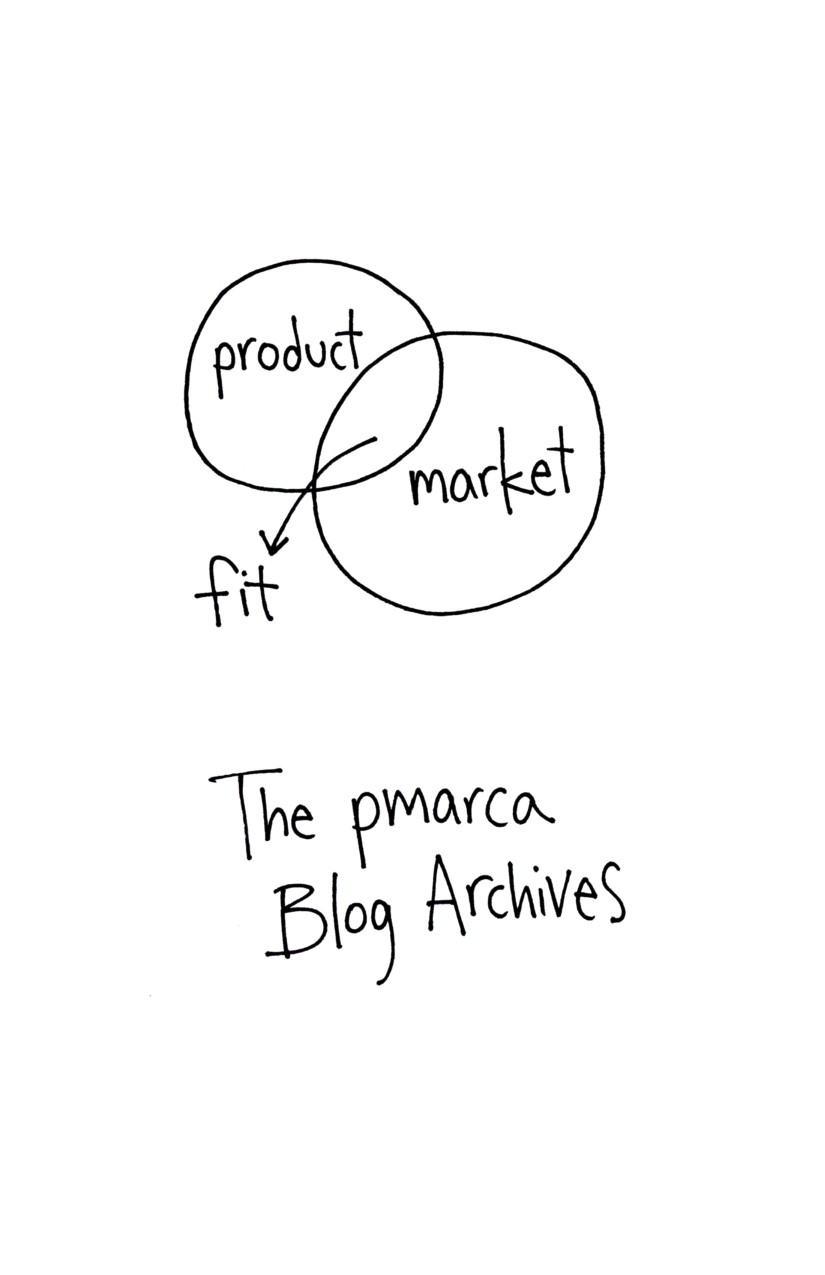
The only thing that matters is getting to product/market fit. Product/market fit means being in a good market with a product that can satisfy that market. You can always feel when product/market fit isn’t happening. The customers aren’t quite getting value out of the product, word of mouth isn’t spreading, usage isn’t growing that fast, press reviews are kind of “blah”, the sales cycle takes too long, and lots of deals never close. And you can always feel product/market fit when it’s happening. The customers are buying the product just as fast as you can make it — or usage is growing just as fast as you can add more servers. Money from customers is piling up in your company checking account. You’re hiring sales and customer support staff as fast as you can. Reporters are calling because they’ve heard about your hot new thing and they want to talk to you about it. You start getting entrepreneur of the year awards from Harvard Business School. Investment bankers are staking out your house. You could eat free for a year at Buck’s.
Lots of startups fail before product/market fit ever happens. My contention, in fact, is that they fail because they never get to product/market fit. Carried a step further, I believe that the life of any startup can be divided into two parts: before product/market fit (call this “BPMF”) and after product/market fit (“APMF”). When you are BPMF, focus obsessively on getting to product/market fit. Do whatever is required to get to product/market fit. Including changing out people, rewriting your product, moving into a different market, telling customers no when you don’t want to, telling customers yes when you don’t want to, raising that fourth round of highly dilutive venture capital — whatever is required. When you get right down to it, you can ignore almost everything else. I’m not suggesting that you do ignore everything else — just that judging from what I’ve seen in successful startups, you can.
Illustrate that point by staying as scrappy as possible on material items — office space, furniture, etc. The two areas to splurge, in my opinion, are big-screen monitors and ergonomic office chairs. Other than that, it should be Ikea all the way.
Part 9: How to hire a professional CEO Don’t. If you don’t have anyone on your founding team who is capable of being CEO, then sell your company — now.
People with drive push and push and push and push and push until they succeed. Winston Churchill after the evacuation of Dunkirk: “We shall not flag or fail. We shall go on to the end, we shall fight in France, we shall fight on the seas and oceans, we shall fight with growing confidence and growing strength in the air, we shall defend our Island, whatever the cost may be, we shall fight on the beaches, we shall fight on the landing grounds, we shall fight in the fields and in the streets, we shall fight in the hills; we shall never surrender.” That’s what you want.
Don’t create a new group or organization within your company whose job is “innovation”. This takes various forms, but it happens reasonably often when a big company gets into product trouble, and it’s hugely damaging. Here’s why: First, you send the terrible message to the rest of the organization that they’re not supposed to innovate. Second, you send the terrible message to the rest of the organization that you think they’re the B team.
(see the classic book Against the Gods:
book The Poker Face of Wall Street,
You’re going to screw up — frequently — and the screwups will have serious consequences, and you’ll feel incredibly stupid every time. It can’t faze you — you have to be able to just get right back up and keep on going. That may be the most valuable skill you can ever learn. Make sure you start learning it early.
Don’t keep a schedule He’s crazy, you say! I’m totally serious. If you pull it off — and in many structured jobs, you simply can’t — this simple tip alone can make a huge difference in productivity. By not keeping a schedule, I mean: refuse to commit to meetings, appointments, or activities at any set time in any future day. As a result, you can always work on whatever is most important or most interesting, at any time. Want to spend all day writing a research report? Do it! Want to spend all day coding? Do it! Want to spend all day at the cafe down the street reading a book on personal productivity? Do it!
[C]reativity is a probabilistic consequence of productivity, a relationship that holds both within and across careers. Within single careers, the count of major works per age period will be a positive function of total works generated each period, yielding a quality ratio that exhibits no systematic developmental trends. And across careers, those individual creators who are the most productive will also tend, on the average, to be the most creative: Individual variation in quantity is positively associated with variation in quality. Wow.
So what have we learned in a nutshell? Generally, productivity — output — rises rapidly from the start of a career to a peak and then declines gradually until retirement. This peak in productivity varies by field, from the late 20s to the early 50s, for reasons that are field-specific. Precocity, longevity, and output rate are linked. “Those who are precocious also tend to display longevity, and both precocity and longevity are positively associated with high output rates per age unit.” High producers produce highly, systematically, over time. The odds of a hit versus a miss do not increase over time. The periods of one’s career with the most hits will also have the most misses. So maximizing quantity — taking more swings at the bat — is much higher payoff than trying to improve one’s batting average. Intelligence, at least as measured by metrics such as IQ, is largely irrelevant.
Chance I is completely impersonal; you can’t influence it. Chance II favors those who have a persistent curiosity about many things coupled with an energetic willingness to experiment and explore. Chance III favors those who have a sufficient background of sound knowledge plus special abilities in observing, remembering, recalling, and quickly forming significant new associations. Chance IV favors those with distinctive, if not eccentric hobbies, personal lifestyles, and motor behaviors.