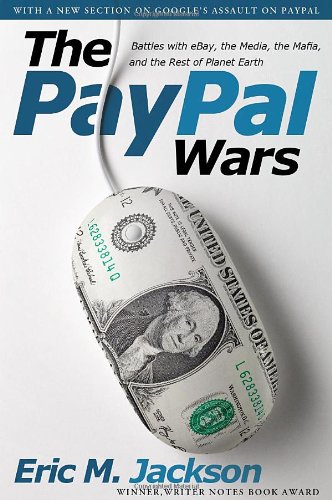

In one sentence
PayPal’s survival depended less on a single brilliant business plan than on rapid adaptation: finding product–market fit, exploiting network effects, managing fraud and cash flow, and repeatedly changing tactics as competitors and regulators responded. Jackson also argues that legal and regulatory pressures can become existential threats to innovative firms.
Overview
Jackson writes as a former PayPal marketing executive and presents the company’s history as a sequence of escalating conflicts. The narrative moves from the founding and merger of PayPal-related ventures through explosive user growth, eBay competition, fraud and operational problems, regulatory and legal pressure, organized-crime attacks, the dot-com downturn, the IPO, and eventual sale to eBay. The published contents include chapters such as “Breakthrough,” “MegaMerger,” “Growing Pains,” “RevolutionPayPal 2.0,” “The Monopolist Strikes,” “To the Brink,” and “Sell Out.”
Core ideas
Product–market fit may emerge through conflict
PayPal’s initial ambitions were broad, involving online payments and even challenges to conventional currency systems. Its durable opportunity became more concrete through online auctions, where buyers and sellers urgently needed a convenient payment mechanism. The lesson is to notice where repeated user behavior reveals a stronger market than the founders’ original concept.
Network effects reward focus and liquidity
A payments service becomes more useful when both sides of a transaction are present. PayPal’s growth therefore depended on recruiting buyers and sellers together, especially within eBay’s marketplace ecosystem. In two-sided markets, distribution and participant density can matter more than feature sophistication.
Growth creates technical and financial liabilities
Rapid adoption brought fraud, customer-service demands, transaction risk, regulatory scrutiny, and pressure on the company’s finances. Growth is not automatically progress: every new user can increase operational exposure, especially when the business handles money.
Revenue design is a strategic turning point
Jackson presents PayPal’s move toward a viable revenue model as central to its turnaround. A free or heavily subsidized service may be necessary to build a network, but the company eventually needs a credible way to monetize valuable transactions without destroying adoption.
Incumbents can be more dangerous than startups
The book frames eBay as both a source of PayPal’s growth and a powerful potential rival. Dependence on a dominant platform can accelerate distribution while leaving the smaller company strategically vulnerable. Partnership, competition, and acquisition may coexist uneasily.
Regulation is part of the competitive environment
Jackson treats regulators, banking interests, lawyers, and litigation as active forces shaping PayPal’s options—not merely as background compliance issues. His argument is that institutional resistance can slow or end innovation, though this framing reflects an entrepreneur-friendly perspective rather than a neutral regulatory analysis.
Crisis management favors speed and experimentation
The narrative’s recurring pattern is attack, improvisation, and adaptation. In unstable markets, waiting for perfect information can be more dangerous than testing a provisional solution, learning quickly, and revising the model.
The ‘PayPal Mafia’ is a retrospective lens
Later prominence of figures associated with PayPal—such as Peter Thiel, Elon Musk, Max Levchin, Reid Hoffman, and David Sacks—makes the company’s early period look like a training ground for technology entrepreneurs. That later reputation should not obscure the book’s more immediate subject: organizational survival under pressure.
Practical takeaways
- Look for the most urgent use case, not only the founders’ grandest mission.
- In a platform business, measure liquidity and participant density, not just registrations.
- Treat fraud, customer support, compliance, and cash requirements as core product constraints.
- Build a revenue model early enough to understand its effects on user behavior.
- Assume that a powerful distribution partner may eventually become a competitor.
- Map regulators, incumbents, lawyers, and other institutions as strategic actors.
- Use crises to test assumptions, but distinguish reversible experiments from decisions that create existential risk.
- When reading insider business histories, separate firsthand operational insight from retrospective self-justification.
Caveats and counterpoints
- Jackson’s position as a former insider gives the book unusual proximity to PayPal’s early operations, but also makes it a participant’s account rather than an independent corporate history.
- The book strongly emphasizes entrepreneurial struggle and the threat posed by regulators, lawyers, and lobbying interests. That interpretation may understate legitimate consumer-protection, fraud-prevention, banking, and systemic-risk concerns.
- Its narrative is centered on PayPal’s early period and eBay acquisition, not a comprehensive history of PayPal’s later strategy, governance, or long-term consequences.
- Bibliographic records describe several editions: the original 2004 publication, a 2006 edition, a 2012 WND Books edition, and a 2023 Republic Book Publishers edition. Page counts and chapter pagination therefore vary; these notes do not assume the user’s edition.
Questions worth revisiting
- Which PayPal decisions were genuinely strategic breakthroughs, and which were emergency responses to problems created by earlier growth?
- When does dependence on a dominant platform become too dangerous to justify its distribution benefits?
- Which regulatory objections described by Jackson would still look unreasonable, and which addressed real risks?
- How much of PayPal’s success came from product design versus incentives, network effects, timing, and aggressive distribution?
- Would the same growth tactics be acceptable for a modern financial platform handling substantially larger volumes?
- Does the book’s ‘war’ metaphor clarify competitive strategy, or does it encourage an overly adversarial view of institutions and stakeholders?
Return to this when…
Return to this book when studying two-sided marketplaces, fintech regulation, growth-stage crisis management, platform dependence, or the early careers of the entrepreneurs later associated with the “PayPal Mafia.”
Highlights
“It’s been a little while since we’ve had one of these, and I think a lot of people have joined us since then,” the CEO said. “Let’s go around the room and have everyone say your name, when you started, and something about yourself.” I did my best to memorize as many names as possible while thinking of a quip about my tenure with the old economy to introduce myself to my new colleagues. “Now, for another piece of news,” Peter casually added when the introductions wrapped up. “It looks like it’s going to be a few more days before we close the next financing round.” My jaw dropped—the imminence of the financing round, after all, was the reason I hastily left Andersen. “But don’t worry, we’re just haggling over details and we’re oversubscribed. Everyone wants to invest in this company! “And why not?” he went on. “We’re definitely onto something big. The need PayPal answers is monumental. Everyone in the world needs money—to get paid, to trade, to live. Paper money is an ancient technology and an inconvenient means of payment. You can run out of it. It wears out. It can get lost or stolen. In the twenty-first century, people need a form of money that’s more convenient and secure, something that can be accessed from anywhere with a PDA or an Internet connection. “Of course, what we’re calling ‘convenient’ for American users will be revolutionary for the developing world. Many of these countries’ governments play fast and loose with their currencies,” the former derivatives trader noted, before continuing, “They use inflation and sometimes wholesale currency devaluations, like we saw in Russia and several Southeast Asian countries last year, to take wealth away from their citizens. Most of the ordinary people there never have an opportunity to open an offshore account or to get their hands on more than a few bills of a stable currency like U.S. dollars. “Eventually PayPal will be able to change this. In the future, when we make our service available outside the U.S. and as Internet penetration continues to expand to all economic tiers of people, PayPal will give citizens worldwide more direct control over their currencies than they ever had before. It will be nearly impossible for corrupt governments to steal wealth from their people through their old means because if they try the people will switch to dollars or Pounds or Yen, in effect dumping the worthless local currency for something more secure. “Granted, that’s still some time off,” Peter continued, glancing around at the faces transfixed on him. “In the meantime our great Palm and Internet products are making quite a splash closer to home. Our user growth continues to ramp up nicely. I think we’re going to generate a lot of media buzz in the next few weeks. I have no doubt that this company has the chance to become the Microsoft of payments, the financial operating system of the world.” Everyone around me burst into a combination of laughter and applause. Though most had evidently heard a similar version of Peter’s speech before, they still seemed to enjoy it. For my part, I stood there with a reaction bordering on awestruck. I knew Peter was a deep thinker who held a strong sense of vision for the world, but when convincing me to join the company he spoke primarily of its great product and omitted any mention of these global aspirations. Now, hearing him articulate such a grand, sweeping mission for our little startup at an otherwise routine company meeting set me aback. Bold vision and corporate management don’t always go hand-in-hand—the few Andersen executives who bothered to attend company events invariably had seemed content to stick to a few platitudes about excellence and empowerment, two qualities in short supply at that firm. Peter, on the other hand, offered a grandiose but specific vision for his company without mentioning the milestone most dot-com CEOs dwelt on—an initial public offering. Why would he? His talk about changing the very workings of international commerce made an IPO sound small by comparison.
Say what you will about this vision’s credibility, but in the days that followed his speech I became convinced that Peter wasn’t the only person in the office who believed it. The company’s Web site designer created a T-shirt that showed God and Adam from Michelangelo’s Sistine Chapel ceiling exchanging cash with a pair of Palm Pilots. Many of the engineers carried around copies of Cryptonomicon by Neal Stephenson, a novel about the offspring of World War II army coders who conspired to build an offshore haven for encryption-protected data in Asia. In between the dings of the World Domination Index emitting from their computers, employees laughed that paper money was passé and insisted on using PayPal to settle their lunch bills and office pools. As a colleague in programming put it, why move atoms in order to exchange bits?
Things went better than I’d hoped. The next day’s daily user update from Jamie Templeton showed that our sign-ups had spiked to several times their normal level. Employees expressed awe as the World Domination Index ratcheted up by more than 1,000 customers overnight. The promising results attracted Peter’s attention and prompted him to call Luke, Sacks, and me into his austere office to discuss them. “What did the cost per user acquisition work out to?” Peter asked, getting quickly to the point by collecting the data he believed was needed to make a decision. “A little less than $20 per account, but we’ll see that come down a little over the next few days as more recipients read the e-mail and sign up,” I noted. “That’s really good,” Peter replied, leaning back in his chair and pausing to calculate some figures in his head. When he finally opened his mouth again, the words that came out surprised me. “We need to scale this up quickly. How fast can you spend $1 million?” “One million?” I parroted. For someone used to dealing with managers who demanded that subordinates submit two forms with an attached receipt just to get a $5 reimbursement, being asked to spend $1 million was new territory. I told him I’d have to do some quick research and get back to him. “How about in the next two weeks?” The CEO shot me a smile, but I could tell he was serious.
Peter stepped up to speak last. Looking fairly relaxed, it was evident that he had not prepared any statement prior to the meeting. Instead, he went into detail on a specific topic that he knew was of interest to Confinity employees, their stock options. “Let’s see, every old share of Confinity is now exchanged into shares of X.com,” he said. “That’s roughly, hmm…” he paused, looking upward for a second, “about 2.0207 shares of X.com stock for every share of Confinity.” Bill Harris laughed hard at the fact that his senior vice president could do division to the ten-thousandth decimal place in his head. Peter finished his brief set of remarks giving everyone an update on the company’s forthcoming financing plans. The goal, he said, was to raise $100 million in venture capital, one of the largest financing rounds ever, and to do it in record time. Fortunately, with the NASDAQ composite looking hale and hearty at 5,000 and record amounts of capital flowing into Silicon Valley, no one envisioned this would be difficult for a company registering 12,000 new customers every day. “I need to tell you something,” Luke said in a subdued tone. Over the past three months I could not think of many instances in which Luke could be characterized as subdued about anything, so his approach came as a surprise. The marketing team, along with business development and finance, had recently moved down the street from the former Confinity office to the X.com one. This had been a homecoming of sorts for Luke. When Confinity and X.com were neighbors the prior year Confinity occupied the southern side of the building, and now Luke found himself sitting in approximately the same location as his original desk. For my part, I longed for the ping pong room after moving into the cramped offices at 394 University. Most employees’ workstations were clustered into bullpen configurations, and marketing was positioned by a rear window that overlooked a communal dumpster. The building’s faulty
In addition to Julie, other members of the company sought ways to help alleviate the crisis. David Sacks emerged from a month of near-exile with a proposal he contended would address the customer service dilemma—adding message boards to PayPal’s site. By allowing customers to communicate with one another they could solve each other’s problems, he argued, stemming the flood of inbound e-mails. Sacks hired an intern to talk to third-party providers to determine the fastest way to get a PayPal message board live.
At Confinity Peter had encouraged the broadest possible dissemination of data so all employees could understand how the business was tracking and have the data necessary to discuss high level strategy. The tradition of sending the report to everyone had continued following the merger, and by now the entire company looked forward to its midday distribution.
Peter Thiel’s e-mail on Friday, May 5, arrived just after noon. I had been talking with Paul about going down the street to pick up some lunch when I saw a subject line that robbed me of my appetite: “Resignation as Executive Vice President.” I blinked and did a double-take. There must be some mistake, I thought. But when I clicked on the message to read its contents, I knew it was not. “Effective today, I am resigning as Executive Vice President of X.com,” the message began. “[After] seventeen months of working literally day and night, I am simply exhausted. In the process, we’ve gone from the early planning stages to a business that’s implementing our plans for world domination… I’m more of a visionary and less of a manager [so] it has become all the more critical to transition to a team that will manage and scale X.com’s operations. The recent $100 million financing round…seemed like a natural point of closure for my day-to-day involvement and like a good point to transition to those who will lead X.com’s IPO.” He concluded by stating that he hoped to stay in contact with the tremendous individuals he had met at X.com and wished everyone well.
Sacks’s tone made it clear that he wanted his producers to feel empowered. X.com’s internal chaos in the wake of the merger had paralyzed most of the company. By contrast, Confinity’s freewheeling atmosphere had allowed minimal supervision to be counterbalanced by shared goals, clear priorities, and encouragement from management that the staff suggest new ideas. I did not fully comprehend this on my tumultuous first day on the job, but Confinity had struck a balance that fostered both employee individuality and corporate flexibility. This winning formula enabled us to stop on a dime and implement new ideas quickly, to the point where we overhauled our business model to focus on eBay in less than a week. The disorganization following the merger had robbed the company of its ability to execute, and Sacks wanted to drive the point home that he saw the product team as the remedy.
Despite Reid Hoffman’s subsequent protest to its legal team, eBay used the event to justify officially banning PayPal from its community boards. Fortunately this scuffle came after Paul succeeded in putting out most of the fires caused by our ill-conceived policy. As the dust settled our young company learned a valuable lesson on the need for customer research, especially for changes that could impact the thousands of sellers now depending on PayPal for their livelihood. What was an item on the income statement for us could be a life-or-death business issue for our users. Although we would need to make tough choices in the weeks ahead to reverse the company’s growing losses, the spending limit fiasco served as a reminder to all of us that those decisions could not be made in a vacuum—or, for that matter, at three in the morning.
A few days later I returned to Paul Tuckfield’s desk to thank him for running my queries. The database administrator inquired about the status of implementing the credit card receiving limit. I glumly shook my head and described how V2 prevented it from being built, possibly for several months. Tuckfield remarked that this was unfortunate, especially since he had already figured out how to make a few modifications over the course of a weekend that would allow the existing database to expand from its current level of 3.5 million accounts up to at least 10 million. The response he had received from on high was not to bother. I shook my head again, this time in disbelief. As the soft-spoken engineer went on to describe the specific changes he wanted to make, I dwelled on the implications of what he had told me. Regardless of the merits of NT versus UNIX, this platform change wasn’t even critical at this point! We had burned two months of development time when a simple upgrade could have seen us through another year while allowing us to launch the “business use” process, attack fraud, and address any of the other challenges to our business model. V2 wasn’t murder, it was suicide.
Branding was the other strategy change. Peter informed everyone that over the following weeks we would begin to shift the Web site away from X and return to the PayPal brand. “I think PayPal is now the second most well known private service on the Internet after Napster,” he said, citing the infamous musicsharing company. “While we’ve been acquiring nearly 4 million customers we’ve also built a tremendous amount of brand equity behind the PayPal name. PayPal’s turned into more than just a way to pay your pal—it’s evolved into an online payment service that is your pal.” As a conciliatory gesture, he said there was no plan to change the corporation’s name from X.com to PayPal at the present time (although this change would eventually be made several months later). Peter’s compassionate tone, coupled with his logical defense of the strategy realignments, soothed many rattled nerves. His willingness to field hostile questions while stressing the interim nature of his own role calmed Elon’s supporters’ fear of reprisal and encouraged employees to be frank about their feelings. Over the following days the number of hushed conversations in the hallways diminished and the mood in the building gradually returned to something close to normal.
As the results from the campaign began to trickle in, the data told the same story as the message boards. In the week following the policy’s announcement, one-tenth of the high volume sellers voluntarily upgraded before encountering any limits. When Paul activated the enforcement of the new policy later in October, the rest steadily began to upgrade and, within a month’s time, 95% of the targeted personal accounts had switched to business status.
This dramatic about-face in our transaction margins was no puzzle to Peter Thiel. It was a few weeks into his stint as the acting-CEO when I heard him compare our new economy payments network to an abstract old economy machine. PayPal’s many policies—such as the fees charged to sellers, spending limits placed on unverified buyers, and our behind-the-scenes fraud algorithms—were like levers, dials, and pulleys. The key was to adjust each of them carefully in unison with the others until the machine hummed along at cruising speed. And Peter had no choice but to tinker. With no documented business precedent similar to PayPal to guide him, he needed his executive team to tweak each variable repeatedly to discover what inputs would optimize the business.
While always courteous to employees, the soft-spoken Peter placed high demands on his officers. Peter kept a running list of critical issues and it was common for him to make impromptu calls for status reports with notepad in hand. Sacks, a close friend of Peter’s, was one of his favorite targets. With Peter’s cube located adjacent to the product team, we frequently heard “David, get over here!” echo over the gray partitions whenever Peter needed an update. But Peter was by no means a micromanaging executive. Quite the opposite, he began moving the organization back toward the decentralized approach he had employed at Confinity. He gave his officers a long leash provided they checked in regularly and backed up their claims with data. As a former derivatives trader, Peter saw numbers as a language of truth. Anyone entrusted with a major project needed to have key figures at his fingertips in case Peter came calling.
On the heels of his latest financing miracle, Peter took the ultimate victory lap in the form of a visit to the White House.2 He later described his encounter with President George W. Bush at a company meeting in PayPal’s parking lot. In just over one-half year PayPal was already bursting at the seams in the Embarcadero building, which prompted HR to convert our large conference room into space for yet more cubicles. Company meetings now had to be held outside with employees seated on folding chairs and Peter standing at a podium equipped with built-in microphone and speaker. It was an odd spectacle, but employees always hurried to be on time ever since Peter had instituted a nominal $1 a minute fine for latecomers to ensure a prompt start to all meetings.
A glance at the company’s operating metrics highlights the reasons for Peter’s concern. In the first two quarters of 2001, auction-related payment volume accounted for a whopping 70% of PayPal’s transactions. This wasn’t a surprise—we had spent much of the first half of the year building products and running campaigns specifically to bolster our position on eBay. Now Peter felt it was time for PayPal to switch gears and expand into new businesses, a direction he articulated company-wide in no uncertain terms. He even made a point to tell Wired magazine that he devoted four out of every five days to growing PayPal’s non-auction business.25
Peter tended to be a libertarian on most social issues, but he took the concerns of his employees seriously. While he didn’t take a poll on every decision he made, he still felt it was important to consult with his personnel on matters that they thought were significant. Since he wanted the company’s workers to be empowered and speak their minds, he knew that listening was a critical part of his job.
On this sensitive topic there was much for him to hear. One afternoon he took a dozen employees, including me, to lunch at a nearby Chinese restaurant. He asked everyone to go around the table one-by-one and let him know their thoughts on the subject. Since the attendees generally opposed the move for one reason or another, the round-table quickly provided a litany of reasons to avoid the adult marketplace. “It’s wrong to help out this immoral industry,” one colleague asserted. “And that’s exactly what we’d be doing—helping pornographers make money. We can’t plead innocence as ‘just a payment provider’ if we’re doing that.” “I really love coming in to work at PayPal—it’s such an exciting place,” someone else added. “But if I knew that part of our company was pursuing the pornography business, I’d feel much less comfortable being here.” While I personally agreed with this cultural critique, I also found myself concerned about the business implications of entering this market. “We can’t ignore the potential damage this will do to our brand,” I ventured. “If PayPal becomes known as a leading processor of adult payments, it stands to hurt adoption on small merchants’ Web sites and even on eBay.” “I appreciate hearing from everyone,” Peter replied, after giving all of us a chance to speak our minds. “I’m definitely going to think about everything I’ve heard today. PayPal’s most important asset really is its people, and because of that it’s critical that PayPal remain a great and comfortable place to work. “But I also ask that everyone understand that I’ve got to examine this from two sides. There’s also the potential that people’s jobs might be at stake, which could be a risk if we opt to stay out of this market. In trying to decide what the moral thing to do is, I’ve also got to weigh this consideration.” About a week later Peter settled on a compromise that kept PayPal from pursuing an unfettered Las Vegas strategy. We would service adult Web sites that sought us out and opened accounts on our Web site, but we would not actively pursue merchants in this sector. This meant the company would not devote resources to obtaining this kind of clientele while still allowing PayPal’s users to transact in an essentially libertarian marketplace where the company would not impose its values on them. Given both our company’s financial risks and the pressure from the board, limiting our participation in the adult market was a bold move by Peter. If it wasn’t obvious before, this was another clear demonstration of Peter’s concern for his employees. His marketplace of ideas was big enough to allow dissent, and he took that diversity of thought into consideration when laying out the company’s policy on this hot-button issue.
“Sometimes we’ve said it feels like the entire world is really against us,” he said, pausing for effect, “Well, it is! “First they thought that banks would put us out of business. And when that didn’t happen, they said our customers would stop using us. And, when that didn’t happen, they called on the rest of the earth to join them.” “Here, let me read a piece from February 2001, ‘Losing Faith in PayPal,’” he said, pulling out a piece of paper. “It says, ‘…Fraud, consumer backlash, new competitors and an industry wracked by failure all highlight the shaky state of PayPal’s prominence and the potential need for more consumer protection.’10 “And here’s another one, from an article called ‘Earth to Palo Alto.’ ‘What would you do with a three-year-old company that has never turned an annual profit, is on track to lose a quarter billion dollars and whose recent SEC filings warn that its services might be used for money laundering and financial fraud?’”
“There are two major trends of the twenty-first century,” Peter continued. “First, the globalization of the economy. The economy is growing internationally and people from all over the world are becoming interconnected. One billion people now live in a country other than their place of birth. “Second, the quest for security. In this globalized, decentralized world, violence and terrorism are widespread and hard to contain. Terrorism has contaminated all countries, and it’s difficult to stop it. The challenge is finding a way to fight violence in the context of an open, global economy. “In my many trips to Washington over the past six months, I’ve met with regulators and politicians in attempts to persuade them not to impose new regulations on our company. And from all these meetings I’ve become convinced that they have absolutely no idea of how to deal with these critical issues. “Most of the conservatives in DC don’t understand that we’re in a changing world, that the world is becoming more interconnected and complicated. But the liberals are even worse—they always want to rely on regulation to make things better. Neither side is asking the right questions regarding the pressing needs of the day. “In our own way, at PayPal this is what we’ve been doing all along. We’ve been creating a system that enables global commerce for everyone. And we’ve been fighting the people who would do us and our users harm. It’s been a gradual, iterative process, and we’ve gotten plenty of stuff wrong along the way, but we’ve kept moving in the right direction to address these major issues while the rest of the world has been ignoring them. “And so I’d like to send a message back to planet Earth from Palo Alto. Life is good here in Palo Alto. We’ve been able to improve on many of the ways you do things. Come to Palo Alto for a visit sometime and learn something. I think you’ll find it’s a much better place than Earth.”
EBay’s, however, were not. Inside the auction giant it seemed as if nothing got done without a face-to-face meeting—or possibly several, if you were unlucky. And holding a meeting was never as simple as just sending an Outlook “meeting request” and sitting down with key stakeholders. EBay employees seemed trained to make phone calls to everyone who might have even the remotest interest in the matter and invite them to the yet-to-be-scheduled meeting. After at least two dozen invitations had been extended, a meeting time and location would be scheduled about a week in advance. The following day, like clockwork, the meeting would be rescheduled because of a calendar conflict of a peripheral stakeholder. After several rounds of schedule shuffling, attendees filing into the summit would be handed a thick set of PowerPoint slides filled with bullet points, tables, and an aphorism or two laid out neatly under a cover page that featured the eBay mascot—a mustachioed cartoon apple-man that bore a striking resemblance to Mr. Potato Head.
The duration of the meeting would then be devoted to wading through the voluminous set of slides, with the usual outcome being an agreement to set up a follow-up meeting so that the issues raised by the slides could be further discussed.
Sacks’s departure opened the floodgates. Within a few months an exodus of talent followed him out the door, most notably the senior executive team of Max Levchin, Roelof Botha, and Reid Hoffman. And they were just the beginning. Vince Sollitto, our grizzled head of PR; Ken Howery, my Stanford friend; Mark Woolway and Jack Selby, Peter’s fundraising experts; Keith Rabois, our head of business development; and a dozen other bright and talented individuals joined them in leaving behind PayPal, an eBay company, for greener pastures. EBay did little to stop the personnel flight. On the contrary, at the same time that many of our most gifted and entrepreneurial people fled the company, Bannick shipped over a bumper crop of eBay personnel to replace them. And with the replacements came a host of new processes, revised org charts, and the advent of the PowerPoint culture—that is to say, an endless parade of meetings accompanied by an endless show of slides. It was as if the entire scenario had itself been scripted out ahead of time. Just as Whitman knew what she was doing by waiting until the last-minute to appoint Bannick to the global online payments job prior to the merger, so too she knew that a little turnover would quickly remake PayPal’s culture in eBay’s image.
I opted not to pursue the permanent VP position. Assuming the stable role of a well-paid manager at a big company—what I had envisioned as my ultimate career goal before I joined PayPal—now seemed unthinkable. Once you’ve become an entrepreneur, there’s no turning back.
Fortunately, as anti-business as today’s environment can be, there’s still one surefire way for entrepreneurs to attempt to cope: hire the best people and empower them. PayPal’s original team of entrepreneurs might not have taken the company to the point of global currency liberation as they had hoped, but they still managed to go a lot further than most of the outside world ever expected. Peter, Max, and Sacks accomplished this by leveraging a diverse set of intelligent people whom they trusted to work hard on behalf of the company. Sometimes it was a messy process, and it was almost always turbulent, but in the end it worked well.
References
- Eric M. Jackson - The PayPal Wars
- en.wikipedia.org
- The PayPal Wars | Book by Eric M. Jackson | Official Publisher Page | Simon & Schuster
- The PayPal Wars: Battles with EBay, the Media, the Mafia and the Rest of ... - Eric M. Jackson - Google Books
- openlibrary.org
- openlibrary.org
- books.google.com
- books.google.com
- Eric M. Jackson - About Eric
- books.google.com
- ericmjackson.wordpress.com
- goodreads.com