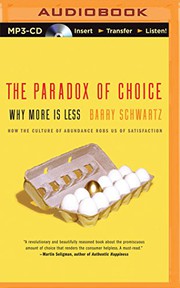

In one sentence
More choice is beneficial up to a point, but beyond that point it creates psychological costs that can outweigh its practical advantages. Schwartz’s central recommendation is not to eliminate freedom, but to become selective about where to invest attention and to replace constant optimization with deliberate satisficing.
Overview
The book examines choice in consumer purchases, work, relationships, education, health care, and personal finance. Schwartz argues that contemporary institutions increasingly turn people into active “choosers” responsible for constructing their own lives. This autonomy can become burdensome: every decision invites comparison with unchosen alternatives, raises expectations, and makes disappointing outcomes feel like personal failures. His solution is a practical ethic of limits—reduce trivial options, set standards in advance, and reserve exhaustive search for genuinely important decisions.
Core ideas
Choice has diminishing returns
A small increase in options can improve fit, control, and freedom. A very large increase can make comparison costly, delay decisions, and leave the chooser less confident. The paradox is that the same abundance that expands opportunity can reduce experienced autonomy.
Maximizers versus satisficers
Maximizers try to identify the best available option; satisficers choose the first option that meets their standards. Schwartz presents satisficing as a rational strategy for ordinary life, not as laziness or low ambition. Research associated with Schwartz found maximizers often report more regret and lower satisfaction, even when their outcomes are objectively strong.
Opportunity costs become psychologically salient
With many alternatives visible, choosing one means imagining the benefits of all the others. The unchosen possibilities remain mentally available, so a satisfactory outcome can feel inferior simply because a better hypothetical outcome can be imagined.
Expectations rise with abundance
More options encourage the belief that a perfect product, career, partner, or lifestyle is available if one searches carefully enough. When reality falls short, people may experience disappointment not only with the outcome but also with themselves.
Responsibility shifts to the individual
When institutions provide many options and frame choice as empowerment, failure is easily interpreted as poor personal selection. This can produce anxiety and self-blame even when outcomes depend on luck, structural conditions, or information unavailable at the time.
Regret and reversibility extend the decision
If choices can be revisited, exchanged, or undone, commitment becomes harder. Schwartz recommends making some decisions effectively irreversible—by closing the search, accepting trade-offs, and investing in the option chosen.
Freedom requires choosing where not to choose
The book’s practical political and personal point is that people need boundaries around choice. Defaults, curated menus, routines, and institutional limits can protect attention and reduce decision costs without eliminating meaningful freedom.
Practical takeaways
- Classify decisions by importance; do not use a high-effort search process for low-stakes choices.
- Set explicit criteria before browsing, shopping, or comparing. Stop when an option meets the criteria.
- Limit the number of alternatives you inspect; more information is not automatically more useful.
- Distinguish “important” from “merely visible.” Online availability can make trivial options feel consequential.
- After choosing, stop comparing and evaluate the actual experience rather than imagined alternatives.
- Lower expectations where perfection is impossible; aim for a strong fit, not an idealized outcome.
- Use routines, defaults, and recurring purchases to conserve attention for decisions that matter.
- For major decisions, maximize selectively: invest time when the stakes, reversibility, and likely benefit justify it.
Caveats and counterpoints
- The book’s thesis is deliberately broad and should not be read as “more choice is always worse.” Choice overload depends on factors such as the complexity of the decision, how differentiated the options are, the chooser’s expertise, and whether the options are attractive or mostly redundant.
- The maximizer/satisficer distinction is useful as a mental model, but people are not permanently one type in every domain; someone may maximize for a career or medical decision and satisfice for groceries.
- Subsequent research has challenged the idea that a simple increase in the number of options reliably causes overload. A meta-analysis of 50 studies found no overall meaningful relationship between choice and anxiety, suggesting that boundary conditions matter.
- Satisficing can be costly when mistakes are dangerous, opportunities are rare, or quality differences are substantial. The strongest version of Schwartz’s advice is domain-specific: limit search for routine decisions, but investigate carefully when consequences warrant it.
- The book is a popular, synthetic argument rather than a comprehensive review of every later finding. Its enduring value lies especially in its vocabulary—maximizing, satisficing, opportunity cost, regret, and expectation inflation.
Questions worth revisiting
- Where in my life am I treating every decision as if an objectively best answer exists?
- Which standards would let me stop searching without feeling careless?
- What choices could be automated, delegated, restricted, or converted into routines?
- When has additional research genuinely improved a decision, and when has it mainly prolonged uncertainty?
- Which decisions deserve maximizing because the stakes are high, and which do not?
Return to this when…
Return to these notes when shopping, comparing services, choosing among career or lifestyle paths, or feeling regret after a decision. The key reminder: a good choice is not only the option selected; it is also the ability to stop searching, accept trade-offs, and live well with what was chosen.
Highlights
When people have no choice, life is almost unbearable. As the number of available choices increases, as it has in our consumer culture, the autonomy, control, and liberation this variety brings are powerful and positive. But as the number of choices keeps growing, negative aspects of having a multitude of options begin to appear. As the number of choices grows further, the negatives escalate until we become overloaded. At this point, choice no longer liberates, but debilitates. It might even be said to tyrannize.
Negative liberty is “freedom from”—freedom from constraint, freedom from being told what to do by others. Positive liberty is “freedom to”—the availability of opportunities to be the author of your life and to make it meaningful and significant.
Americans go to shopping centers about once a week, more often than they go to houses of worship, and Americans now have more shopping centers than high schools. In a recent survey, 93 percent of teenage girls surveyed said that shopping was their favorite activity.
NOVELIST AND EXISTENTIALIST PHILOSOPHER ALBERT C AMUS POSED the question, “Should I kill myself, or have a cup of coffee?” His point was that everything in life is choice. Every second of every day, we are choosing, and there are always alternatives. Existence, at least human existence, is defined by the choices people make.
Nobel Prize–winning psychologist Daniel Kahneman and his colleagues have shown that what we remember about the pleasurable quality of our past experiences is almost entirely determined by two things: how the experiences felt when they were at their peak (best or worst), and how they felt when they ended.
According to James Twitchell, the key insight that has shaped modern advertising came to cigarette manufacturers in the 1930s. In the course of market research, they discovered that smokers who taste-tested various cigarette brands without knowing which was which couldn’t tell them apart. So, if the manufacturer wanted to sell more of his particular brand, he was either going to have to make it distinctive or make consumers think it was distinctive, which was considerably easier. With that was born the practice of selling a product by associating it with a glamorous lifestyle.
One high-end catalog seller of mostly kitchen equipment and gourmet foods offered an automatic bread maker for $279. Sometime later, the catalog began to offer a larger capacity, deluxe version for $429. They didn’t sell too many of these expensive bread makers, but sales of the less expensive one almost doubled! With the expensive bread maker serving as an anchor, the $279 machine had become a bargain.
Beyond the difference in presentation, though, there is no difference in the price structure at these two gas stations. A discount for paying cash is, effectively, the same as a surcharge for using credit.
As the rich get richer, each additional unit of wealth satisfies them less.
The endowment effect helps explain why companies can afford to offer money-back guarantees on their products. Once people own them, the products are worth more to their owners than the mere cash value, because giving up the products would entail a loss.
The alternative to maximizing is to be a satisficer. To satisfice is to settle for something that is good enough and not worry about the possibility that there might be something better. A satisficer has criteria and standards. She searches until she finds an item that meets those standards, and at that point, she stops. As soon as she finds a sweater that meets her standard of fit, quality, and price in the very first store she enters, she buys it—end of story. She is not concerned about better sweaters or better bargains just around the corner.
when all the costs (in time, money, and anguish) involved in getting information about all the options are factored in, satisficing is, in fact, the maximizing strategy.
An opportunity cost of vacationing on the beach in Cape Cod is great restaurants in California. An opportunity cost of taking a job near your romantic partner is that you won’t be near your family. Every choice we make has opportunity costs associated with it.
Ultimately, the quality of choices that matters to people is the subjective experience that the choices afford.
Surprisingly, however, 73 percent go with the Sony, as opposed to 66 percent when it was offered by itself. So the presence of a clearly inferior alternative makes it easier for consumers to take the plunge.
Instead of “Should I take A or B or C or . . . ?” the question people asked themselves was more like “Should I take it or leave it?” In a world of scarcity, opportunities don’t present themselves in bunches, and the decisions people face are between approach and avoidance, acceptance or rejection.
Anticipated regret will make decisions harder to make, and postdecision regret will make them harder to enjoy.
we are responsible for an action that turns out badly and if it almost turned out well, then we are prime candidates for regret.
the ticket holders should be asking themselves on the night of the performance is, “Will I get more satisfaction out of a night at the theater or out of a night spent reading and listening to music at home?” But people don’t operate this way.
Many people persist in very troubled relationships not because of love or what they owe the other person or because they feel a moral obligation to honor vows, but because of all the time and effort they’ve already put in.
But individuals who regularly experience and express gratitude are physically healthier, more optimistic about the future, and feel better about their lives than those who do not. Individuals who experience gratitude are more alert, enthusiastic, and energetic than those who do not, and they are more likely to achieve personal goals.
The “hedonic treadmill” and the “satisfaction treadmill” that I discussed in the last chapter explain to a significant degree how real income can increase by a factor of two (in the U.S.) or five (in Japan) without having a measurable effect on the subjective well-being of the members of society. As long as expectations keep pace with realizations, people may live better, but they won’t feel better about how they live.
One way of achieving this goal is by keeping wonderful experiences rare. No matter what you can afford, save great wine for special occasions. No matter what you can afford, make that perfectly cut, elegantly styled, silk blouse a special treat. This may seem like an exercise in self-denial, but I don’t think it is. On the contrary, it’s a way to make sure that you can continue to experience pleasure. What’s the point of great meals, great wines, and great blouses if they don’t make you feel great?
Indeed, social psychologists have found that upward comparisons produce jealousy, hostility, negative mood, frustration, lowered selfesteem, decreased happiness, and symptoms of stress. By the same token, downward comparisons have been found to boost selfesteem, increase positive mood, and reduce anxiety. But it needn’t be this way.
Students work to get good grades even when they have no interest in their studies. People seek job advancement even when they are happy with the jobs they already have. It’s like being in a crowded football stadium, watching the crucial play. A spectator several rows in front stands up to get a better view, and a chain reaction follows. Soon everyone is standing, just to be able to see as well as before. Everyone is on their feet rather than sitting, but no one’s position has improved. And if someone, unilaterally and resolutely, refuses to stand, he might just as well not be at the game at all. When people pursue goods that are positional, they can’t help being in the rat race. To choose not to run is to lose.
As a society, we have achieved what our ancestors could, at most, only dream about, but it has come at a great price. We get what we say we want, only to discover that what we want doesn’t satisfy us to the degree that we expect. We are surrounded by modern, time-saving devices, but we never seem to have enough time. We are free to be the authors of our own lives, but we don’t know exactly what kind of lives we want to “write.”
I knew I didn’t want to spend all this time solving my telephone problem, but it was like an itch that I couldn’t resist scratching. Then, one day I went out to replace a toaster. One store, two brands, two models, done. As I walked home, it occurred to me that I could, if I wanted to, pick my long-distance service in the same way. I breathed a sigh of relief, I did it, and I haven’t thought about it since.
A friend once told me how his minister had shocked the congregation with a sermon on marriage in which he said flatly that, yes, the grass is always greener. What he meant was that, inevitably, you will encounter people who are younger, better looking, funnier, smarter, or seemingly more understanding and empathetic than your wife or husband. But finding a life partner is not a matter of comparison shopping and “trading up.” The only way to find happiness and stability in the presence of seemingly attractive and tempting options is to say, “I’m simply not going there. I’ve made my decision about a life partner, so this person’s empathy or that person’s looks really have nothing to do with me. I’m not in the market—end of story.” Agonizing over whether your love is “the real thing” or your sexual relationship above or below par, and wondering whether you could have done better is a prescription for misery. Knowing that you’ve made a choice that you will not reverse allows you to pour your energy into improving the relationship that you have rather than constantly second-guessing it.
- Keep a notepad at your bedside. 2. Every morning, when you wake up, or every night, when you go to bed, use the notepad to list five things that happened the day before that you’re grateful for. These objects of gratitude occasionally will be big (a job promotion, a great first date), but most of the time, they will be small (sunlight streaming in through the bedroom window, a kind word from a friend, a piece of swordfish cooked just the way you like it, an informative article in a magazine). 3. You will probably feel a little silly and even self-conscious when you start doing this.
- Adopting the standards of a satisficer rather than a maximizer. 2. Reducing the number of options we consider before making a decision. 3. Practicing gratitude for what is good in a decision rather than focusing on our disappointments with what is bad.
References
- apnews.com
- The Paradox of Choice: Why More is Less - Barry Schwartz - Google Books
- books.google.com
- sciencedirect.com
- editorsreads.com
- ronang.life
- vejdani.org
- works.swarthmore.edu
- sciencedirect.com
- Maximizing versus satisficing: happiness is a matter of choice - PubMed
- journals.aom.org
- sciencedirect.com
- en.wikipedia.org