
In one sentence
Exceptional CEOs often create more value through superior capital allocation than through charisma, industry expertise, publicity, or operational heroics. Thorndike’s “outsiders” focused on free cash flow, per-share value, and rational deployment of capital while delegating day-to-day operations to capable managers.
Overview
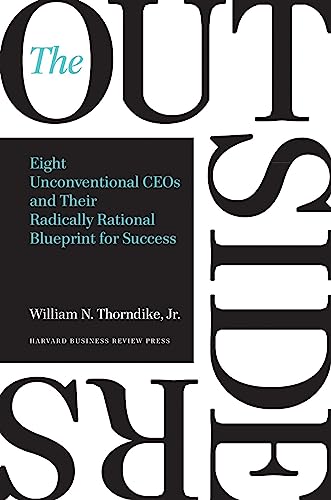
Published by Harvard Business Review Press in 2012, the book profiles eight CEOs: Tom Murphy of Capital Cities, Henry Singleton of Teledyne, Bill Anders of General Dynamics, John Malone of TCI, Bill Stiritz of Ralston Purina, Dick Smith of General Cinema, Katharine Graham of The Washington Post Company, and Warren Buffett of Berkshire Hathaway. Their companies’ returns substantially outperformed both peers and the broader market during the relevant tenures.
Core ideas
The CEO’s underappreciated job is capital allocation
Thorndike separates two executive responsibilities: operating the business and deciding where its cash, debt capacity, acquisitions, divestitures, buybacks, and human resources should go. The profiled CEOs treated the second responsibility as central rather than incidental.
Optimize per-share value, not corporate size
The outsiders resisted the usual prestige metrics—revenue growth, earnings growth, headcount, acquisitions, or market visibility. They asked whether each decision increased long-term value per share, often accepting a smaller or less glamorous company when that improved economics.
Cash flow matters more than reported earnings
Free cash flow gives management more real choice than accounting earnings do. The CEOs emphasized cash generation and then directed it toward the highest-return available use: reinvestment, acquisitions, debt reduction, or repurchases.
Decentralization increases both speed and accountability
Many of the CEOs kept headquarters small and gave operating managers substantial autonomy. Local managers ran businesses; the CEO concentrated on setting incentives, evaluating returns, allocating capital, and replacing weak leadership.
Buybacks work only when price and value diverge
Repurchasing shares can be an attractive investment when the company’s stock is materially undervalued, but it destroys value when used mechanically at inflated prices. The relevant comparison is the expected return from buying the company’s own shares versus every alternative use of cash.
Acquisitions are tools, not proof of ambition
The outsiders bought selectively, often using unusual structures or financial discipline, and were willing to sell businesses that failed to meet return thresholds. The lesson is not “acquire more,” but “allocate only when the expected return and strategic fit justify the price.”
Rationality often looks unconventional from the outside
These leaders commonly avoided celebrity-CEO behavior, corporate perks, excessive Wall Street communication, and fashionable management doctrines. Their independence was useful because it protected decisions from imitation, quarterly pressure, and status competition.
The model depends on trustworthy operators
A CEO cannot focus on allocation without managers who can run decentralized units. The architecture is therefore complementary: capable operators generate cash and information; the CEO decides where the next dollar has the greatest expected return.
Practical takeaways
- For evaluating a CEO, study capital-allocation history: acquisitions, divestitures, leverage, repurchases, dividends, reinvestment, and the results per share.
- Ask what the company should do with its next dollar—not what would make it larger, more visible, or more admired.
- Compare repurchases with intrinsic value rather than treating buybacks as automatically good or bad.
- Track returns on invested capital by business unit, and be willing to shrink or exit areas that chronically destroy value.
- Keep headquarters and reporting systems proportionate to the work; decentralization is valuable only with clear metrics and accountability.
- Design incentives around long-term per-share outcomes, not short-term revenue, adjusted earnings, or acquisition volume.
- If the CEO is a poor operator but a strong allocator, hire excellent operators and make the allocation role explicit.
Caveats and counterpoints
- The book is intentionally selective: it studies conspicuous winners, so survivorship bias makes the shared traits look more decisive than they may be across the full population of CEOs.
- Its outcome measure is primarily long-term shareholder return. That lens can underweight employee welfare, customer effects, environmental costs, public-interest obligations, and distributional consequences.
- The cases span different eras, industries, ownership structures, and regulatory environments; a tactic that worked for TCI, Teledyne, or Berkshire is not automatically transferable to a modern company.
- The narrative is more admiring than adversarial. A critical reader should separately test whether returns came from managerial skill, favorable industry economics, leverage, tax conditions, market concentration, or unusually long holding periods.
- Decentralization can fail when operating units lack talent, incentives, coordination, or reliable performance data. Small headquarters are not a substitute for sound governance.
Questions worth revisiting
- What percentage of a CEO’s time should be devoted to operations versus capital allocation in this particular business?
- Does management evaluate decisions by per-share value and opportunity cost, or by growth and size?
- When has the company sold a mediocre business rather than defending it?
- Are repurchases being made below a credible estimate of intrinsic value?
- Which managers can operate autonomously, and what evidence shows that their autonomy is productive?
- Would the company’s results still look exceptional after adjusting for leverage, industry tailwinds, and acquisition accounting?
Return to this when…
Return to the chapters on Singleton, Malone, Buffett, and Murphy when evaluating capital allocation, decentralization, leverage, or buybacks. Revisit the epilogue’s checklist before assessing a CEO; read the whole book when you want memorable historical cases rather than a technical finance manual.