
In one sentence
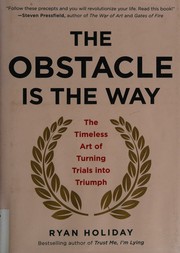
An obstacle is not merely something blocking progress; approached with disciplined perception, purposeful action, and resilient will, it can become the material through which progress is made. Holiday presents this as a pragmatic application of Stoicism, especially ideas associated with Marcus Aurelius, Epictetus, and Seneca.
Overview
The book is divided into three disciplines: Perception, Action, and Will. Perception concerns how events are framed; action concerns converting circumstances into concrete steps; will concerns endurance and acceptance when outcomes remain outside one’s control. Its organizing maxim comes from Marcus Aurelius: what impedes action can advance it.
Core ideas
Perception is the first battlefield
Separate facts from interpretation. Panic, ego, resentment, and catastrophic storytelling often enlarge an obstacle beyond its actual dimensions. Objectivity, emotional steadiness, and a change of perspective can reveal choices that were initially hidden.
Control the response, not the whole situation
The Stoic distinction between what is and is not up to us is central. You may not control rejection, illness, competitors, institutions, or other people, but you can control attention, preparation, judgment, effort, and conduct.
Turn constraints into leverage
Instead of waiting for ideal conditions, ask what the present limitation makes possible. A closed route may force a better route; scarcity may sharpen resourcefulness; failure may provide information. The obstacle becomes useful when treated as a problem to work with rather than merely resist.
Action should be deliberate and persistent
Good intentions do not alter circumstances. Break the problem into immediate steps, act with purpose, adapt tactics when necessary, and continue after setbacks. Holiday favors practical movement over rumination or elaborate planning.
Will is disciplined endurance—not passivity
Acceptance means acknowledging reality without wasting energy wishing it were different. It does not mean liking every event or abandoning goals. The aim is to preserve agency, dignity, and effort when external success cannot be guaranteed.
Examples are demonstrations, not proof
Holiday uses figures from history, business, sport, politics, and the arts to illustrate the framework. Their stories make abstract principles memorable, but exceptional people and retrospective success stories cannot establish that every hardship contains a hidden advantage.
Practical takeaways
- When upset, write down the event, your interpretation of it, and the facts that remain actionable.
- Ask: “What part of this is under my control?” Then identify one concrete next action.
- Replace “Why is this happening to me?” with “What does this situation require of me?”
- Treat setbacks as data: determine what they reveal, what they rule out, and what tactic should change.
- Use a two-track plan: pursue the desired outcome while preparing to act well if the outcome fails.
- Practice responding more slowly than your first emotional impulse, especially when reputation or ego is involved.
- Review the day by asking whether your perception was accurate, your action useful, and your will steady.
Caveats and counterpoints
- This is a modern, motivational adaptation of Stoicism rather than a comprehensive account of Stoic philosophy. Critics note that it tends to foreground resilience, productivity, and success while giving less attention to Stoic ethics, virtue, cosmology, and communal obligation.
- “The obstacle is the way” should not be read as a promise that every tragedy produces personal growth, or that structural injustice, illness, grief, and poverty can be solved through attitude alone.
- The book’s historical anecdotes are selected to support the framework and are often simplified; they work best as illustrations rather than as neutral historical analysis.
- Advice to persist can fail when the correct response is withdrawal, rest, treatment, protest, delegation, or changing the goal. Endurance is not automatically virtuous if it preserves a harmful situation.
- Its achievement-oriented framing may understate values that matter even when there is no strategic advantage—care, mourning, solidarity, play, and simply doing what is right.
Questions worth revisiting
- What exactly is the obstacle: the event, my interpretation, a missing skill, another person’s decision, or an unrealistic goal?
- Which facts are fixed, and which variables can I still influence?
- What opportunity is genuinely present—not merely one I am forcing myself to find?
- Am I persisting from principle and judgment, or from pride and sunk-cost thinking?
- What would Stoic action require if success were impossible but good conduct still mattered?
- Where would acceptance, support, or recovery be wiser than continued pushing?
Return to this when…
Return to the three-part structure when facing a setback: Perception—describe reality without drama; Action—identify the next useful move; Will—accept what cannot be controlled and continue acting according to your values. For a fuller account of Stoicism, pair this accessible introduction with primary texts by Marcus Aurelius, Epictetus, or Seneca.
Highlights
Our actions may be impeded . . . but there can be no impeding our intentions or dispositions. Because we can accommodate and adapt. The mind adapts and converts to its own purposes the obstacle to our acting. And then he concluded with powerful words destined for maxim. The impediment to action advances action. What stands in the way becomes the way.
And from what we know, he truly saw each and every one of these obstacles as an opportunity to practice some virtue: patience, courage, humility, resourcefulness, reason, justice, and creativity. The power he held never seemed to go to his head—neither did the stress or burden. He rarely rose to excess or anger, and never to hatred or bitterness.
To prevent becoming overwhelmed by the world around us, we must, as the ancients practiced, learn how to limit our passions and their control over our lives. It takes skill and discipline to bat away the pests of bad perceptions, to separate reliable signals from deceptive ones, to filter out prejudice, expectation, and fear. But it’s worth it, for what’s left is truth.
Our brains evolved for an environment very different from the one we currently inhabit. As a result, we carry all kinds of biological baggage. Humans are still primed to detect threats and dangers that no longer exist—think of the cold sweat when you’re stressed about money, or the fight-or-flight response that kicks in when your boss yells at you. Our safety is not truly at risk here—there is little danger that we will starve or that violence will break out—though it certainly feels that way sometimes.
Choose not to be harmed—and you won’t feel harmed. Don’t feel harmed—and you haven’t been. —MARCUS AURELIUS
There is always a countermove, always an escape or a way through, so there is no reason to get worked up.
The Greeks had a word for this: apatheia. It’s the kind of calm equanimity that comes with the absence of irrational or extreme emotions. Not the loss of feeling altogether, just the loss of the harmful, unhelpful kind. Don’t let the negativity in, don’t let those emotions even get started. Just say: No, thank you. I can’t afford to panic.
Don’t let the force of an impression when it first hit you knock you off your feet; just say to it: Hold on a moment; let me see who you are and what you represent. Let me put you to the test. —EPICTETUS
A deer’s brain tells it to run because things are bad. It runs. Sometimes, right into traffic. We can question that impulse. We can disagree with it. We can override the switch, examine the threat before we act.
In its own way, the most harmful dragon we chase is the one that makes us think we can change things that are simply not ours to change. That someone decided not to fund your company, this isn’t up to you. But the decision to refine and improve your pitch? That is. That someone stole your idea or got to it first? No. To pivot, improve it, or fight for what’s yours? Yes.
Remember and remind yourself of a phrase favored by Epictetus: “persist and resist.” Persist in your efforts. Resist giving in to distraction, discouragement, or disorder.
This is pragmatism embodied. Don’t worry about the “right” way, worry about the right way. This is how we get things done.
If someone we knew took traffic signals personally, we would judge them insane. Yet this is exactly what life is doing to us. It tells us to come to a stop here. Or that some intersection is blocked or that a particular road has been rerouted through an inconvenient detour. We can’t argue or yell this problem away. We simply accept it.
Letters used to be signed “Deo volente”—God willing. Because who knew what would happen?
My formula for greatness in a human being is amor fati: that one wants nothing to be different, not forward, not backward, not in all eternity. Not merely bear what is necessary, still less conceal it . . . but love it. —NIETZSCHE
In your worst moments, picture Johnson: always calm, always in control, genuinely loving the opportunity to prove himself, to perform for people, whether they wanted him to succeed or not.
Not: I’m okay with this. Not: I think I feel good about this. But: I feel great about it. Because if it happened, then it was meant to happen, and I am glad that it did when it did. I am meant to make the best of it.
We don’t get to choose what happens to us, but we can always choose how we feel about it. And why on earth would you choose to feel anything but good? We can choose to render a good account of ourselves. If the event must occur, Amor fati (a love of fate) is the response.
When a man knows he is to be hanged in a fortnight, it concentrates his mind wonderfully. —DR. JOHNSON
The Stoics liked to use the metaphor of fire. Writing in his journal, Marcus once reminded himself that “when the fire is strong, it soon appropriates to itself the matter which is heaped on it, and consumes it, and rises higher by means of this very material.”
First, see clearly. Next, act correctly. Finally, endure and accept the world as it is.
Meditations by Marcus Aurelius (Modern Library). There is one translation of Marcus Aurelius to read and that is Gregory Hayes’s
Letters of a Stoic by Seneca (see also: On the Shortness of Life). Both these translations by Penguin are fantastic. Seneca or Marcus are the best places to start if you’re looking to explore Stoicism. Seneca
Discourses by Epictetus (Penguin). Personally, I prefer the Penguin translations, but I’ve tried a handful of others and found the differences to be relatively negligible. Of
Some other great authors/philosophers to read—particularly their books of maxims or aphorisms, which are in line with a lot of stoic thinking: Heraclitus Plutarch Socrates Cicero Montaigne Arthur Schopenhauer