
In one sentence
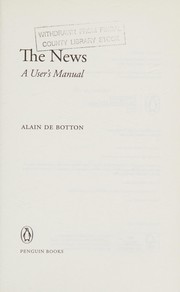
News is not a neutral stream of facts: it selects and frames reality, thereby influencing what citizens fear, desire, envy, admire, and regard as important. De Botton argues that news should do more than attract attention—it should deepen understanding, cultivate empathy, provide context, and help people live better.
Overview
The book is organized around roughly twenty-five archetypal news stories, including plane crashes, murders, political scandals, celebrity interviews, and economic reports. De Botton analyzes why these stories command attention and what their usual treatment leaves out. His proposed alternative is a more therapeutic and educational news culture: less episodic, sensational, and consumerist; more explanatory, humane, morally serious, and connected to longer narratives.
Core ideas
News constructs reality
Because news organizations cannot show everything, their choices become a map of significance. News therefore acts almost like a modern source of orientation or authority, not merely a delivery system for information.
The fragment problem
A headline often presents an isolated incident without the background needed to understand it. De Botton wants stories to function more like chapters in larger narratives—connecting events to history, institutions, psychology, and consequences.
Attention is not the same as importance
Sensational, dramatic, unusual, and emotionally vivid events routinely defeat slower-moving issues that may matter more to public welfare. The book asks readers to notice this mismatch rather than treating popularity as a measure of significance.
News has psychological effects
Repeated exposure to catastrophe, scandal, envy-inducing wealth, and moral failure can distort risk perception and collective mood. De Botton also treats news-checking as a response to anxiety and uncertainty, though reviewers argue that distraction, entertainment, and curiosity may be equally important explanations.
The humane treatment of subjects
Crime and disaster reports commonly reduce people to the moment of their downfall. De Botton argues that journalism should recover the fuller human context of victims, perpetrators, families, and communities so that audiences understand rather than merely consume suffering.
Celebrity as secular mythology
Celebrity coverage attracts us because it offers imagined access to status, intimacy, romance, success, and humiliation. De Botton sees it as a distorted form of moral and emotional education—teaching us what to envy or desire while rarely challenging consumerist values.
A better economic and foreign news
Economic reporting should not assume that growth, consumption, or wealth are self-evident goods; it should ask what kind of society economic decisions create. Foreign reporting should convey the texture of distant lives, not reduce countries to crises, statistics, or geopolitical abstractions.
The reader also has responsibilities
The book is not only a critique of journalists. It asks readers to examine their own appetites for outrage, celebrity, catastrophe, and novelty, and to resist confusing constant updates with genuine understanding.
Practical takeaways
- When reading a major story, ask: What background is missing? What longer process does this event belong to?
- Separate prominence from importance: a vivid story may be highly attention-grabbing but socially marginal.
- Look for the people and institutions behind the headline, not only the event itself.
- Treat news as a constructed interpretation of reality, and compare different outlets’ selections and framing.
- Prefer reporting that explains causes, incentives, history, and consequences over reporting that merely supplies fresh episodes.
- Notice your emotional response—fear, envy, contempt, excitement—and ask what the story is training you to value.
- Set limits on compulsive checking. More updates can produce the feeling of participation without increasing understanding.
Caveats and counterpoints
- The book is philosophical and interpretive rather than a systematic study of journalism or audience behavior; reviewers noted its limited empirical research.
- De Botton sometimes treats “the news” as a single system, underplaying differences among outlets, countries, business models, audiences, and digital formats.
- His ideal of contextual, morally constructive journalism can become paternalistic: deciding what would make citizens “better” risks imposing the author’s preferred values.
- The criticism of episodic reporting is persuasive, but digital journalism already offers hyperlinks, archives, explainers, and continuing coverage—an omission highlighted by reviewers.
- The proposed therapeutic role for journalism may conflict with journalism’s other purposes: accountability, speed, adversarial scrutiny, public record, and the right to know uncomfortable facts.
- The argument that anxiety chiefly drives news consumption is contestable; reviewers suggest entertainment, distraction, curiosity, identity, and habit also deserve attention.
Questions worth revisiting
- Which stories do I habitually click, and what do they reveal about my fears or desires?
- What important subjects receive less attention because they lack drama, novelty, or identifiable villains?
- Would more context make a story more understandable—or simply less accessible and less engaging?
- Who decides what counts as humane, constructive, or socially valuable news?
- Can journalism cultivate empathy without becoming sentimental or sacrificing scrutiny?
- What is the difference between being informed, feeling informed, and understanding?
- Which of de Botton’s ideal-news proposals are feasible within commercial or platform-driven media?
- Does the book criticize news itself, or our unreflective relationship with it?
Return to this when…
Return to this book when news consumption feels compulsive, emotionally destabilizing, or strangely uninformative. Its most useful reminder is to pause between exposure and judgment: ask what has been selected, what has been omitted, and whether the story is helping you understand reality or merely react to it.
Highlights
Societies become modern, the philosopher Hegel suggested, when news replaces religion as our central source of guidance and our touchstone of authority. In the developed economies, the news now occupies a position of power at least equal to that formerly enjoyed by the faiths.
For all their talk of education, modern societies neglect to examine by far the most influential means by which their populations are educated. Whatever happens in our classrooms, the more potent and ongoing kind of education takes place on the airwaves and on our screens. Cocooned in classrooms for only our first eighteen years or so, we effectively spend the rest of our lives under the tutelage of news entities which wield infinitely greater influence over us than any academic institution can. Once our formal education has finished, the news is the teacher. It is the single most significant force setting the tone of public life and shaping our impressions of the community beyond our own walls. It is the prime creator of political and social reality. As revolutionaries well know, if you want to change the mentality of a country, you don’t head to the art gallery, the department of education or the homes of famous novelists; you drive the tanks straight to the nerve centre of the body politic, the news HQ.
WHAT DOES ALL this news do to us over time? What remains of the months, even years we spend with it in aggregate? Whither those many excitements and fears: about the missing child, the budget shortfall and the unfaithful general? To what increase in wisdom did all these news stories contribute, beyond leaving behind a vague and unsurprising sediment of conclusions, for example, that China is rising, that central Africa is corrupt and that education must be reformed?
Now the news is for everyone, and yet the wheels of our curiosity are too often at risk of spinning idly in a soft slush of data. It is as if, every day before breakfast, a stern and alarmed civil servant rushed in to see us with a briefcase filled with a bewildering and then in the end tiring range of issues: ‘Five hospitals are predicted to breach their credit limits by the end of the month’, ‘The central bank is worried about its ability to raise money on the bond markets’, ‘A Chinese warship has just left the mainland en route for Vietnam’, ‘The Canadian prime minister will be here for dinner tomorrow’. What are we meant to think? Where should all this go in our minds?
A contemporary dictator wishing to establish power would not need to do anything so obviously sinister as banning the news: he or she would only have to see to it that news organizations broadcast a flow of random-sounding bulletins, in great numbers but with little explanation of context, within an agenda that kept changing, without giving any sense of the ongoing relevance of an issue that had seemed pressing only a short while before, the whole interspersed with constant updates about the colourful antics of murderers and film stars. This would be quite enough to undermine most people’s capacity to grasp political reality – as well as any resolve they might otherwise have summoned to alter it. The status quo could confidently remain forever undisturbed by a flood of, rather than a ban on, news.
Strangely though, the more cheerful side of the coin never makes it into the news. There is a plethora of headlines that would be both true and yet impossible to run: Grandmother, 87, helped three flights up the stairs at railway station by 15-year-old bystander she didn’t know Teacher surmounts his feelings for a young student Man abandons rash plan to kill his wife after brief pause 65 million people go to bed every night without murdering or hitting anyone There are so many different versions of ‘reality’, it is impossible to speak of the nation as if it were a single thing that could daily be captured by the most determined news organizations. The news may present itself as the authoritative portraitist of reality. It may claim to have an answer to the impossible question of what has really been going on, but it has no overarching ability to transcribe reality. It merely selectively fashions reality through the choices it makes about which stories to cast its spotlight on and which ones to leave out.
FOR ALL THE supposed plurality of the news, across outlets, the questions that end up being asked in a number of areas fail to range beyond some punishingly narrow boundaries. In the field of education, it seems ‘normal’ to run stories about class sizes, teachers’ pay, the country’s performance in international league tables and the right balance between the roles of the private and state sectors. But we would risk seeming distinctly odd, even demented, if we asked whether the curriculum actually made sense; whether it really equipped students
In the field of education, it seems ‘normal’ to run stories about class sizes, teachers’ pay, the country’s performance in international league tables and the right balance between the roles of the private and state sectors. But we would risk seeming distinctly odd, even demented, if we asked whether the curriculum actually made sense; whether it really equipped students with the emotional and psychological resources that are central to the pursuit of good lives.
In one sense, the great goal of the Enlightenment has been achieved: the average citizen now has near-instantaneous access to information about events in every nation on earth. But we’ve also been forced to learn something rather more surprising: no one is particularly interested.
AT THE HEART of the desire for fame lies a touching, vulnerable and simple aspiration: a longing to be treated nicely. Whatever secondary impetus may be supplied by appetites for money, luxury, sex or power, it is really the wish for respect that drives the will to fame. If this hardly seems like a fuel powerful enough to propel a lifetime’s worth of the efforts that becoming and remaining famous require, we should never underestimate the negative stimulus provided by fame’s opposite, humiliation. We may come to want fame desperately because of just how searing is the pain of being overlooked, patronized, left alone in the corner, ordered to go to the end of the line, thought of as a nobody or told to call back in a few weeks. The wish to be famous is a bid to have our dignity fully respected in a world where it almost certainly won’t be unless we are prepared to take extreme measures.
THE INTENSITY OF the desire for fame depends also on the nature of one’s society. The more dignity and kindness are given only to the very few, the stronger will be the urge to avoid being simply normal. Those who pin the blame for ‘celebrity culture’ at the door of the immoral young are hence missing the point. The real cause of celebrity culture isn’t narcissistic shallowness, it is a deficit of kindness.
The real cause of celebrity culture isn’t narcissistic shallowness, it is a deficit of kindness. A society where everyone wants to be famous is also one where, for a variety of essentially political (in the broad sense) reasons, being ordinary has failed to deliver the degree of respect necessary to satisfy people’s natural appetite for dignity. In so far as the modern world is celebrity-obsessed, we are living not so much in superficial times as in unkind ones. Fame has become a means to an end, the most direct route to a kind of respect that could otherwise have been won in different, less renown-dependent ways – through kindness rather than magazine covers.
References
- The News: A User's Manual by Alain de Botton – review | Alain de Botton | The Guardian
- The News: A User's Manual by Alain de Botton – review | Philosophy books | The Guardian
- THE NEWS | Kirkus Reviews
- kirkusreviews.com
- independent.co.uk
- medium.com
- fixquotes.com
- goodreads.com
- kobo.com
- The News: A User's Manual by Alain de Botton | Goodreads
- goodreads.com
- search.worldcat.org