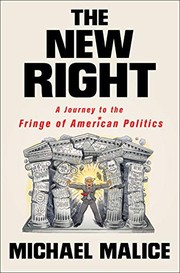

In one sentence
The “New Right” is less a unified ideology than a coalition held together by hostility to progressive cultural power, egalitarianism, and the institutions Malice calls the “Cathedral.” Its participants differ sharply on nationalism, race, economics, technology, and political strategy; their common ground is often opposition rather than a shared positive program.
Overview
Published in 2019, the book combines memoir, interviews, intellectual history, and political commentary. Malice traces a lineage from older heterodox right-wing currents through the Buchanan–Rothbard alliance and into internet-based communities, while discussing figures and subcultures associated with the alt-right, techno-anarchism, populism, white nationalism, and online trolling. He also considers how Trump helped move some fringe ideas toward mainstream visibility without making Trump or his movement identical to the New Right.
Core ideas
Study movements on their own terms
Malice argues that dismissing every New Right participant as simply a Nazi or irrational extremist prevents outsiders from understanding the movement’s internal distinctions and motivating ideas. This is an interpretive and methodological claim, not proof that the ideas are sound or harmless.
Coalition by negation
The movement’s strongest unifying force is opposition to “progressivism” and the institutional network—universities, media, and professional elites—that adherents believe reproduces progressive norms. Because agreement is primarily negative, the coalition contains major contradictions and rival end states.
The internet changes political formation
Online forums and meme-oriented communities allow isolated, provocative, or previously marginal ideas to circulate, combine, and recruit. Irony, trolling, sincere belief, and deliberate taboo-breaking can coexist, making it difficult to distinguish performance from conviction.
Trump as accelerator, not complete explanation
The book presents Trump’s rise as making some New Right themes more visible and politically consequential, while emphasizing that Trump’s coalition and governing politics do not map neatly onto the movement’s more radical or anti-establishment ideas.
The author is a participant-observer, not a neutral historian
Malice’s access to relevant conversations gives the book an unusual insider perspective, but his anarchist commitments, combative style, and sympathy for examining unfashionable arguments shape the account. Publishers Weekly specifically describes the work as wavering among anthropology, memoir, and polemic.
Provocation is part of the subject—and part of the problem
Malice criticizes broad-brush condemnation while sometimes making broad claims about the Left himself. The result can illuminate the rhetoric and grievances of the New Right while also reproducing the adversarial, overgeneralizing style he analyzes.
Practical takeaways
- When analyzing a political fringe, separate shared enemies from shared goals; a coalition can be powerful without being ideologically coherent.
- Treat online political language as potentially layered: sincere belief, irony, status-seeking, provocation, and strategic ambiguity may operate simultaneously.
- Do not use Trump’s electoral success as a complete genealogy of the New Right; examine older intellectual and subcultural networks as well.
- Read first-person accounts for vocabulary, self-understanding, and social dynamics—not automatically for balanced causal explanation.
- Cross-check the book’s historical claims and generalizations against academic histories and reporting on the alt-right, white nationalism, libertarianism, and Trumpism.
Caveats and counterpoints
- The book’s central label is expansive: it groups together movements with substantially different commitments, including anarchists, populists, techno-oriented thinkers, internet trolls, and white nationalists. That breadth is useful for mapping a milieu but risks conceptual blurring.
- The publisher presents the book as an “objective and unbiased” account, but serious reviews characterize it as partisan, polemical, and sometimes scattershot. Treat neutrality as an aspiration or marketing claim, not an established feature.
- The book is from 2019. It is valuable for understanding the Trump-era formation and self-description of these currents, but it cannot by itself explain developments after its publication.
- Its interview-based and anecdotal approach is good at conveying personalities and arguments but weaker for measuring prevalence, influence, or causal importance across American politics.
- The account may understate how racism, antisemitism, authoritarianism, and political violence function within parts of the movement by emphasizing distinctions and intellectual rationales. This is a critical concern raised by the review literature, not a claim that every subject shares those traits.
Questions worth revisiting
- Which groups does Malice place under “New Right,” and what important differences disappear when they are treated as one movement?
- When does anti-progressive dissent become a substantive critique, and when does it become an excuse for reactionary or exclusionary politics?
- How much of online extremism is sincere ideology versus performance, marketing, or status competition?
- Does the book demonstrate that fringe ideas influence mainstream politics, or mainly that mainstream figures borrow selected rhetoric from them?
- What would a more empirically grounded account—using polling, network analysis, party data, or archival research—confirm or challenge?
- How does Malice’s anarchist perspective alter his judgments of hierarchy, nationalism, state power, and political legitimacy?
Return to this when…
Return to this book when you need a compact, vivid introduction to the self-understanding and internal vocabulary of the Trump-era online right. Pair it with a more systematically researched history before using it to assess the movement’s size, influence, or political consequences.