
In one sentence
Do not ask customers to predict whether your idea will succeed. Ask about their actual lives and recent behavior, then look for evidence that the problem is painful enough to motivate change. Good customer conversations produce facts, not compliments; useful next steps, not vague encouragement.
Overview
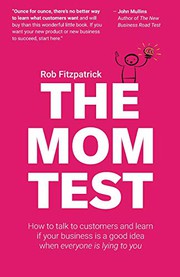
The book is a short field guide to customer conversations within customer development and Lean Startup practice. Fitzpatrick focuses on the common failure mode in early research: founders unintentionally pitch, receive supportive opinions, and mistake social politeness for demand. His remedy is to structure conversations around learning about the customer’s world before discussing a solution. The original work was first published in 2013, with a 2014 print edition catalogued by WorldCat; a revised and expanded publisher edition is listed for March 9, 2027, so these notes primarily reflect the established original work rather than assuming access to that future edition.
Core ideas
The “Mom Test” is a question-design rule
Even well-meaning people may praise an idea to protect the founder’s feelings. The solution is not to find more brutally honest people, but to ask questions that remain useful even when the respondent is being friendly: focus on their experience rather than asking whether the proposed product is good.
Ask about the past, not hypothetical futures
Questions about what someone would do, might buy, or thinks others need invite speculation and politeness. Questions about the last time the problem occurred, what they tried, how they handle it now, and what it cost produce more reliable evidence because they are anchored in behavior.
Talk about problems before solutions
Pitching too early shifts the conversation toward reactions to your idea. First learn the customer’s goals, workflow, frustrations, current alternatives, and frequency of the problem. Only then should a possible solution be introduced, if it helps test a specific remaining uncertainty.
Compliments and opinions are weak evidence
Praise such as “That sounds great” is socially easy and operationally ambiguous. Deflect compliments into specifics: ask what prompted the reaction, whether they have faced the problem themselves, and what they currently do about it. The useful output is concrete behavior, not positive sentiment.
Commitment and advancement reveal seriousness
A credible signal is a meaningful action: spending time, sharing data or access, making an introduction, changing an existing process, or paying. The conversation should end with a clear next step; otherwise the founder may leave with enthusiasm but no evidence of demand.
Prepare to learn, not to perform
Before an interview, identify the uncertainty you need to resolve and the customer segment whose experience is relevant. During the conversation, listen, ask follow-ups, and resist defending the idea. Afterward, record facts, patterns, surprises, and commitments rather than collecting flattering quotes.
Customer discovery is iterative
One conversation rarely validates a business. Repeated conversations should sharpen the customer segment, problem definition, and understanding of existing alternatives. If the evidence remains weak, the appropriate response may be to change the idea or stop—not to reinterpret every objection as hidden interest.
Practical takeaways
- Replace “Would you use this?” with “Tell me about the last time you dealt with this.”
- Ask for concrete details: when it happened, how often, what they tried, what they use now, and what the workaround costs.
- Avoid explaining the product during the first part of discovery; explanation can manufacture agreement.
- Treat future promises as hypotheses until they become observable commitments.
- When someone gives a compliment, ask a follow-up that converts it into a fact about their experience.
- End every promising conversation with a specific next action and owner.
- Review interviews for repeated behavior and pain, not for the number of people who said they liked the idea.
- Keep founders directly involved in early conversations until the customer segment, message, and sales process are genuinely repeatable.
Caveats and counterpoints
- The method is strongest for early-stage uncertainty about customer problems and demand; it does not replace market sizing, technical validation, legal review, pricing experiments, or observing actual retention and purchases.
- Past behavior is better evidence than hypothetical intent, but past behavior can still be unrepresentative, especially when the proposed product changes the category or creates a new habit.
- A customer’s lack of commitment may reflect poor access, timing, authority, budget, or trust—not necessarily lack of need. Interpret the evidence in context.
- The book’s deliberately blunt rules can be over-applied: a conversation may appropriately include explanation, co-design, or selling once the learning goal is clear and the product is sufficiently developed.
- The publisher currently lists a revised and expanded edition for March 9, 2027; edition-specific wording or examples may differ from the original 2013/2014 work summarized here.
Questions worth revisiting
- What customer behavior would convince me this problem is real without relying on stated enthusiasm?
- Which recent event, workaround, expense, or failure should I ask about first?
- Am I trying to learn something, or am I trying to get the person to validate my idea?
- What commitment would be appropriate evidence at this stage—time, money, access, data, or an introduction?
- Which assumptions remain untested after the conversation?
- What result would make me abandon, narrow, or substantially change the idea?
Return to this when…
Return to these notes before customer interviews, discovery calls, prototype tests, or any meeting where you are tempted to pitch first. The central reminder is: investigate what people already do, how painful the problem is, and what they will concretely do next.
References
- The Mom Test | Book by Rob Fitzpatrick | Official Publisher Page | Simon & Schuster
- The Mom Test by Rob Fitzpatrick
- The Mom Test: How to talk to customers & learn if your business is a good idea when everyone is lying to you by Rob Fitzpatrick | Goodreads
- search.worldcat.org
- simonandschuster.com
- goodreads.com
- openlibrary.org
- The Mom Test review, Books
- goodreads.com
- pmnorthstar.in
- editorsreads.com
- campelolabs.com