
In one sentence
The book’s central claim is that income and visible affluence are poor proxies for wealth. Wealth is what remains after spending: households that consistently live below their means, save and invest deliberately, use their time well, and avoid status-driven consumption are more likely to become financially independent.
Overview
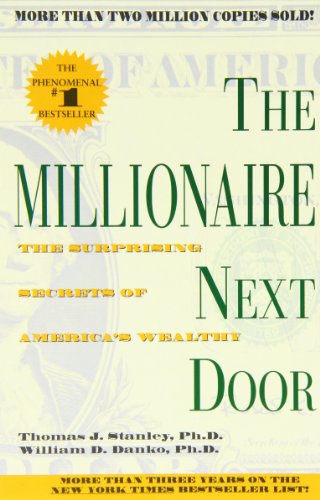
Originally published in 1996 by Thomas J. Stanley and William D. Danko, the book presents survey and interview-based observations about American millionaire households. Its chapters move from identifying the “millionaire next door,” to frugality, time and money management, automobiles and housing, financial assistance to adult children, occupational choices, and the difference between self-made wealth and inherited advantage. The revised editions retain the original structure and add a later foreword.
Core ideas
Net worth matters more than income
A high salary can support an expensive lifestyle without creating financial independence. The authors distinguish people who look affluent from people who have accumulated assets relative to their consumption.
Frugality is a wealth-building system
The book repeatedly links wealth accumulation to spending discipline: planning purchases, resisting status competition, and maintaining a lifestyle that costs substantially less than household income. Frugality is presented not as occasional coupon-cutting but as a durable operating norm.
PAWs versus UAWs
The authors use “Prodigious Accumulators of Wealth” and “Under Accumulators of Wealth” to compare households with similar income but different asset-building results. The useful question is not simply “What do I earn?” but “How much wealth should someone with my age and income have accumulated?”
Time, energy, and money reveal priorities
Successful accumulators treat financial planning as a recurring allocation problem. They spend time researching purchases, managing investments, and choosing work or business opportunities rather than allowing consumption and convenience to absorb all available resources.
Consumption communicates status—but can destroy wealth
Expensive cars, large homes, designer goods, and prestigious neighborhoods may signal success while reducing saving capacity. The book’s memorable reversal is that many genuinely wealthy households appear ordinary because they prioritize balance sheets over display.
Economic outpatient care can weaken independence
Regular financial gifts or subsidies from parents may make adult children dependent, increase consumption, and reduce their incentive to develop financial competence. The authors argue that assistance should not replace work, budgeting, and long-term responsibility.
Occupation and ownership shape the path
The book highlights business owners and people in less glamorous, specialized, or highly practical occupations as important sources of accumulated wealth. It challenges the assumption that elite credentials or prestigious employment automatically produce wealth.
Practical takeaways
- Track net worth, savings, debt, and annual spending—not just salary or investment returns.
- Set a deliberate savings rate and automate contributions before lifestyle upgrades absorb raises.
- Use a written spending plan, especially for housing, vehicles, education, and recurring status purchases.
- Evaluate large purchases by their opportunity cost: what assets or future flexibility will the spending displace?
- Compare financial progress with a realistic age-and-income benchmark, while treating the book’s historical formulas as rough prompts rather than universal rules.
- Discuss family assistance explicitly: define whether money is a gift, loan, tuition payment, or emergency support, and avoid making recurring subsidies part of an adult child’s normal budget.
- Choose work partly for its capacity to produce surplus cash, ownership, autonomy, or specialized demand—not only for prestige.
Caveats and counterpoints
- The evidence is primarily descriptive and observational: it identifies patterns among surveyed millionaire households, but it does not prove that every recommended habit caused their wealth.
- The original research reflects the economic conditions and household patterns of late-20th-century America. Housing costs, education costs, labor markets, taxation, investment access, and family structures have changed substantially since the 1996 publication.
- The book’s millionaire threshold is a net-worth definition, not a guarantee of financial security; $1 million has different purchasing power across places, ages, and dates.
- Survey participation and self-reporting can create selection and recall biases. The portrait may overrepresent people willing to discuss or attribute their wealth to frugality and personal discipline.
- The emphasis on behavior can understate structural influences such as inheritance, discrimination, health shocks, unequal access to housing and education, and differences in income stability.
- Some recommendations may be psychologically or practically costly if interpreted as minimizing all present consumption. Frugality is most useful when it protects valued goals rather than becoming an identity or an excuse to ignore quality of life.
- The authors’ contrast between self-made millionaires and beneficiaries of family support is analytically useful but morally and causally incomplete: family resources can affect opportunities even when no direct inheritance is received.
Questions worth revisiting
- What is my current net worth, and how has it changed over the last year?
- Which expenses are genuinely valuable to me, and which mainly communicate status or keep pace with peers?
- How much of each raise or windfall will become permanent lifestyle spending?
- Am I a high-income under-accumulator—earning well but converting too little income into assets?
- Would my current housing and vehicle choices still look sensible if nobody else could see them?
- Which form of work best fits my strengths while creating durable surplus, ownership, or autonomy?
- If I support relatives, does the arrangement build capability or merely sustain consumption?
Return to this when…
Return to this book when a higher income, larger home, expensive vehicle, or status purchase is beginning to feel like proof of financial success. Its most useful refresher is the distinction between appearing rich and becoming wealthy. Read it alongside newer data before applying its numerical benchmarks or treating its household portrait as representative of today’s entire economy.
Highlights
What is so profound about these discoveries? Just this: Most people have it all wrong about wealth in America. Wealth is not the same as income. If you make a good income each year and spend it all, you are not getting wealthier. You are just living high. Wealth is what you accumulate, not what you spend.
Is anyone in your household responsible for budgeting? All too often the answer is “not really.” All too often people allow their income to define their budgets. When we tell our audiences about the budgeting and planning habits of the affluent, someone always asks a predictable question: Why would someone who is a millionaire need to budget? Our answer is always the same: They became millionaires by budgeting and controlling expenses, and they maintain their affluent status the same way.
If you’re not yet wealthy but want to be someday, never purchase a home that requires a mortgage that is more than twice your household’s total annual realized income.
Consider the frugal orientation of Dr. North. He stated emphatically, for instance, that he never bought a suit that was not offered at a discount or a special price. This is not to suggest that Dr. North is poorly dressed. Nor does he wear cheap suits. Rather, he purchases quality clothing, but not at full price and never on impulse.
Money should never change one’s values…. Making money is only a report card. It’s a way to tell how you’re doing.
References
- The Millionaire Next Door | Book by Thomas J. Stanley Ph.D., William D. Danko Ph.D, Sarah Stanley Fallaw Ph.D | Official Publisher Page | Simon & Schuster
- simonandschuster.com
- The Millionaire Next Door: The Surprising Secrets of America's Wealthy - Thomas J. Stanley, William D. Danko - Google Books
- books.google.com
- books.google.com
- luvembooks.com
- books.google.ca
- reiprime.com
- researchgate.net
- books.google.com
- books.google.com
- simonandschuster.com