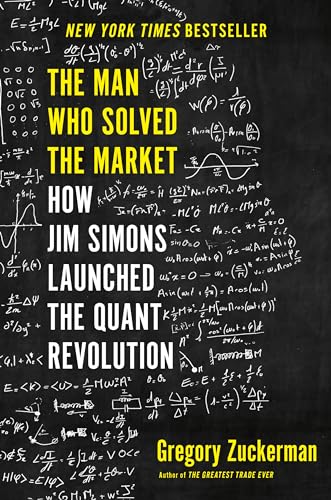

In one sentence
Renaissance’s achievement came less from one magical formula than from building an unusually disciplined research organization: recruit exceptional scientists, convert market questions into statistical problems, test ideas relentlessly, automate execution, manage risk, and protect the research culture. Simons was the architect and catalyst, but the “solution” was collective rather than personal—a point emphasized by later criticism of the title.
Overview
Zuckerman follows Simons from mathematics and code-breaking into finance, then recounts Renaissance’s evolution from uncertain experiments to a highly successful quantitative trading operation. The narrative focuses on the firm’s people, methods, internal conflicts, secrecy, and extraordinary performance, ending with the broader consequences of Renaissance’s wealth and influence—including philanthropy, politics, and the Mercer controversy.
Core ideas
Build a research machine, not a heroic trading desk
The central organizational insight is to make investing a repeatable scientific process. Renaissance favored mathematicians, physicists, statisticians, and computer scientists over conventional Wall Street personalities, treating markets as noisy systems from which modest, testable signals might be extracted.
Small edges can compound when execution is systematic
The book presents quantitative trading as an exercise in finding many weak or fleeting statistical relationships, combining them across instruments, and executing consistently. The advantage is not necessarily a dramatic prediction; it is the accumulation of numerous small edges after costs, with disciplined risk control.
Data quality and feedback matter as much as clever mathematics
Renaissance’s edge is portrayed as an iterative loop: gather and clean historical information, formulate hypotheses, back-test them, detect failure, revise the model, and automate what survives. This makes infrastructure, experimentation, and error detection strategic assets—not merely technical support.
Secrecy protects an edge but creates institutional risks
Keeping methods confidential helped Renaissance preserve its advantage, but secrecy also limited outside scrutiny and made succession, internal disputes, and public controversies harder to resolve. The firm’s opacity is therefore both a competitive strength and a governance weakness.
Exceptional returns do not make the method universally transferable
The story can tempt readers to copy the surface features—more data, more math, more automation—without possessing Renaissance’s talent, infrastructure, trading access, research discipline, or capacity to absorb complexity. A later technical review argues that Simons was primarily a builder and impresario, not a lone market-solving genius.
Financial success carries consequences beyond finance
Zuckerman connects Renaissance’s wealth to scientific philanthropy and to political activity by senior figures, especially Robert Mercer. The book’s broader question is how a private quantitative enterprise can become socially consequential without having been designed to manage that influence.
Practical takeaways
- When evaluating a quantitative or data-driven strategy, ask how signals are generated, tested, monitored, and retired—not merely what the headline returns were.
- Treat hiring and research culture as part of the investment strategy. Renaissance’s distinctive advantage was organizational: scientific talent, collaboration, skepticism, and technical infrastructure working together.
- Expect back-tested or historical success to degrade when markets adapt, data contains hidden biases, transaction costs rise, or the strategy becomes crowded.
- Separate process lessons from performance claims. “Use evidence, automate repeatable decisions, and control risk” is portable; Renaissance’s exact edge is intentionally not disclosed.
- For any concentrated investment success, examine survivorship bias, leverage, liquidity, fees, taxes, capacity, and the period over which returns were measured.
- Remember that a firm’s external impact may come from accumulated wealth and personnel networks, not only from its stated business purpose.
Caveats and counterpoints
- This is a reported narrative biography, not a technical manual or a reproducible account of Renaissance’s models; the firm’s most important methods remain proprietary and unavailable to readers.
- The dramatic title personalizes an achievement that reviewers and technical commentators describe as the product of a large team and institutional system.
- The book’s performance figures and historical claims should be read as reported within a 2019 publication context; they are not a current assessment of Renaissance or a promise about future returns.
- The political sections broaden the book’s scope but may compete with its main financial story; readers primarily seeking portfolio guidance may find the biography more useful than the investment instruction.
Questions worth revisiting
- Which parts of Renaissance’s advantage were genuinely mathematical, and which came from data, execution, technology, secrecy, or organizational culture?
- How much of the reported performance survives after fees, taxes, capacity limits, and the exceptional conditions of particular market periods?
- Could a smaller organization reproduce the culture, or did Renaissance’s scale and ability to recruit elite scientists become essential to its edge?
- Where should the ethical boundary lie between private financial secrecy and public accountability when a firm’s wealth enables major political influence?
- What would count as evidence that a quantitative strategy has stopped working rather than merely experiencing a temporary drawdown?
Return to this when…
Return to these notes when studying quantitative investing, systematic trading, research-driven organizations, hedge-fund biographies, or the social consequences of concentrated financial wealth. The most useful reminder is that Renaissance’s achievement was an institutional process—talent, data, experimentation, automation, and risk discipline—not a simple formula that readers can copy.
Highlights
Simons once quoted Benjamin, the donkey in Animal Farm, to explain his attitude: “‘God gave me a tail to keep off the flies. But I’d rather have had no tail and no flies.’ That’s kind of the way I feel about publicity.”
“The lesson was: Do what you like in life, not what you feel you ‘should’ do,” Simons says. “It’s something I never forgot.”
“I realized I might not be spectacular or the best, but I could do something good. I just had that confidence,” he says. One day, Simons saw two of his professors, renowned mathematicians Warren Ambrose and Isadore Singer, in deep discussion after midnight at a local café. Simons decided he wanted that kind of life—cigarettes, coffee, and math at all hours. “It was like an epiphany . . . a flash of light,” he says.
Simons put mathematicians and students at ease, dressing more informally than others at the school. He rarely wore socks, even in the frigid New York winters, a practice he would continue into his eighties. “I just decided it takes too much of my time to put them on,” Simons says.
Getting fired can be a good thing. You just don’t want to make a habit of it. Jim Simons
References
- The Man Who Solved the Market: How Jim Simons Launched the Quant Revolution - Gregory Zuckerman - Google Books
- books.google.com
- All Book Marks reviews for The Man Who Solved the Market: How Jim Simons Launched the Quant Revolution by Gregory Zuckerman Book Marks
- THE MAN WHO SOLVED THE MARKET | Kirkus Reviews
- gregoryzuckerman.com
- betaglyph.com
- Full article: The Man Who Solved the Market: How Jim Simons Launched the Quant Revolution
- fivebooks.com
- tandfonline.com
- marketfolly.com
- gregoryzuckerman.com
- ritholtz.com