
In one sentence
Breakthrough creative work is usually a prolonged, uncertain process rather than a clean sequence of inspired decisions. Mechner’s journals show how persistence, technical constraint, experimentation, outside collaborators, and fortunate timing gradually turned an unclear idea into Prince of Persia.
Overview
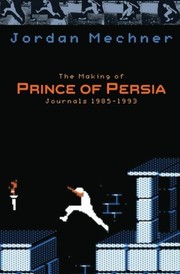
This is not a conventional retrospective history of the game. It is a selected and abridged journal written during the period itself, lightly edited and supplemented—especially in the illustrated Stripe Press edition—with archival material and annotations. The entries begin after Mechner’s earlier game Karateka and extend through the development and release of Prince of Persia, then into the making of Prince of Persia 2. Mechner records coding problems, rotoscoped animation, design revisions, business relationships with Brøderbund, changing ambitions, and long stretches of doubt. The immediacy is the book’s strength, but it also means the account is partial: it reflects what Mechner noticed and chose to record, not a complete production history.
Core ideas
The work develops through visible uncertainty
The journal preserves false starts, abandoned ideas, procrastination, frustration, and periods when the project appears stalled. Creative progress is shown as irregular and difficult to interpret while it is happening—not as a predictable march toward a known masterpiece.
Constraints can become design material
The Apple II’s limited memory, graphics, and processing power force Mechner to simplify, reuse, and invent. Technical limitations do not merely restrict the game; they help shape its distinctive animation, pacing, combat, and visual language.
Observation and imitation can produce originality
Mechner’s animation process uses filmed human movement, including his brother David as a model, then translates that movement into game frames. The originality lies less in inventing motion from nothing than in carefully observing, selecting, and adapting it to a new medium.
A solo creator still depends on a system
Although Mechner performs much of the programming and design, the project depends on publishers, testers, artists, business partners, friends, family, and distribution infrastructure. “One person made it” is therefore true at the creative center but misleading as a complete production account.
Commercial success changes the creative problem
After Prince of Persia gains attention, the challenge is no longer simply finishing an ambitious game. Mechner must navigate expectations, sequel pressure, licensing, organizational growth, and competing artistic interests while trying to preserve the qualities that made the original distinctive.
The journal form captures process but limits interpretation
Because the entries were written close to events, they preserve mood, confusion, and changing priorities better than polished memoir usually does. They also contain mundane digressions, incomplete explanations, and personal judgments that should not be mistaken for an objective account.
Practical takeaways
- Keep a contemporaneous project log: record decisions, doubts, experiments, reversals, and external constraints before hindsight smooths them into a success story.
- When technology is limited, ask which limitations can become rules, style, or focus rather than treating every constraint as a problem to eliminate.
- Prototype the hardest perceptual or technical challenge early. For Prince of Persia, believable character movement became a central test of whether the project could work.
- Measure progress by accumulated experiments and resolved uncertainties, not only by finished features or visible milestones.
- Protect long periods of focused work, but recognize that pauses can sometimes provide distance, new references, or a better understanding of the problem.
- Separate creative ownership from production mythology: acknowledge the collaborators, intermediaries, and institutions that make individual work possible.
- Treat success as a new phase with different risks. Recognition can bring resources and leverage, but also expectations that distort the original creative aim.
Caveats and counterpoints
- The book is Mechner’s personal journal, not an independently verified oral history of Prince of Persia’s development; other participants’ perspectives are comparatively limited.
- The published text is selected and abridged, so apparent continuity and emphasis are editorially shaped. The book should not be read as every day of the project or as a complete technical record.
- Its focus is broader than programming: film-school ambitions, relationships, travel, business, and self-doubt occupy substantial space. Readers seeking a narrowly technical postmortem may find it diffuse.
- The Apple II-era workflow is historically specific. Its lessons about constraint and iteration generalize better than its exact tools, schedules, or business conditions.
- The journal’s candid self-observation can still be self-presentational. Immediate writing reduces hindsight bias, but it does not eliminate selective attention or self-interpretation.
- The sequel and later career material may be more useful as a study of changing ambition and commercial pressure than as a unified account of the original game.
Questions worth revisiting
- Which entries show genuine design progress, and which merely show increased activity or confidence?
- Where does Mechner’s persistence become productive iteration, and where does it become attachment to a weak idea?
- How much of Prince of Persia’s identity came from deliberate artistic choice versus Apple II limitations and available tools?
- What would this history look like from the perspectives of Brøderbund, the testers, the animators, or the distributors?
- Which parts of the process could be reproduced by a modern small team, and which depended on the unusually concentrated conditions of 1980s game development?
- How does the experience of making a first breakthrough differ from making its sequel under commercial expectations?
Return to this when…
Return to the journal when evaluating stories about “overnight” creative success, designing within severe technical limits, starting a long solo project, or needing a reminder that uncertainty and unfinished work are normal parts of making something ambitious.
Highlights
Then a strange thing happened. I started getting images in my head of the characters: The Sultan. The Princess. The Boy. I saw the scenes in my mind as if it were a Disney movie. So I wrote up a scenario — churned it out in an hour. It came out pretty well, I think. It’s just similar enough to Karateka, but more plausible, more intricate, and most important, more humorous. Gene will love it. Maybe the back story could even be written up and illustrated, like a comic book, and published with the game. My night thoughts lately have been along the lines of: “Do I have it in me to do another computer game? Is this what I want to do? Can I do it? What if the code-writing part of my brain has atrophied? Will I fail ignominiously? Should I just turn to screenwriting full-time?”
AUGUST 29, 1988 I gotta finish this damn computer game. God, I’m restless; I want everything to start happening now. I want to fast-forward through the next five months of grueling work and just be there. I have no excuse for slacking off. As Adam Derman once told me in a letter (about Karateka): “You dumb shit. You’ve dug your way deep into an active gold mine and are holding off from digging the last two feet because you’re too dumb to appreciate what you’ve got and too lazy to finish what you’ve started.”