
In one sentence
The novel argues that extinction may result not only from environmental catastrophe but also from maladaptive behavior: organisms can become too specialized, too isolated, or too poorly coordinated to survive. Human beings repeat the same pattern when they treat living systems as controllable commodities.
Overview
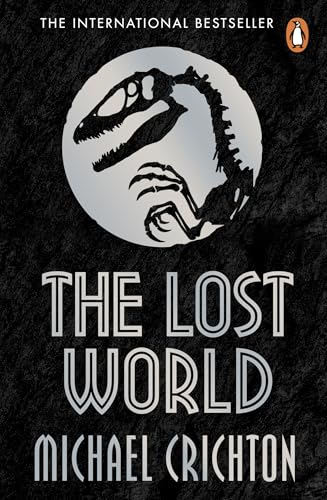
The Lost World shifts the premise from a failed amusement park to an apparently functioning dinosaur ecosystem. Ian Malcolm serves as the skeptical, ironic commentator; Richard Levine pursues a grand theory about a surviving “lost world”; Sarah Harding brings practical knowledge of animal behavior; and Lewis Dodgson represents commercial exploitation. The novel alternates field science, technical explanation, rivalry, and sudden predator encounters. It is substantially different from the 1997 film, with more emphasis on dinosaur behavior and extinction theory.
Core ideas
Extinction as behavioral failure
Malcolm’s central idea is that species can decline because their patterns of behavior stop fitting changing conditions. The dinosaurs become a case study, but the argument also reflects on human overconfidence and self-destructive social habits. Critics found this scientifically provocative but sometimes too clearly designed to teach a theory.
Nature is not a stable exhibit
The surviving animals are not simply restored specimens waiting to be observed. They form shifting relationships, adapt to one another, and create consequences the researchers cannot fully predict. The island challenges the assumption that an ecosystem can be isolated, restarted, or managed like a machine.
Science versus possession
Levine wants discovery and recognition; Dodgson wants usable biological assets; Malcolm wants a better explanation of what is happening. Their competing motives expose the difference between studying life and claiming ownership of it.
Human expertise is partial
The expedition succeeds only through complementary forms of knowledge: mathematical reasoning, paleontology, field biology, engineering, and practical judgment. No single specialist understands the whole system, and confident theories repeatedly meet inconvenient evidence.
The sequel as self-conscious adventure
Crichton deliberately revives Malcolm and borrows the expeditionary tradition associated with Arthur Conan Doyle’s earlier The Lost World. Malcolm’s commentary gives the action an argumentative, sometimes satirical layer rather than presenting it as pure monster fiction.
Practical takeaways
- When examining a complex system, distinguish an attractive explanation from evidence that actually supports it.
- Expertise is most useful when different disciplines can correct one another rather than compete for authority.
- A system that appears stable may merely be temporarily balanced; removing constraints can reveal hidden dependencies.
- Technological capability does not imply ecological understanding or moral permission.
- The book’s strongest questions concern whether observation can remain ethical when knowledge itself has commercial value.
Caveats and counterpoints
- The novel is more pedagogical than Jurassic Park: long discussions of extinction and behavior interrupt the thriller. Publishers Weekly praised Crichton’s scientific interests while criticizing the balance between theory, action, characterization, and originality.
- Its behavioral account of extinction is presented dramatically and should not be treated as a complete scientific explanation; behavior, environment, population dynamics, and evolutionary change are interconnected.
- Malcolm’s return is narratively useful but reduces some continuity tension: Crichton openly described him as necessary because he functions as the story’s ironic commentator.
- The characterization is functional rather than deeply psychological. The novel’s intellectual conflicts and set pieces are generally more developed than its emotional realism.
- The familiar Jurassic Park setup can make the book feel repetitive, even as the island ecosystem and scientific focus broaden the premise.
Questions worth revisiting
- Does Malcolm’s theory illuminate the dinosaurs, or mainly provide a framework for Crichton’s concerns about human behavior?
- Which characters are genuinely seeking knowledge, and which are using science to justify ambition or profit?
- Does studying the island preserve the animals’ autonomy, or does observation become another form of intrusion?
- How does Sarah Harding’s practical attention to behavior differ from Levine’s desire for a totalizing theory?
- What kinds of uncertainty does the expedition accept, and what kinds does it dangerously try to eliminate?
Return to this when…
Return to this book when thinking about sequels that revise rather than simply repeat an original premise; science fiction that uses technical debate as suspense; or stories about extinction, ecological systems, and the danger of confusing prediction with control.